How Much Does UGC Cost? 2026 Rates for DTC Brands
What UGC costs in 2026
- A single UGC video runs roughly $75-$300 from a beginner, $300-$800 from a mid-tier creator, and $800-$3,000+ from a seasoned pro.
- The market median sits around $150-$175, though the mean drifts up to $198-$212 because premium creators skew the average.
- Those are creation-only, organic-use prices. They are not what you actually pay.
- Paid-ad usage rights add 30-75%. A perpetual buyout adds 100-150%. Raw footage adds 30-50%. Bundles cut 15-20%.
- Most DTC brands budget by month, not by video: ~$1k buys a self-managed sandbox, ~$3k a managed pipeline, $5k+ a full performance engine.
The unit you are paying for is a created asset plus a defined license, not a creator's follower count. Influencers monetize reach; UGC creators monetize production and the right to put their face behind your ad spend.
The single trap that explains every "why was my invoice higher than the quote" question: the base rate covers creation and the right to post organically for a 3-to-6-month window. Usage rights, raw footage, hook variations, and rush turnaround are all separate line items. The page below walks the rate, the levers that move it, the add-on stack, the sourcing-path cost compare, and the monthly tiers. If you are still asking whether that spend pays for your brand at all, start there first.
Per-video rates by creator tier
Rate tracks the creator's track record and the production load, not their audience size. A 200k-follower creator with no DTC reps will quote below a 5k-follower creator with 80 shipped ads.
The 2026 market pays these rates by tier, for creation only (no usage rights stacked on top yet):
| Deliverable | Beginner (0-1 yr) | Intermediate (1-3 yr) | Experienced / Pro (3+ yr) |
|---|---|---|---|
| Single video (15-60s) | $75-$300 | $300-$800 | $800-$3,000+ |
| Photo set (5-10 images) | $75-$300 | $300-$900 | $600-$3,000+ |
| 3-video bundle (~15% off) | $350-$600 | $1,000-$2,000 | $2,500-$6,000 |
| 5-video bundle (~20% off) | $550-$900 | $1,500-$3,500 | $4,000-$10,000 |
| Hybrid (5 video + 10 photo) | $700-$1,200 | $2,000-$4,500 | $5,000-$12,000+ |
Relative 2026 market ranges. Creation fee before any usage licensing or add-ons.
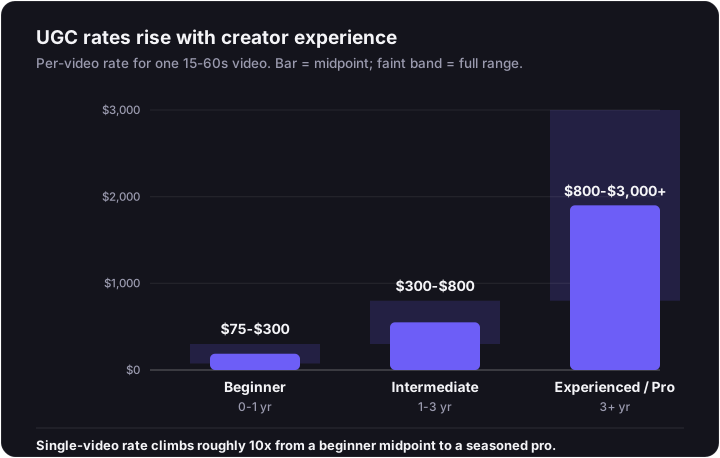
The median sits at $150-$175 because a handful of $3,000-per-video creative directors pull the arithmetic mean up to $198-$212. Most working DTC programs live in that median band.
What each tier actually buys is more useful than the dollar range:
- Beginner. High-volume testing fuel. You will write the brief, hold their hand, and burn through revisions. Good for proving angles, not for running them.
- Intermediate. The reliable backbone of a DTC creative program. One brief in, brand-safe assets out, minimal revision cycles. This is where most retainers live.
- Pro. Effectively a freelance creative director. They understand hook psychology, ad structure, and conversion metrics, and they ship zero-revision assets that often run as-is. You are paying for judgment, not just filming.
If you do not know how to tell those tiers apart in a portfolio, the creator vetting framework covers it.
Format changes the price too
A talking-head testimonial is the cheapest format on the menu, often the floor of a creator's range. Product demos and unboxings cost more because of setup, lighting, and b-roll requirements. Long-form YouTube content carries the biggest premium (often $350-$1,000+, averaging around $675 per collaboration) because of the scripting and edit load. The production workflow behind each format explains where the labor actually goes.
What drives the rate up or down
UGC pricing is modular, which is why the same creator can quote you wildly different numbers for two briefs that look identical on the surface.
Up-levers:
- Usage rights (the single largest multiplier in the market)
- Production complexity: multi-scene, outdoor location, outfit changes, 4K, professional lighting
- Regulated or technical niches: finance, health, B2B SaaS
- Rush turnaround inside 24-48 hours
Down-levers:
- Volume commitments and monthly retainers
- Organic-only use, no paid spend behind it
- Low-production formats: faceless unboxing, screen-record demos
- Beginner creators building portfolios who will accept lower rates (or gifted product) to generate case studies
The lesson: do not negotiate on the base rate. Negotiate on what is bundled. A $200 video with raw footage and 90-day paid rights included is a better deal than a $150 video with both as upcharges.
Niche multipliers
Some categories cost more because the talent is rarer or the compliance heavier.
| Category | Typical rate | Why |
|---|---|---|
| Beauty, skincare, fashion | $150-$400 | Saturated talent pool suppresses price |
| Pet, food and beverage | $100-$250 | Easy lifestyle b-roll, low compliance |
| Finance, fintech | $300-$600 | Compliance load plus articulate, credible delivery |
| Health supplements | $300-$700 | Premium tier requires credentialed pros (doctor, nurse, nutritionist) |
| B2B SaaS | $1,000-$3,000+ | 2-3x markup; rare technical talent |
Relative market findings; vary by creator and scope.
If you are in a hard-to-film category, the production playbook covers the workarounds.
The add-on stack: where the base rate becomes the real rate
Add-ons explain every "wait, why is this $2,700 and not $1,500" conversation.
The creation fee buys the asset and the right to post it on your own channels for a defined window, usually 3-6 months. Everything that makes UGC actually useful for paid acquisition is a priced add-on.
| Add-on | Typical cost | What you get |
|---|---|---|
| Extra hook / CTA variations | $50-$100 each | A/B-test the first 3 seconds, the part that decides whether anyone watches |
| Raw footage delivery | +30-50% of base | Your editor remixes infinite cuts without re-hiring the creator |
| Paid-ad usage rights (30-90 days) | +30-75% of base | Legal cover to run the video as a paid ad |
| Perpetual buyout | +100-150% of base | Forever use across all channels |
| Whitelisting / Spark Ads access | +30-100% of base per month | Run the ad from the creator's handle, not your brand handle |
| Ad-spec edit only | $150-$400 | Creator edits brand-supplied footage |
| Scriptwriting and strategy | +$100-$400 | Creator develops the concept, not just performs it |
| Rush 24-48h | +25-50% of base | Compensates for a disrupted schedule |
Relative 2026 market ranges. Percentages are of the base project rate.
A few of these are load-bearing enough to take in turn.
Hook variations are how performance teams test the part of the ad that actually decides scroll-stop rate. Paying an extra $50-$100 for three opening clips against the same body is dramatically cheaper than commissioning three separate videos. The mechanics of why bulk hooks matter are covered in the ad craft breakdown.
Raw footage used to be the creator's third rail. In 2026 most will hand it over for a 30-50% premium because that surcharge functions as a buyout for the future editing work you would otherwise hire them for. From a brand side it is one of the best dollar-for-dollar add-ons in the entire stack; a 4-minute raw take can yield ten distinct ad permutations in an internal editor's hands.
Whitelisting and Spark Ads are their own animal. You are paying for the right to run paid traffic through the creator's personal account, which inherits their social proof and (per market data) tends to lower CPMs 30-50% and lift CTRs 20-40% versus the same ad from your brand handle. The mechanical setup is covered separately in the Spark vs Partnership Ads guide.
For what each license actually grants legally, and what to secure before you spend a dollar on paid amplification, the rights primer is the canonical reference.
Why usage rights cost the most
The base fee pays for making the asset. The moment ad spend goes behind a creator's face, you are commercially exploiting their likeness, and they are entitled to a license fee for that. Window length, exclusivity, and perpetual buyouts all stack on top.
It is increasingly standard to see a creator quote split into two lines: a $1,500 production fee for ten videos, and a $500-$1,500 usage fee on top for 60-to-90-day paid rights. That is a feature, not a markup trick. It keeps the cost of amplification visible and lets you scale the license window with the actual campaign. Everything about which license type to pick lives on the rights and whitelisting page.
How the math actually adds up
One worked example so you can price your own brief. A mid-tier skincare creator, five videos to fight Meta ad fatigue, paid spend going behind them:
- 5-video bundle, $300 base each, ~16% volume discount: $1,250 base
- +10 hook variations at $50 each (two alternate hooks per video): +$500
- +60-day paid usage rights at +50% of base: +$625
- +raw footage buyout at +30% of base: +$375
Total: $2,750 for five fully licensed core ads, ten split-test hooks, and remixable raw footage.
Illustrative market math, not a quote.
The headline number is more than double the base, but the per-asset math is the point. Five core ads plus ten hook variants is fifteen testable creative permutations, at an effective cost-per-asset well under what a traditional production house would charge for a single ad.
Buying direct vs a marketplace vs an agency
The per-video number looks similar across all three paths (~$150-$300 effective). What that number includes is the whole story. Direct is cheapest per asset and most expensive in your time. Agency is most expensive per asset and removes nearly all the internal time.
| Path | Per-video | ~20 videos/mo | Bundled in | Not bundled / hidden cost |
|---|---|---|---|---|
| Direct creator | $75-$300 | $3,000-$6,000 raw | Files, one minor revision, basic organic rights | Paid usage, strategy, scaling. Heavy internal admin (negotiation, shipping, W-9s), ghosting risk. Internal coordinator overhead runs $50k-$80k/yr fully loaded. |
| Marketplace / platform | $99-$200 (+7-20% fee) | $2,000-$3,800 | Vetted creators, escrow, rights clearance, volume | Deep strategy, scripting, performance guarantees. Commissions plus software lock-in plus a quality ceiling where top creators opt out. |
| Managed agency | ~$150-$300 effective | $5,000-$15,000+ | End-to-end execution, strategy, briefs, all revisions, perpetual rights, guaranteed monthly volume | Ad spend and media buying. High baseline minimums ($2k-$5k floor before you can engage). |
Relative 2026 market ranges. The agency premium buys removed internal hours, not just video.
The trap with the direct path is assuming your team's time is free. Sourcing twenty videos a month directly means scraping a hundred creators, negotiating with the forty who reply, drafting and managing twenty contracts, shipping twenty products, chasing twenty deliverables, and processing twenty W-9s. That is a full-time coordinator role, and the loaded cost of that role erases the per-video savings.
The trap with the agency path is the opposite. A $6k retainer looks expensive next to a $3k direct buy, until you price the time the direct buy actually costs. The agency math also includes the difference in what gets tested: a structured studio with a hook-testing framework will get more winning angles out of a single shoot than a brand juggling freelancers.
For the actual which-path-for-which-brand-stage decision, the sourcing-path selector is the dedicated breakdown. For what a managed pipeline scopes, see the agency offer page.
Marketplace and platform price points
Concrete 2026 entry pricing across the major platforms, so the page is actually useful when you are scoping:
- Billo: from $99/video; 6-video pack $500, 14 for $1,000, 37 for $2,500.
- Trend.io credit packs: $550 for ~6 videos, $1,045 for ~14, $1,980 for ~28, $3,872 for ~56, with full perpetual rights bundled.
- Influee: ~$79-$87/video, or a $300-$700/mo subscription model that brings average 30-second video cost down to around $36.
- JoinBrands: free-to-$499/mo subscription tiers plus an 8-15% platform fee, scaling with revision count.
- Insense: $550-$2,900/mo subscription plus 10-20% platform fee on creator payouts; built for enterprise scale and Spark/Partnership Ads integration.
- AI-avatar tools: Arcads from ~$110/mo for ~10 videos, MakeUGC ~$49-$119/mo. Far cheaper, with avatar limitations covered elsewhere.
Published 2026 platform pricing; subject to change.
The AI options undercut human entry rates by an order of magnitude, but the realism, product-in-hand, and lip-sync tradeoffs are real. The AI UGC tools breakdown covers where the floor of usable quality sits. For the full platform-vs-agency-vs-in-house selection, the roundup page handles it.
What $1k, $3k, and $5k a month actually buys
Smart brands budget UGC by the month, not by the video, because the only volume that beats Meta and TikTok ad fatigue is sustained volume.
| Budget | What you get | Who runs it | Internal friction |
|---|---|---|---|
| ~$1,000/mo (sandbox) | 10-15 baseline assets via credit platforms, direct freelance, or AI testing | Your team is the agency: briefs, sourcing, edits | High |
| ~$3,000/mo (managed pipeline) | An entry agency retainer (e.g. ~10 fully edited videos plus strategy plus perpetual rights), or 2 top creators on retainer producing 10-15 assets | You direct, they produce | Medium |
| $5,000+/mo (performance engine) | 20-40+ assets, multiple aspect ratios, whitelisting handled, continuous data-driven iteration, fully outsourced | The agency is your creative team | Low |
Relative market expectations. Cited package examples (~$2,400 for a 10-video managed package, ~$4,500 for 20, $5k-$12k for integrated growth tiers) are third-party market data.
The honest framing: the $1k tier is not actually cheap. It is the tier where your founder or your marketing generalist trades hours for dollars. If you are pre-$1M ARR with founder time to spend and a need to prove the channel, that trade makes sense. If you are past $3M ARR with a media buyer waiting on creative, the same trade is a tax on your growth.
The $3k tier is where most scaling DTC brands first stop bleeding internal hours. The $5k+ tier is where creative stops being a bottleneck and starts being a lever your media buyer can actually pull on.
Whether your margin and AOV actually justify any of those tiers is a separate question, covered on the worth-it page.
Retainers and how they cut the rate
Monthly beats one-off on price for two reasons. Creators on a retainer typically price 15-30% below their per-video equivalent because they are trading rate for revenue stability. And retained creators hit the brief right on the first try 70-80% of the time, versus roughly 40% for one-off gigs, which means less waste in revision cycles.
Typical retainer bands in 2026:
- Starter: $800-$1,800/mo for 4-6 videos with 1-2 revision rounds and 30-60 day paid rights.
- Growth: $1,500-$3,500/mo for 8-10 multi-format assets with extended rights and hook variants.
- Premium / strategic: $3,500-$8,000/mo for 12-20 assets, perpetual rights, and the creator acting as a creative director who reviews your ad performance data between shoots.
For the actual cadence and content-engine mechanics that a retainer funds, the pipeline guide is where to go.
Payment terms and the fine print
A handful of standards that prevent surprise on both sides:
- 50% upfront deposit is the industry default to secure the booking and cover product cost.
- Net-15 or Net-30 is the standard invoice cycle for the back half. Anything past Net-45 is a creator-side red flag and will start narrowing the pool willing to work with you.
- Kill fees: 25% if you cancel before filming begins, 75-100% if you cancel after the shoot.
- Late fees: most pro contracts include a 5-business-day grace period, then 1.5-10% per week or a flat re-engagement fee.
Getting an actual number for your brand
The reason no honest article can give you a single answer is that a real quote depends on four things: monthly volume, niche, the usage window you actually need, and whether you want strategy bundled or just assets. A managed pipeline scopes all four in one conversation instead of asking you to price each line yourself.
If you want to see how Chance Ecom scopes and prices a UGC program against your specific volume and channel mix, the UGC agency page is the next step. If you are still working out whether to commit to the channel at all, take the detour through the worth-it qualifier first.
You
Can you look at our ads?
Want this read on your own ads?
We pull your live ads from the Meta Ad Library, set them next to the longest-running ads in your category, and send back what we'd change and test next. The teardown is free.
Get my free creative teardownWe usually reply within one business day.