UGC for Ecommerce: What Actually Moves DTC Sales
Your acquisition costs are climbing, your polished studio ads are getting scrolled past, and someone keeps telling you the fix is "more UGC." That advice is right and almost useless at the same time, because UGC content for ecommerce is not one thing you switch on. It is a supply you build, place, and license, and most of the budget that gets burned on it goes to brands who never figured out where it actually pays.
UGC is real-customer and creator-style content (photos, videos, reviews) that reads as a peer recommendation instead of a brand broadcast. The reason it works is that shoppers have built a reflex to tune out anything that looks like an ad, and this slips under that reflex.
Where UGC actually pays
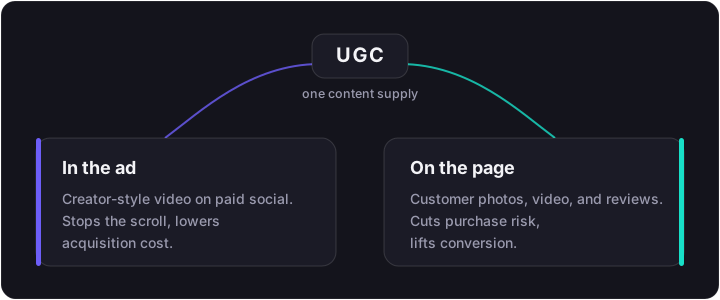
UGC earns its keep in two places for a DTC brand:
- In the ad. Native, creator-style video reads as organic, so it bypasses ad blindness and the platform delivers it cheaper. That drops your cost per click and your acquisition cost on cold traffic.
- On the page. Real customer photos, video, and reviews on the product page reduce the risk a shopper feels before buying, which lifts conversion.
It is not a vibe or an aesthetic you copy. It is content you produce on purpose (in-house, through creators, or through a UGC agency), place where it does work, and own the rights to before it runs.
Below: where UGC works, what it costs, and how to make it perform, then points you to the deeper piece on each.
What counts as UGC for an ecommerce brand (and what doesn't)
The term gets thrown at anything shot on a phone, and that confusion costs brands money. There are really four things hiding under the same word: a real customer's organic post, a paid creator who films native-looking video to order, an influencer who sells access to their own audience, and your own polished studio work. The one distinction that matters when you are writing a check is whether you are buying a content asset you own or buying someone's reach.
You do not need to memorize the taxonomy to spend well, but you do need to know which is which. Start with what UGC is, and if you want the full set of formats and when each one fits, see the UGC formats.
Why UGC beats studio creative on paid social
A polished studio ad announces itself as an ad in the first half-second, and the modern feed has trained people to scroll right past that. Creator-style video does the opposite: it looks like the content around it, so it earns the three-second view, and the algorithm reads that engagement as relevance and discounts your delivery. The result is a higher click-through rate and a lower cost to acquire on cold audiences.
This matters more every quarter because the platforms have made creative the targeting layer. You no longer hand-pick audiences; you feed the system a steady supply of distinct creative and let it find the buyers, which means volume is now a survival requirement, not a nice-to-have. The benchmarks behind all of this live in the deeper piece on UGC ads on paid social.
What makes a UGC ad actually convert
A converting UGC ad is not a polished vlog. It is a strong hook attached to a tight problem-then-solution structure, and the hook does most of the heavy lifting, because if the first three seconds do not stop the scroll, nothing after them gets watched.
This is repeatable, not luck. There are a handful of hook patterns that reliably earn attention and a predictable beat sequence that carries the viewer from "that's my problem" to "I'll try it." The full anatomy of a video ad is worth a read, and if you learn better from teardowns, see the DTC ad breakdowns.
Where UGC lifts conversion on your site
Ads are only half the story. The same kind of real content does a second job once a shopper lands on your product page, where the question is no longer "will they notice this" but "will they trust it enough to buy." Customer photos and video answer the thing a studio shot cannot, which is "does this actually look and work like that in real life," and reviews settle the risk of spending money on something they cannot touch.
Placement is the lever most brands get wrong, burying proof at the bottom of the page where the hesitant shopper has already bounced. How to place it, which formats convert hardest, and where it goes are all covered in UGC on product pages.
AI-generated UGC: where it helps, where it hurts
AI UGC is excellent for volume and terrible for trust. It will spin out dozens of script and hook variants for pennies, localize a winning video into a dozen languages, and generate b-roll to break up a talking head, which is exactly what the volume problem demands.
Where it backfires is hero creative and high-consideration buyers, where a synthetic-looking face or a warping product label trips the viewer's brain and quietly drags conversion down. The working rule is AI for volume, humans for the hero. The full split on AI UGC is worth reading, and if you want the tools weighed against each other, see the AI UGC tools compared.
UGC creators vs influencers (you are buying two different things)
This is the most expensive mix-up in the category. A UGC creator sells you a content asset and a license to run it; their follower count is irrelevant, because you are buying the video, not their audience. An influencer sells you the opposite: access to the people who follow them and the trust they have built with that group.
Confuse the two and you either pay influencer rates hoping for reusable ad creative, or hire a UGC creator expecting an organic sales spike that was never part of the deal. Which one fits which goal is laid out in UGC vs influencer.
How UGC gets made (briefs, creators, production)
UGC that performs is not happy accident; it comes from a real brief and a vetted creator. The workflow is straightforward to name (concept, brief, creator, shoot, edit) but the brief is the part that decides whether the video converts or wastes a slot, because it has to direct the hook and the structure without over-scripting the life out of it.
Get the brief right and your revision rounds shrink and your hit rate climbs. The end-to-end production workflow is written up separately, and the document that does the heavy lifting is the creator brief template.
Where to get UGC: your customers, creators, platforms, or an agency
There are four ways to source it, and the right one depends on how much volume you need and what stage you are at. You can collect it from your own customers, hire individual creators directly, pull from a marketplace, or hand the whole pipeline to a managed team. Each trades cost against speed, control, and how much of your own time it eats.
Pick by your constraint, not by what a vendor is selling. The three paths are covered separately: from your customers, hiring creators, and platforms vs agency.
What you have to own before you run it (usage rights)
You need the license before the content runs as a paid ad, a step brands skip and regret. Posting a creator's video organically is usually included in the base rate, but putting spend behind it, or running it past the agreed window, requires paid rights you actually secured in writing.
Running content you do not own is real legal exposure, not a technicality, and the traps include expired rights, unlicensed music, and a creator's likeness used past its terms. What to secure before you spend a dollar is in usage rights and whitelisting. Two related pieces worth knowing: running ads from the creator's own handle with Spark vs partnership ads, and the music and likeness traps.
What UGC costs
You can set expectations at a glance: there is a per-video range for human creators, usage rights and whitelisting add to it, and an agency, a marketplace, and doing it yourself all land at different price points. The number on the invoice is rarely the full cost once licensing is in.
The actual rate cards belong in one place, not scattered here. They are in what UGC costs, and the question of whether the spend pays back for your specific situation is in when UGC pays off.
What good UGC looks like (a few real examples)
It helps to see the thing rather than read about it. A converting DTC UGC ad usually opens on a specific problem in someone's own words, or leads with visible before-and-after proof, then demos the product in hand instead of floating it on a render. The polish is deliberately low; the structure underneath is tight.
Teardowns make this concrete fast. Real ones, broken down beat by beat, are in the DTC ad examples.
How to tell if UGC is right for your brand
Quick gut check before you commit a budget: UGC pays hardest when your margins can absorb a real testing cadence, your average order value justifies the spend, your offer is clear, and you are ready to ship creative continuously rather than once a quarter. If your product is a low-consideration commodity or your model depends on extreme luxury distance, the math shifts.
Place yourself honestly against those before you scale. The full decision, with the cases where it does not pay, is in is UGC worth it.
Working with a team that runs this end to end
UGC is a supply you build, place, and license, and the work is getting all three right at the same time, every week, without it falling apart. That is the part most brands underestimate: the production cadence, the on-page placement, and the rights paperwork are one connected job, not three separate ones.
If you would rather run the engine than rebuild it from scratch, have our UGC team build it.
You
Can you look at our ads?
Want this read on your own ads?
We pull your live ads from the Meta Ad Library, set them next to the longest-running ads in your category, and send back what we'd change and test next. The teardown is free.
Get my free creative teardownWe usually reply within one business day.