The UGC Creative Pipeline That Scales DTC Ads
What a UGC creative pipeline actually is
A UGC creative pipeline is the operating system a brand runs every week to turn ideas into modular creator footage, into many distinct ad variants, into killed losers and scaled winners, into the next brief. It exists because winning ads now fatigue in days, so the unit of work is no longer "an ad," it is the system that ships and sorts ads at the rate fatigue eats them.
The numbers behind that reframe: industry analyses indicate winning Meta ads lose roughly 50% of their effectiveness inside 10 to 14 days, while TikTok creative compresses to 5 to 7. Worse, Meta's Andromeda retrieval system clusters near-duplicate uploads into a single Entity ID and gives them one collective auction ticket, so naive volume gets actively penalized.
What matters here is the operating system. The strategic case for why UGC ads beat studio creative lives elsewhere, and the craft of one converting ad is its own page. Here we cover how the factory runs.
How much volume the pipeline has to produce
The verdict first: how many concepts you ship per month is decided by what you spend, not by ambition. A sub-tier brand testing 20 simultaneous variants on a $15k budget starves each variant of impressions and learns nothing.
The other half of that math is structural. Andromeda penalizes overlap. Real volume means genuinely diverse format, persona, and environment, not 50 micro-tweaks of the same talking head.
| Spend tier | Monthly ad spend | Monthly UGC variants | Weekly batch | Testing budget |
|---|---|---|---|---|
| Emerging | Under $20k | 10 to 15 | 3 to 5 variants | ~10% |
| Growth | $20k to $50k | 15 to 25 | 2 to 4 concepts | 10% to 15% |
| Scaling | $50k to $100k | 30 to 50 | 4 to 6 concepts | 15% to 20% |
| High-spend | $100k+ | 80 to 200+ | 20 to 50 variants | 20%+ |
Relative 2025-2026 industry findings; treat the bands as operating ranges, not exact thresholds.
The asymmetry shows up at the edges. Aggregated 2026 media data finds that brands shipping fewer than 10 new ads per month see a 35% to 45% CPA increase when they push budget, while brands shipping 30+ hold CPAs stable through aggressive scaling. The cost side of feeding this volume is its own conversation, covered in UGC pricing by tier.
Why more videos is not more volume
The trap: hire five creators, give them the same brief, ship five lookalike videos. The platform reads the structural overlap (same format, same hook shape, same pacing) and collapses them into one Entity ID, so the brand effectively bought one ad five times.
True volume requires variation in concept, persona, and environment, not just face swaps. That requirement is what the matrix is built to solve.
The shooting matrix: how one shoot becomes 27 ads
Brands shipping 50 variants a month do not shoot 50 videos. They shoot modular components and recombine them.
The math is the 3-3-3 framework popularized by agency Pilothouse: one creator films 3 distinct hooks, 3 distinct bodies, and 3 distinct CTAs in a single afternoon. The editor mixes any hook with any body and any CTA, yielding 27 unique variations from one shoot. Cost per variant collapses from roughly $200 down to under $15.
Cross-creator "Frankenstein" combinations multiply that further. Three creators contributing modular components produces an inventory of 400+ permutations, which is how brands sustain weekly batches without rebuilding production from scratch.
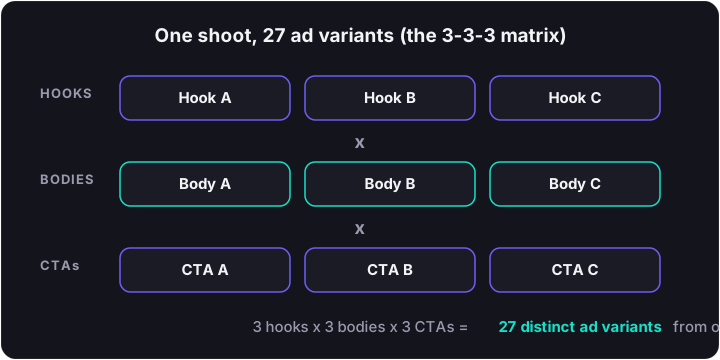
For leaner budgets, the 3-2-1 variant (3 hooks, 2 bodies, 1 CTA) yields 6 assets and is the right starting point. The actual document that requests these components is the modular brief template, and the shoot-day workflow lives in the production workflow. This whole approach only works because the brand bought the asset, not a one-time post, which is the same logic that separates UGC from influencer placements.
One variable per test
Inside the matrix, only one variable changes per test. If a single test alters hook + creator + length + overlay, the data tells you nothing because no single driver can be isolated.
Week one tests four hooks against a control body. Week two tests three bodies against the winning hook. That sequencing is what turns the matrix into a learning system instead of an output machine.
The weekly loop the pipeline runs on
The pipeline is a calendar, not a project plan. Each block has a job, and skipping a block breaks the next one.
- Monday, diagnostics and kill/scale. Sort the previous cohort by the naming convention, kill what hit the spend threshold without converting, bump 20% on clear winners.
- Tuesday, hypothesis and brief. Translate the data into the next test: if problem-aware hooks beat product-demo, brief four new problem-aware hooks against the winning body.
- Wednesday, modular production. Edit team assembles new variants from the modular library. Strict naming applied on export.
- Thursday, launch into a sandbox. New batch goes into a dedicated testing campaign so scaling campaigns are not disrupted.
- Friday through Sunday, learning phase. Resist pausing. Let variants spend through the algorithm's learning window. Friday afternoon glance only for technical failures.
That weekly sprint rolls up into a 90-day macro loop where bigger creative bets (new positioning angles, new creator tiers) get tested, validated, and either retired or graduated into the core library.
Reading the diagnostic waterfall
Judging an ad by CPA alone tells you it failed, not where. The pipeline reads metrics in sequence so it knows exactly which modular component to swap.
- Thumb-stop / hook rate (3s): healthy range is roughly 25% to 30%+ on Meta, 30% to 40%+ on TikTok. Low here means swap the hook, nothing else matters yet.
- Hold rate (25%, 50%, 75%): roughly 40% to 50% through the mid-bridge, 15% to 20% to the CTA on Meta. Strong hook with weak hold means the body lost the promise.
- Outbound CTR: cold prospecting around 1.0% to 1.5%+, retargeting above 2%. Strong hold with weak CTR points at an ambiguous CTA or an offer mismatch.
- Spend allocation: under GEM and Lattice-style delivery, the algorithm routing budget toward one variant is itself a primary signal of efficacy. Read allocation alongside CPA, not after it.
Each gate maps to one modular component, which is what makes the next brief writable. Hook craft itself, which is where most of these diagnoses end up, is the job of the hook-craft page.
Kill rules and scale rules
The math that protects the pipeline from human emotion. Cutting on day two and doubling budget on day two are equally expensive mistakes.
- Kill threshold: let a variant spend 1.5x to 3x the target CPA before killing. The 20%-over-CPA rule kicks in only after the 72-hour mark.
- Impression floor: roughly 10,000 impressions (about $50 to $100 in spend) before any hook-rate read is directionally reliable.
- Scale rule: the 20% / 48-hour rule. Winners get +20% budget every 48 hours, no more. Aggressive doublings reset the learning phase and routinely destroy the ROAS the buyer was scaling.
- Horizontal duplication: for top-decile winners, duplicate into fresh campaigns or migrate the winning Meta variant into a TikTok Spark Ad rather than risk the original ad set. Cross-platform migration also reshapes the cut, which is its own channel question.
Iterating winners without killing them
A winning UGC ad is a blueprint, not a finished asset. When CPMs climb and thumb-stop softens, the pipeline iterates instead of discarding.
- Hook swap. Five new 3-second hooks attached to the winning body. The auction reads this as a new Entity ID, production is minutes per variant, and it is usually the first move.
- Partial refresh. Keep the winning video, change headline, primary text, or CTA copy. Low-risk, roughly 70% effective at extending life.
- Format diversification. Animate a winning static into a Reel, cut a winning video into a multi-card carousel, port a Meta winner into a Spark Ad. Same psychology, new cognitive pathway, lifespan extension in the 30% to 50% range.
This is how the pipeline graduates "tests" into "learned concepts" the brand can iterate on for months instead of weeks.
Retention editing as a pipeline input
The modular pieces only work if they hold attention, which is what retention editing is for. The edit spec for every variant the pipeline ships builds in 0.8 to 2 cuts per second, a B-roll-heavy structure (often a 90/10 B-roll to talking-head split), word-by-word captions in the lower-middle third, sound design tied to visual cuts, and a deliberate pattern interrupt around the 8-second mark.
Those inputs exist to keep the viewer through each gate of the diagnostic waterfall above. The actual anatomy of one ad, and how its failure modes get diagnosed and rebuilt, belongs to the ad anatomy page.
Naming so the data is readable
The pipeline collapses the moment the data cannot be aggregated. If creator agencies ship Final_Video_V2.mp4, the media buyer loses hours to manual spreadsheet work and the AI dashboards (Motion, Triple Whale, Atria) cannot pivot at all.
The convention is position-based. Campaign level: [Product]_[Geo]_[Phase]_[Date]. Ad level: [Creative Source]_[Format]_[Angle]_[Hook]_[Creator]_[Version]. A real file looks like UGC_9x16_ProblemSolution_TiredSkin_Sarah_V1.
That syntax is what lets the team aggregate spend and ROAS by creator, by hook, by angle in a few clicks. The failure mode is mechanical: when an external agency ignores the naming taxonomy, the feedback loop severs and the pipeline stops learning until it is fixed.
Roles, rosters, and the pieces the pipeline relies on
The pipeline is run by a small pod, not a department. Four roles carry it: a creative strategist who writes the brief and reads the data, a producer who manages the roster, rights, and shipping, an editor who runs modular assembly inside a VAMS, and a copywriter who drafts hooks at volume.
Roster shape matters as much as headcount. A tiered network (a small core on retainer for hero work, a larger pay-per-video bench, an experimental seeding tier on free product) consistently out-performs marketplace one-offs because the core understands the brand voice and needs fewer revision cycles. The full vetting playbook lives in how to hire creators, and the marketplace vs managed roster choice is its own decision. Rights tracking sits alongside the assets, covered in UGC usage rights.
A note on the tooling
The pipeline runs on an interconnected stack, not one tool. Most teams settle on a creative-analytics dashboard (Motion, Superads, or Triple Whale for LTV by creative), a video asset management system that AI-tags raw footage and tracks licensing (Sovran, Recharm, Uplifted), and one or two AI-assisted editors or scripters (CapCut, UGC Copilot, OpusClip, Submagic for word-by-word captions).
AI-generated UGC (Arcads, Creatify, HeyGen) sits in the volume / variant slot, not in the hero-ad slot. The named AI UGC tools are honest about where they help and where they fail.
When this whole pipeline is the wrong investment
The doctor-not-waiter close: building this pipeline only pays back if the unit economics support it. The preconditions are concrete.
- Gross margin floor around 50% for one-time-purchase brands, higher for repeat or subscription.
- Contribution margin floor around 30%+ for one-time-purchase, 40%+ for repeat, 50%+ for subscription.
- Willingness to commit 10% to 20% of media budget to ongoing testing, with the bandwidth to brief, ship, and read it weekly.
- A product category UGC actually serves: impulse-friendly, social-proof-driven items. High-AOV (>$100) or trust-dependent categories such as clinical skincare, nutraceuticals, or complex tech usually convert better with founder or expert content than with peer UGC.
If those preconditions are not in place, the pipeline scales cash burn, not revenue. The full self-qualify decision is laid out in the worth-it analysis, and the production cost at each tier is in the pricing breakdown.
Running the pipeline for you
The bottleneck for most brands is not knowing the pipeline exists. It is the operational discipline to run it every week without dropping a node: brief Tuesday, ship Thursday, kill Monday, repeat, while the founder is also doing supply, finance, and product.
That is the work we run for DTC brands as a UGC agency, so the founder stays on offer and product instead of project-managing creators and editors.
You
Can you look at our ads?
Want this read on your own ads?
We pull your live ads from the Meta Ad Library, set them next to the longest-running ads in your category, and send back what we'd change and test next. The teardown is free.
Get my free creative teardownWe usually reply within one business day.