UGC on Product Pages: The DTC Conversion Lever
What UGC on the product page actually does
User-generated content on a product detail page is the social-proof layer a shopper needs before they hit Add to Cart: real photo and video reviews, shoppable customer galleries, and the star block they see before they scroll. Done right, third-party benchmarks put the page-level conversion lift in the high teens, with a median around 18%, and stronger lifts in visual categories. The three load-bearing decisions are media type, placement on the page, and whether the gallery is actually shoppable.
Everything else is secondary. Pick the wrong media type and you cap the ceiling. Bury the proof below the fold and you forfeit most of the lift. Build a pretty gallery that does not add to cart and you have a decoration, not a CRO asset.
The focus is UGC living on your own PDP. The paid-social side, where the same assets feed the ad account, is a different argument with different mechanics. For the wider map of UGC across an ecommerce stack, start there.
Why peer proof outperforms anything you write yourself
Shoppers in 2026 read brand copy with full skepticism and actively look for flaws as a proxy for truth. UGC sits at the bottom of the trust funnel, right where the purchase decision happens, because it is unpaid, unprompted, and reads as real.
The headline finding from Bazaarvoice's 2025 Shopper Experience Index: 79% of shoppers say UGC has a "high impact" on their purchase decisions, against 13% for brand-produced content and 8% for influencer marketing. The structural reason is simple. A studio hero shot cannot close the "will this look like this in real life" gap. A handheld customer photo of the same product, lit by an actual kitchen window, can.
There is now a discovery layer on top of that. Generative AI shopping agents (ChatGPT, Perplexity, Gemini) weight verified-buyer reviews up to 14 times more heavily than unverified content when summarizing products, per Bazaarvoice. Your reviews are no longer just an on-page CRO asset; they are how AI decides whether to put your SKU in the consideration set at all.
The media-type hierarchy: text, photo, video
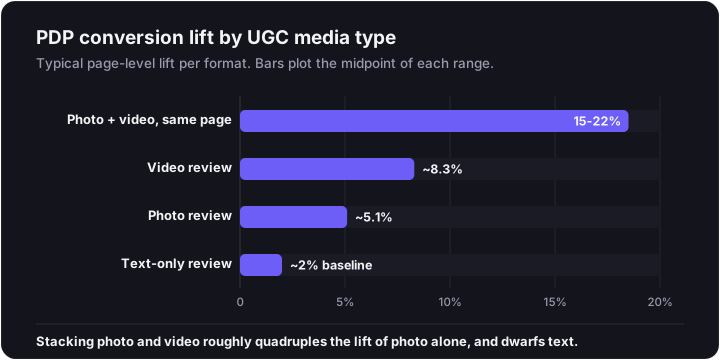
Photo beats text. Video beats photo. The margins are large enough to plan around.
PowerReviews and Idukki aggregate the lifts cleanly. Treat these as relative third-party findings on page-level conversion, measured against an identical control PDP.
| Media type | Typical PDP conversion lift | What it actually does |
|---|---|---|
| Text-only review | ~2.0% baseline lift | The verdict ("this shirt fits great") |
| Photo review | ~5.1% lift (~2.6x text) | The proof you can verify with your own eyes |
| Video review | ~8.3% lift (~4.1x text) | The demo of scale, movement, finish |
| Photo + video on same page | 15-22% above single-format | Stacked formats, layered confidence |
The catch is supply. Unprompted, about 71% of customers who leave a review leave only text. Only 14% submit a photo. A mere 3% will film and upload a video. So the highest-ROI media types are also the hardest to collect, which is why most stores end up with a wall of text and almost no video.
The fix is structural, not aspirational, and it lives mostly in the post-purchase flow. We cover that depth on getting customers to actually submit photo and video. The shorthand for this page: build a baseline of text and photo, then specifically engineer for video as a high-impact accent.
The "perfect 5.0" trap
Counterintuitively, purchase likelihood peaks when the average star rating sits between 4.0 and 4.7, and starts dropping as the rating climbs past 4.7 toward a perfect 5.0. Spiegel Research Center data and follow-on consumer surveys converge here: shoppers read perfection as curated or fake.
About 85% of buyers actively seek out negative reviews before they commit. Shoppers who interact with negative reviews convert at a 67% higher rate, provided the negatives are subjective ("color too bright for me") rather than objective product failures. The practical implication: do not suppress critical reviews on subjective features. That suppression pattern is what kills CVR, not the criticism itself.
Where on the page the UGC actually lives
After media type, placement is the highest-leverage decision on the PDP. The rule: above the fold lifts conversion roughly 2.4x more than identical content placed below it, because trust is a precondition for exploration. A shopper who has to scroll to the footer to verify a product is already halfway to bouncing.
There are three slots that matter, in descending order of importance.
1. Beside the title, above the fold. The aggregate star rating and total review count, immediately below the product title and price. Something like "4.7 stars, 1,128 reviews." This kills uncertainty before the shopper reads a single line of product copy.
2. Adjacent to the Add to Cart button. A micro-badge ("Trusted by 10,000+ customers") or a tight three-quote slider directly next to the buy button. Industry-average ATC rates sit between 5% and 9%; this is the slot that fights for them. When the cursor is already over the CTA, a piece of nearby peer evidence neutralizes buyer's-remorse anxiety in the last half-second.
3. A shoppable UGC gallery just below the ATC block. Not in the footer. Treat the gallery as a second rail of the main product image stack. This slot is the answer to "does it actually look like this in real life," placed exactly where the shopper is asking the question.
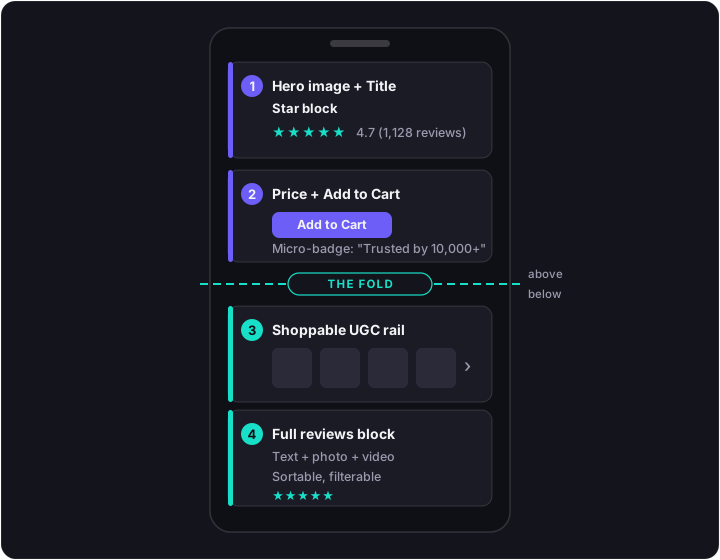
The most common architectural failure on legacy DTC PDPs is burying reviews in a tab at the bottom of the page. If your PDP has not been touched in two years, this is the single biggest fix on the page. Idukki's A/B work shows UGC delivers a roughly 29% conversion advantage over brand-produced creative when placed on the PDP itself, but the hero slot still belongs to a clean brand shot. The optimized 2026 PDP is hybrid: brand-produced hero up top, robust UGC below.
Shoppable galleries: where customer photos turn into baskets
A shoppable UGC gallery is a grid or carousel of real customer Instagram, TikTok, or direct-upload photos, with each image tagged so the shopper can click the exact item and add it to cart without ever leaving the gallery view.
Across 500+ A/B-tested implementations between 2025 and 2026, Idukki's benchmark put the median page-level conversion lift at 18%. That number is real, but it is also an aggregate, and the spread by category is enormous.
| Category | Median PDP lift from shoppable UGC | Why the spread |
|---|---|---|
| Skincare | +34% | Decision rides on visible result on a specific skin type |
| Athleisure | +29% | Fit, drape, body-shape variance |
| Kids fashion | +27% | Parents need real-kid context, not catalog shots |
| Beauty / cosmetics | +22% | Shade and undertone matching |
| Home goods | +16% | Scale and room-context |
| Commodity electronics | +6% | Standardized spec; nothing to "see" |
The lift tracks how much of the purchase decision is visual and subjective. Where fit and aesthetic carry the call, UGC carries the lift. Where the SKU is a spec sheet, it does not.
What separates a gallery that lifts from one that decorates
- Tag the exact product, not every loosely related SKU. "Catalog tagging," where every product in inventory gets tagged to every vaguely related photo, is the most common failure. It creates visual noise and routes high-intent clicks to the wrong PDP.
- Infinite scroll, not pagination. Pagination adds a click that measurably degrades CVR.
- Volume floor: 20-30+ pieces of UGC per SKU. Below that, the gallery does not register as social consensus. Idukki's operational analysis puts this threshold inside the 73% of variance explained by three factors: volume, placement, and freshness.
- Weekly refresh. Galleries left stale for 90+ days degrade. A 2021 photo of an old formulation reads as "the brand stopped caring." A 2025 survey of 19,000 consumers found 90% regularly consider how recently a review was written.
- Real customer aesthetic, not influencer-perfect. The whole point of the gallery is that it looks unlike the hero image.
Shoppable video on the PDP: the highest-impact format
Replacing a passive YouTube embed with native shoppable video, where clickable hotspots inside the player add directly to cart, is the single highest-impact PDP move on most DTC stores in 2026. Treat the findings below as relative third-party benchmarks.
- ~30% baseline conversion lift over static PDPs when shoppable video replaces a hero image (Videowise / aggregate brand reports).
- ~225% higher add-to-cart rate vs visitors who see only static page elements.
- Engagers who actually interact with the video convert at up to ~7x the average site visitor.
- Return rates fall 12-40%, because video closes the expectations gap on scale, movement, and finish before the order is placed.
- Across 500+ PDP A/B tests, Idukki found shoppable video lifted overall PDP conversion by a median of 21% against photo-only pages, and up to 38% in high-consideration categories like furniture.
- UGC-style customer video earns ~35% higher watch-through and ~6x more engagement than polished brand video.
Specs that actually work: 15-30 seconds (the sweet spot for commerce-focused content, with roughly 3.2x higher conversion than longer formats), vertical 9:16, sound-on but functional with captions, native player rather than an iframe embed.
The caveat is supply and rights. Shoppable video on the PDP is the most expensive UGC format to maintain because you need the assets and the legal right to use them commercially. The playbook is to harvest from real customer reviews via the post-purchase flow and supplement with commissioned creator shoots. We cover the customer side on sourcing video from your buyers and the legal side on the rights to clear before you embed.
Read the data honestly: page-level vs engager-only
Vendor decks routinely quote 144%, 161%, even 354% conversion lifts from UGC. These numbers are mathematically real. They are also the wrong number to plan around.
The trick is the denominator. "Engager-only" methodology isolates the subset of shoppers who actively clicked into a gallery, expanded a review, or sorted by star rating, and compares their conversion against shoppers who did none of that. That cohort already has dramatically higher baseline purchase intent. UGC did not generate them; it converted them.
"Page-level" methodology measures the conversion rate of everyone who lands on a PDP with the UGC widget installed, against a control page where it is hidden. That includes the engagers, the casual scrollers, and the immediate bouncers. The median page-level lift across Idukki's 2,400-program dataset lands around 18%.
| What it measures | Where you'll see it | What to use it for |
|---|---|---|
| Page-level (all PDP visitors, A/B tested) | Idukki ~18% median; Spiegel 270% for going from 0 to 5 reviews | Financial forecasting, procurement, the CFO conversation |
| Engager-only (only visitors who clicked, sorted, expanded) | Bazaarvoice ~161%; PowerReviews ~100-360%; Yotpo ~354% | The internal argument to move the gallery higher up the page |
Both are real. Both are useful. They answer different questions, and confusing them is how UGC projects get pitched on engager-only numbers and then audited against page-level reality. If you want a deeper inventory of the stats worth citing with their sources, we keep that one separate on purpose.
When UGC on the PDP earns less than it costs
This is not a universal upgrade. The categories where the lift is structurally small show up clearly in the data.
Commodity electronics (~6% median lift) and groceries (~4%) move very little because the subjective peer experience of a standardized AA battery or a bag of flour does not carry enough variance to influence the decision. Very low-AOV items also see smaller absolute lift because the consumer never needed much reassurance to spend $9 in the first place.
The fix in those categories is not to skip UGC entirely. Text and photo reviews still lift basic trust and remain a discovery surface for AI shopping agents. The fix is to invest in the cheap tier (post-purchase email asks, photo reviews) and skip the expensive tier (commissioned shoppable video shoots).
Frank diagnosis line: if your AOV is below $25 and your category is a commodity, fix conversion somewhere else first. Offer, page speed, checkout flow: that is CRO work, not a gallery problem. We work through the full preconditions on the worth-it decision, and the cost side is broken out on what a UGC program actually runs.
Bolt-on, not break-the-site: protecting site speed
Aggressively deployed UGC widgets and video players add 100-200KB of JavaScript, which can blow up Google's Core Web Vitals (LCP under 2.5s, INP under 200ms, CLS under 0.1) and bounce visitors before the page even renders. The lift you bought disappears at the network layer.
Three guardrails handle most of it.
- Lazy-load everything below the fold. Galleries, the full reviews block, anything not in the initial viewport waits for the user to scroll.
- Async-load review widget scripts so they do not block the initial page render.
- Use a thumbnail facade for video. Show a lightweight static image; only fire the heavy player script after the user explicitly clicks play.
Pick widgets engineered for speed (Junip and Moast both built around this) rather than the heaviest enterprise suite you can afford.
The tool stack: what brands actually use
Two compact tables. These are categories you pick from, not endorsements. Pricing reflects late-2025 and 2026 public tiers and shifts often.
Review widget platforms (text + photo + video collection and display)
| Tool | Best for | Where it fits | Pricing tier |
|---|---|---|---|
| Judge.me | Cheapest accessible option, Google rich-snippet integration | Stores under $1M GMV | Free / ~$15 flat |
| Loox | Visual-heavy brands; ~7%+ photo and video capture vs 2-3% industry | Shopify only, $1M-$5M GMV | $10-$300/mo |
| Junip | Lightweight, clean code, Core Web Vitals friendly | Growing Shopify brands | $19-$399/mo |
| Okendo | Zero-party data, attribute filtering (skin type, fit), ~12.4% collection rate | $5M+ GMV Shopify Plus | $19-$499/mo |
| Stamped | Bundled reviews + loyalty | Mid-market | $23-$199+/mo |
| Yotpo | Enterprise all-in-one, AI summaries, multi-platform | 500+ orders/month brands | $79-$2000+/mo |
Shoppable video and gallery platforms
| Tool | Best for | Where it fits | Pricing tier |
|---|---|---|---|
| Videowise | Performance-built shoppable video, AI clips, A/B testing | High-traffic brands comfortable with impression caps | $9-$479/mo + overages |
| Tolstoy | Shoppable video + interactive quizzes, AI Studio | Beauty / fashion | $19-$499/mo + per-impression |
| Moast | Clean, flat-priced shoppable video, no overage anxiety | DTC under $10M GMV | $0 or flat $15/mo |
| Foursixty | Instagram and TikTok to shoppable gallery, "shop the look" multi-tagging | Fashion and lifestyle | $90-$500/mo |
| LiveMeUp / Firework | Shoppable video + live commerce | Brands running live events | Tiered, enterprise |
The right choice tracks your platform (Shopify vs headless vs multi), monthly traffic volume, and whether you actually want live commerce or just static shoppable widgets.
The brands that already do this well
Four short proofs of pattern. Real public deployments, not testimonials.
- Gymshark runs Yotpo for reviews and integrates shoppable Instagram and Foursixty-style galleries directly into their storefront. Knitting reviews, loyalty (ReCharge), and visual UGC together as one stack contributed to a reported 150% increase in revenue attributed to personalization.
- Jones Road Beauty uses Okendo with attribute-tagged reviews (skin tone, skin type, age concern) so prospective buyers can filter visual reviews and find creators matching their exact physical profile. That filtering attacks the highest-stakes hesitation moment on a high-AOV beauty PDP.
- Frankies Bikinis deployed Foursixty-powered shoppable UGC galleries, which the brand reports drive 19% of total store orders and over 23% of online revenue.
- Dame added Moast shoppable video on PDPs and reported a $26,000 monthly MRR lift and a $0.16 lift in revenue per visitor, without changing top-of-funnel traffic.
The shared pattern: all four picked one collection tool, one display tool, and integrated them into the actual buying flow rather than appending UGC as an afterthought.
Where the assets come from (and the rights to use them)
The PDP playbook only works if you actually have the photos and videos. There are two real sources: customer submissions through the post-purchase flow, and commissioned creator content. Mid-market DTC brands routinely build libraries of 5,000-10,000 visual assets per year using both.
The rights point is the one most brands get wrong. A customer tagging your brand on Instagram does not grant you commercial use rights. Embedding their photo on a PDP or in a paid ad without documented consent exposes you to copyright claims, right-of-publicity suits, and (under GDPR Article 6) a data-processing violation with a roughly 30-day erasure SLA when the customer revokes.
The depth on both sides lives elsewhere. The customer side is on the customer sourcing playbook. The legal mechanics, including magic-link consent flows and audit trails, live on UGC rights and whitelisting. The commissioned-creator side sits on hiring creators.
Getting your PDP UGC built and shot
The bottleneck on most DTC PDPs is not the widget or the placement. It is the supply of genuinely good visual UGC, on enough SKUs, refreshed often enough to keep the gallery from going stale. Picking Loox over Judge.me does not solve that. The shoot calendar does.
That is what we produce: rights-cleared, customer-style photo and video at the volume and cadence a PDP program actually needs. If your gallery is empty, your video tab is a YouTube embed, or your aggregate rating has been "4.9 stars (43 reviews)" for the last eighteen months, that is the conversation. See how we produce the customer-style content that lives on your PDP.
You
Can you look at our ads?
Want this read on your own ads?
We pull your live ads from the Meta Ad Library, set them next to the longest-running ads in your category, and send back what we'd change and test next. The teardown is free.
Get my free creative teardownWe usually reply within one business day.