UGC Videos That Convert: Hooks, Pacing and the Ask
What separates UGC videos that convert from ones that burn money
UGC videos convert as ads when three things hold. The first three seconds stop the scroll. The body is paced tight enough to keep people watching to the pitch. The end makes one clear ask. Most ads die at the hook. The rest die in the middle.
You can tell exactly which one is killing yours by reading four numbers in order: hook rate, hold rate, click-through rate, conversion rate. Each one gates the next, so you debug top down.
Whether to run UGC at all is a separate call: here is why UGC wins paid social in 2026.
The first three seconds decide almost everything
The hook is not the introduction to the ad. The hook is the ad.
Across 2025-2026 performance reporting, roughly 71% of viewers decide whether to keep watching or scroll past inside the first three seconds, with the average decision landing around 1.7 seconds. TikTok's own business guidance pegs about 90% of an ad's recall inside the opening six seconds. A weak open wastes every dollar of the spend behind it, because the demo, the proof, and the CTA never get seen.
The single number that scores the open is hook rate: three-second views divided by impressions. Performance teams treat anything under about 25% on Meta or under about 30% on TikTok as a failed hook. Past that line, the algorithm responds with higher CPMs and starves the ad of distribution.
How to read your creative, four numbers in order
| What you measure | What it scores | Warning line | What a miss usually means |
|---|---|---|---|
| Hook rate (3s views / impressions) | The opening frame | < ~25% Meta, < ~30% TikTok | The hook failed; nothing downstream was seen |
| Hold rate (% watching to ~15s) | Body and pacing | < ~10-15% while hook is healthy | The open wrote a check the body could not cash |
| Click-through rate | The ask | < ~1% on cold prospecting | They watched but were not told to act |
| Conversion rate | The post-click promise | High clicks, near-zero buys | The landing page broke the ad's promise |
These are relative findings from 2025-2026 platform and agency reporting; ranges vary by category, AOV, and placement. Diagnose top down, because each stage gates the next. The operating side of this loop is how brands kill, iterate, and scale from those numbers at volume.
The hook archetypes that actually stop the scroll
A small set of opening patterns wins reliably. Each one works by opening a curiosity loop or a pattern interrupt the brain cannot easily ignore. Treat these as starting formats to test against each other, not as a recipe to copy once and reuse forever. Brand-named ad teardowns show the same patterns on real ads.
Hook archetypes at a glance
| Archetype | Why it stops the scroll | Best-fit categories | 3-second example |
|---|---|---|---|
| Problem-callout | Accurate diagnosis of a hidden pain | Skincare, supplements, ergonomic apparel | "Still waking up tired after 8 hours of sleep?" |
| Curiosity gap | Open loop with a withheld mechanism | Cosmetics, wellness, broad-appeal | "I tried 11 of these. Only one worked." |
| Unboxing | Kinetic ASMR plus a "did it deliver?" loop | Fashion, tech, premium CPG | Knife through tape, "wasn't expecting much..." |
| POV | Hyper-specific scenario the viewer has lived | Apparel, comfort goods, decor | "POV: you stopped dealing with the underwire pinch" |
| Founder-to-camera | Personal stake and borrowed authority | High-ticket, ingestibles, premium | "I built this because nothing else worked for me" |
| Skeptic-to-believer | Voices the viewer's own doubt first | Beauty tools, high-claim categories | "Honestly, I thought this brand was hype..." |
| Instant proof | Visual evidence before any sales pitch | Skincare, cleaning, hair, organization | Magnified close-up of before-and-after skin |
Pick three to five and test them against one shared body, not all at once.
Problem-callout
Name the viewer's specific pain in the first frame in conversational, FaceTime-with-a-friend language. Then twist before the product appears. Wins because an accurate diagnosis triggers what cognitive psychology calls the curiosity gap, the cognitive itch the brain cannot rest until it closes. "Still waking up tired after eight hours of sleep?" beats "tired of being tired?" every time. Best for health, skincare, supplements, problem-solving gadgets.
Curiosity gap
Tease the outcome, withhold the mechanism. "I tried 11 of these. Only one actually worked." The viewer has to watch to close the loop. The failure edge: if the claim crosses into unbelievable territory, skepticism fires and they drop early. Best for cosmetics, wellness tools, broad-appeal goods.
Unboxing
Start mid-action. Knife through tape. Genuine reaction. Low-expectation framing makes the payoff feel earned. The mechanic is kinetic plus ASMR, tearing cardboard and tapping glass, which breaks the auditory rhythm of the feed. Best for visually striking goods where packaging is part of the value.
POV
A bold POV text overlay drops the viewer into a scenario they have personally experienced. Voiceover is minimal; trending audio carries the energy. POV reads as organic, so the viewer is several seconds in before they recognize the ad. Best for apparel, comfort, lifestyle.
Founder-to-camera
The founder explains the exact frustration that made them build the product. The format borrows authority and lowers buyer hesitation in categories where trust is the gate. It stabilizes well in Meta's learning phase for ingestibles, high-ticket, premium formulations. The broader strategic case for founder-led, beyond this opening format, sits inside the paid social strategy discussion.
Skeptic-to-believer
Open by attacking the product. "Thought this was hype. Ignored it for three months." Then the turn, then visible proof. The mechanic is cognitive dissonance: voicing the viewer's own doubt disarms it and earns the pitch. The polished scripted testimonial is effectively dead in 2026; this is its replacement. Best for high-scrutiny categories and bold claims.
Instant proof (before and after)
Lead with undeniable result in frame one. The magnified skin shot. The split-screen. Visual evidence neutralizes skepticism before a word is spoken. Best for skincare, cleaning, hair, organization.
Day-in-the-life and trend-jacking
The quieter and riskier ends of the set. Day-in-the-life sells through aspirational voyeurism, the product woven into a routine. It tends to win on hold rate and is potent for mid-funnel retargeting more than cold prospecting. Trend-jacking surfs a viral sound or format for organic-style reach, but demands a 24-48 hour turnaround and a playful brand voice. It is high-risk, high-reward, and weak for serious or high-ticket products.
How the rest of the ad has to be built
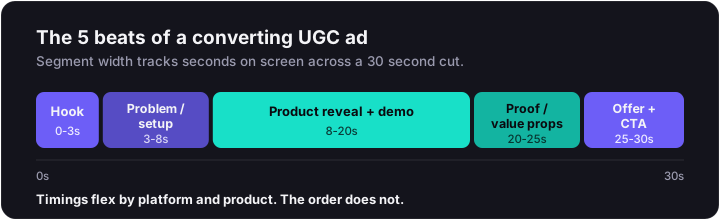
The hook earns attention. The body has to convert it. Winning DTC creative follows a tight five-beat sequence, not a vlog structure.
Why the body loses people: retention and pacing
The most common silent killer is a great hook attached to a draggy middle. The tell: a healthy hook rate alongside a hold rate under about 10-15%. The open over-promised; the body under-delivered.
The fixes are editing mechanics, not new ideas:
- Introduce the product visually inside the first five seconds.
- Cut filler words, breaths, and dead air.
- Hold a cut cadence of roughly 0.8 to 2 cuts per second across the middle.
- Layer B-roll as visual proof of each spoken claim, instead of letting the talking head carry alone.
- Break the visual pattern (zoom, angle change, insert shot) every three to five seconds.
- Keep total runtime under 25 to 30 seconds.
Word-by-word burned-in captions in the lower-middle third of the frame quietly fix a second problem: roughly 85% of Meta video impressions happen on mute, and dynamic captions also act as a micro pattern interrupt with every word.
The ask: one message, one clear next step
The end is where watched-but-did-not-click ads die. Diagnose with CTR.
The fixes: a direct verbal and visual CTA in the final few seconds, a single core message rather than five competing benefits, and one concrete offer. "It's on sale right now" or "linked it below, it sells out fast" beats a fade-to-logo every time.
Continuity is the matching rule. The landing page has to mirror the hook headline, the offer, and the variant shown. When CTR is strong but CVR collapses, the ad is doing its job and the destination is breaking the promise.
Why most UGC ads fail (and how to tell which problem you have)
UGC is a format, not a strategy. The failures are diagnosable in sequence, not by guesswork.
The UGC ad failure checklist
| The symptom | Likely cause | The fix |
|---|---|---|
| Strong early metrics fade fast; comments call it "fake" or "AI" | Over-polished aesthetic or uncanny-valley AI avatar | Strip the polish: smartphone footage, natural light, human texture |
| Every creator opens identically and sounds stiff | Over-scripted from a corporate brief | Framework brief, not a script; let creators use their own words |
| Steep drop in the first three to eight seconds, no visible text | No captions, sound-off blindness | Burn in large captions and a title card from second one |
| High views, low conversion; audience rejects the speaker in comments | Creator-product mismatch | Match the messenger to the buyer demographic, or go founder-led for trust categories |
| Ads flagged, rejected, or stuck in review | Aggressive absolute claims (the compression problem) | Dilute absolutes ("I noticed" not "this cured"); secure usage rights up front |
| Wild day-to-day ROAS swings; nobody can say why a winner won | No structured testing method | Isolate one variable at a time |
The structural failures (weak hook, draggy body, no CTA, landing-page mismatch) are covered above. Three neighbors are worth knowing: the same cut failing on the other platform is a sound-on versus sound-off problem covered in the channel comparison; securing the right to run a customer's video is the rights primer; where synthetic creators hold up and where they tank trust sits in the AI UGC discussion.
What good looks like
A converting UGC video ad earns the open, keeps the middle moving, and makes one clear ask. It is heavily engineered, and it must not look engineered. Every number downstream gets a fair shot because the structural job at each beat actually got done.
UGC videos built to pass the four-number test
Knowing what a good hook is, is the easy part. The hard part is producing a steady stream of genuinely distinct, performance-built variations week after week and reading the data honestly on each one.
That is the work. If you want UGC built to pass this diagnostic instead of looking pretty in a portfolio, see how we build UGC ads that perform, or start upstream with the creator brief we use to ship hooks that actually land.
You
Can you look at our ads?
Want this read on your own ads?
We pull your live ads from the Meta Ad Library, set them next to the longest-running ads in your category, and send back what we'd change and test next. The teardown is free.
Get my free creative teardownWe usually reply within one business day.