Chance Ecom Get my teardown

CRO agency for ecommerce Your traffic is paid for. Make it convert.

We audit the site, test the pages that carry revenue, and ship only the edits that win. If media hits its targets while blended CAC keeps climbing, the leak is after the click. Every test is judged on revenue per visitor, not a button-color win rate.

Get my free teardown

Rather start on your own? Work through the ten on-site conversion levers in order of impact before you buy another click.

Chance EcomCreative agency, DTC

A typical first conversation

  1. You

    The ads hit their targets. Blended CAC keeps climbing anyway.

  2. Chance Ecom

    Then the leak is after the click. You're paying for traffic the pages don't convert.

  3. You

    We redesigned the product page last year. Nothing moved.

  4. Chance Ecom

    A redesign is one big guess. We find where buyers drop off, test the pages that carry revenue, and ship only the edits that win.

  5. You

    Win on conversion rate?

    Seen

  6. Chance Ecom

    On revenue per visitor. More orders at a smaller cart isn't a win.

You

Why is CAC climbing when the ads hit target?

The leak is after the click.

Ads are upstream. Conversion is the multiplier on what they buy: hold the media bill flat, lift conversion, and every customer costs less.

A one-point lift in ecommerce conversion rate beats buying cheaper clicks, which is why the page comes before the media bill.

  • Acquisition got expensive

    Blended CAC sits far above where it was before iOS 14. A sloppy site used to be an annoyance. Now it's a margin event.

  • The math favors the page

    At a fixed media bill, moving conversion from 2% to 3% buys half again as many customers, and CAC drops by a third. No new platform needed.

  • Bundled CRO is guesswork design

    Performance agencies are built for demand generation. CRO tucked into a media agency's scope usually means surface edits, not validated experiments.

You

So what do you actually do?

Audit the site. Test what carries revenue. Ship what wins.

Page edits and disciplined A/B tests on the pages that move money. Not a standing dev team, and not new photo shoots.

The core

Tests that pay

A backlog scored on revenue per visitor, then A/B tests on the pages that move money: product page, cart, checkout and [[landing-page-design-agency|the landers your paid traffic hits]].

Native theme tests
Variants ship as duplicated Shopify themes, so there's no page flicker and no hit to load speed.
Offer and threshold tests
Free-shipping thresholds, volume discounts and price, read against margin, not just revenue.
One to three tests a month
On the pages with the worst drop-off first. Each one is A/B tested to significance, with no peeking at a noisy first week.
what feeds the tests

  • Heuristic and analytics audit

    GA4 funnels, session recordings and heatmaps to find the real friction, not opinions or what worked for another brand.

    A funnel friction audit like this maps where the site loses buyers, so the first fixes go where the money leaks.

  • Cart and checkout

    Checkout copy, trust badges, and when shipping cost gets disclosed. The last steps leak the most money.

    Surprise fees drive most abandoned carts, so checkout fixes start with when shipping cost appears.

  • On-site lead capture

    Popup timing, exit intent, offer strength and quiz entry points, tested against repeat purchase, not just opt-in rate.

    Timing and trigger decide whether a popup or opt-in captures the email or just annoys the visitor.

  • Conversion copy and hierarchy

    Hero messaging, value-prop order, social proof placement and product page layout, edited on assets you already own.

    A product-finder quiz runs on the same hierarchy: the recommendation leads and the proof sits right under it.

You

How does it run?

Quick fixes in week one. Then one test always running.

A rolling roadmap, not a locked year of tests. Each round names the Metric on Fire: the funnel stage bleeding the most revenue right now.

  1. 1

    First week

    The leak report on the worst drop-off, plus the fixes that don't need a test.

    • GA4 funnels by device, source and page
    • Broken elements and obvious friction fixed
    • A backlog scored on impact, ease, traffic
  2. 2

    First test

    Weeks 2 to 4. One or two tests on the Metric on Fire.

    • Recordings and heatmaps shape the hypothesis
    • Native theme duplicates: no flicker, no speed hit
  3. 3

    Read, roll, queue

    Each test runs to significance, not to a calendar. Winners roll, the next test queues.

    • Reported on revenue per visitor
    • True Profit when margin's in play

then we re-diagnose and name the next one

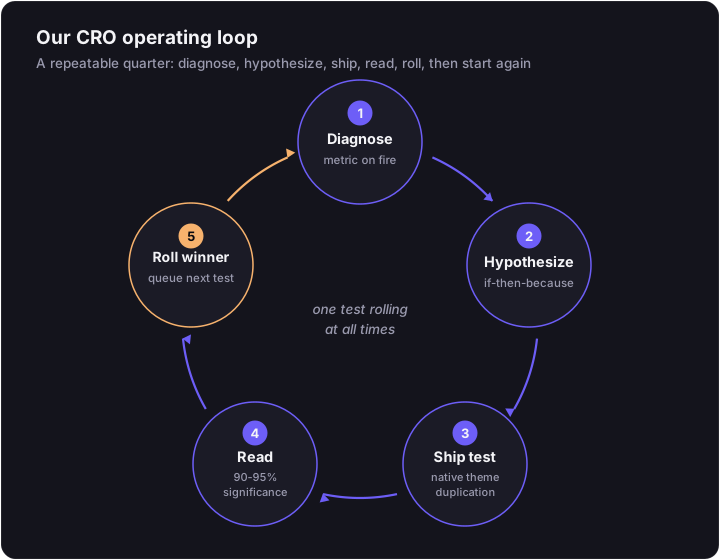
A pentagon ring of five steps linked clockwise: Diagnose the metric on fire, Hypothesize, Ship the test via native theme duplication, Read at 90 to 95 percent significance, and Roll the winner while queuing the next test, with a closing arrow back to Diagnose.
One test rolling at all times, round after round.

You

What do you need from us?

Restricted access, your data, and someone to approve tests.

The access is deliberately narrow, which is what makes it workable on both sides.

  • Shopify Collaborator access or a restricted CMS seat
  • Read-only GA4 for the funnel data
  • Margin and COGS for any test that touches price, shipping or discounts
  • Your raw creative library, organized or not
  • One point of contact who can approve hypotheses

What we never ask for: master admin passwords, financial systems or banking, or ownership of your ad accounts.

You

How do you call a winner?

On revenue per visitor. Not on conversion rate.

RPV blends conversion rate with order value, so a test can't win on conversion and lose on basket size.

  • RPVRevenue per visitor. The primary metric on every test.
  • True ProfitMargin-aware reporting on any test that touches price, shipping or discounts. A lift that crushes margin isn't a lift.
  • 90-95%The confidence a test reaches before we call it. No reading results off one noisy week.
our read

A sitewide 20%-off popup will spike conversion rate and gut margin. The job is profitable revenue per visitor, not a prettier metric.

Peeking, novelty spikes and small samples all make fake winners, which is why a store A/B test runs to significance before anyone calls it.

Every test, run the same way

  • A hypothesis scored on impact, ease and traffic.
  • The variant served as its own theme.
  • Run to 90-95% confidence before a call.
  • Reported on RPV, and on True Profit when margin's in play.

To know whether a 2% rate is healthy, check it against conversion rate benchmarks by industry and device. Audit, scored hypothesis, test, roll: that loop is how CRO compounds, round after round.

You

Is this for us?

Built for stores with traffic to test and a CAC problem spend won't fix.

A good fit

  • Shopify or Shopify Plus. With enough traffic for a test to reach significance in a 30 to 60 day window.
  • A creative library already moving. So there's raw material to re-cut for test variants.
  • A CAC problem more ad spend won't solve. The traffic arrives. It doesn't buy.

Not a fit

  • Not enough traffic yet. Tests won't reach significance fast enough. Light page edits from your performance agency are usually enough at that stage.
  • Need a permanent experimentation team. Server-side, multi-market, multivariate testing as a standing function is an in-house build.
  • Need dev work. Custom Liquid sprints, app development, replatforms and headless migrations belong with a dev-led shop.

You

A few more questions

Ask away. These come up on most first calls.

What does it cost?

Pricing depends on scope. Tell us what you're running and we'll quote after the free teardown.

Which testing tools do you use?

Native theme-testing apps for Shopify, so variants run as their own themes. Tool subscriptions are billed by the tool, separate from our work.

Heatmaps, recordings and popup apps sit alongside them, and which testing and analytics tools earn their cost depends on the job and the size of the store.

Can our paid-media agency just do this?

They can ship landing-page edits for ad-to-page continuity, and they should. They generally don't run statistically disciplined experiments, because that's not what their team is built for.

Do we need to give you admin access?

No. Shopify Collaborator permissions or a restricted CMS seat is all we need. Master admin, banking and your ad accounts stay with you.

Will tests slow our site or cause flicker?

No. Each variant is its own duplicated theme, served natively, so there's no script swapping the page after it paints.

Do you produce the creative?

Not in this engagement. We edit, re-cut and overlay copy on the assets you provide. New ads are their own service.

Our ad creative service makes them: creator videos, AI variations and recuts, each one testing a real idea.

You

OK. Look at our store.

Tell us what's broken. We'll tell you what we see.

A few short fields. The last one matters most: the more honest you are about what's not working, the more useful the audit.

  1. You

    Sent. Here's our brand and what's stuck.

  2. Chance Ecom

    Got it. We pull your live ads from the Meta Ad Library, set them next to the longest-running ads in your category, and send back what we'd change and test next. We usually reply within one business day.

Then, the diagnostic

If we go further, it reads:

  • GA4 funnels by device, source and page
  • Session recordings and heatmaps, plus a heuristic UX review
  • The Metric on Fire: the stage with the worst drop-off

Out comes a test backlog scored on impact, ease and traffic.

We usually reply within one business day. Not ready to send it? Read the blog first.