
Not legal advice. Talk to qualified counsel about your specific contracts.
What "usage rights" actually means (and why tagging you is not consent)
The creator owns the copyright the second they hit record, so a UGC video is licensed to you, not owned by you, unless you buy it outright. What you can legally do with it depends entirely on the license you secured: where it runs, for how long, and whether you can put ad spend behind it. Get this wrong and an asset that cost $200 can expose you to five and six-figure damages.
- Three tiers, in plain terms: organic-only (your own feeds, no ad spend), paid usage (you run it as an ad), full buyout (you own it forever).
- A license is a rental with an expiry date, a territory, and a platform list, not a blank cheque.
- Whitelisting is a separate, premium right: running the ad through the creator's own handle.
- "They tagged us" or "it was public" is not permission. You need an explicit, written license.
The myth that public posts or branded-hashtag tags equal commercial consent is the single most common mistake DTC brands make, and courts have rejected it consistently. Copyright vests the moment the work is fixed in a tangible medium, the same way you automatically own a photo you took on holiday. The creator is in that position. They are not a salaried photographer working under a "work for hire" doctrine.
Tagging your brand, using your hashtag, posting publicly: none of that transfers a commercial license. Volvo learned this the expensive way in 2019 when it argued a tagged Instagram post created an "implied non-exclusive license" and was widely ridiculed for the defense. Treat every piece of UGC the same: you need explicit, documented permission for both the footage and the human in it. For deep coverage of the customer-content side, see the legal traps in reusing content you did not commission, and the consent step lives inside getting UGC from customers.
The three tiers of UGC rights: organic, paid, buyout
Pick the tier that matches how the asset will actually be used. Conflating tiers is the single most common cause of disputes, and the line between "we reshared it" and "we ran it as an ad" is the one brands cross by accident most often.
Organic-only. You can publish the asset on the brand's owned channels (Instagram grid, TikTok, PDPs, email) with zero ad spend behind it. This tier is usually bundled into the base creation fee, which sits around $150 to $300 for a mid-level creator in 2026 industry ranges. Use it for product-page social proof and community, not net-new acquisition. The hard limit: no boosting, no Ads Manager, ever.
Paid usage. This grants permission to put spend behind the asset through Meta Ads Manager, TikTok Ads Manager, Google, or programmatic. The creator keeps the copyright; you are renting commercial reach. Industry guidance puts the premium at roughly 20% to 50% on top of the base fee for a standard 30 to 90 day window, scaling higher for longer terms.
Full buyout. A perpetual transfer where you can use, modify, distribute, and remix the asset forever. Industry premiums sit around 100% to 300% over base, which translates to $800 to $3,000 per asset for standard UGC and far more for larger talent. Reserve buyouts for evergreen demos and core site assets; for fast-fatiguing social creative, this is over-buying.
Organic vs paid vs buyout, at a glance
| Tier | What it lets you do | Who keeps the copyright | Typical cost shape | Best for |
|---|---|---|---|---|
| Organic-only | Post on your own channels, no ad spend | Creator | Included in base fee (~$150 to $300) | PDPs, social proof, community |
| Paid usage | Run as a paid ad on Meta, TikTok, etc. | Creator | Base + ~20% to 50% per month | Acquisition, testing, scaling |
| Full buyout | Anything, anywhere, forever | Brand | Base + ~100% to 300% (often $800 to $3,000+) | Evergreen demos, core assets |
These are 2026 industry ranges drawn from practitioner data, framed as relative findings rather than a single rate card. Usage costs scale with the creator's base rate, so a higher-tier creator's licensing premium compounds. For full pricing depth, line by line, see the UGC rate card.
The transition from organic to paid is where brands get burned
A creator who agreed to let you reshare a video on your Story did not agree to be the face of a globally targeted Meta campaign. "Boosting" an organic-licensed post is a breach of contract, not a gray area. Diagnose the use case before you brief the creator, not after the ad is already spending.
How long a license lasts, and where it can run
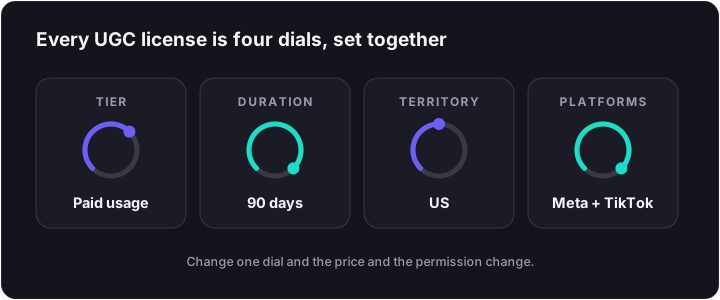
Beyond the tier, every UGC license has three more dials: duration, territory, and platform scope. When a time-limited license expires, you have a binary choice: renew and pay, or pull the content immediately from active campaigns. There is no third option.
Duration. Most DTC brands license in cycles that match the creative's lifecycle. Testing windows run 30, 60, or 90 days. The scaling standard for proven winners is 6 to 12 months. Perpetual licenses exist but many professional creators now refuse them, because they do not want to be tied indefinitely to a product they may stop using.
Territory. A US-only license is cheaper but breaks the moment you point an EU campaign at the asset. If you ship internationally, worldwide rights are mandatory, and they carry a real premium (often a 1.5x to 2x multiplier on the total project fee).
Platform and derivative scope. A tight contract names exactly which platforms the asset can run on (e.g., Meta and TikTok, not YouTube or CTV). If the contract is silent on edits, assume you cannot re-cut, crop, add captions, or chop a 60-second video into three 15-second hooks without going back for permission. Raw-footage access is a separate paid add-on, typically a 30% to 50% surcharge on the base creation rate.
Whitelisting: running the ad through the creator's handle
Whitelisting (also called Spark Ads on TikTok, Partnership Ads on Meta, dark posting, or creator licensing) is a separate, premium right where the paid ad runs from the creator's own account. To the viewer it looks like an organic post by the creator, carrying their handle, their profile photo, and their audience trust. That perceived authenticity is exactly why whitelisted ads consistently outperform standard brand-handle ads on click-through and conversion.
It is also why creators charge more for it. With standard paid usage you are renting the asset. With whitelisting you are also renting the creator's identity and reputation, ongoing, which is why the cost is structured as a recurring access fee.
Practitioner data puts whitelisting at roughly 30% to 100% of the base rate per month on top of the standard paid license. Many creators bypass percentages entirely and charge a flat monthly access fee instead, typically $150 to $500 per month per platform for micro-influencers and $500 to $2,000 per month for mid-tier creators. On TikTok, Spark Ad access codes often start around $100 and scale with campaign scope.
Treat whitelisting as an ongoing operational cost, not a one-time buy. The setup mechanics (authorization codes, account access vs code access, why creator-handle ads convert better in depth) live on Spark Ads vs Partnership Ads. Channel-level format notes live with UGC on TikTok and UGC on Meta.
What whitelisting costs vs standard paid usage
Standard paid usage runs the asset from your brand's ad account at roughly +20% to 50% of base per month. Whitelisting runs it from the creator's handle at roughly +30% to 100% per month, or a flat access fee in the same band. The extra premium is the creator's identity and reputation, which is why it stacks on top of the paid license rather than replacing it. For the full breakdown of how these add-ons compound, see what UGC costs.
Locking in exclusivity (and why "no skincare brands" gets struck down)
Exclusivity is paying a creator to NOT work with your direct competitors. By default UGC deals are non-exclusive, which means a creator can shoot for you on Monday and your closest rival on Tuesday, and that is the creator's right.
To restrict that, the category has to be defined narrowly. "No skincare brands" is overly broad and routinely gets struck down because it kills the creator's livelihood. Workable language looks like "Vitamin C serums sold DTC in the US" or naming 3 to 5 specific competitor brands. The restriction also has to be time-bound: typically the campaign duration plus a 30 to 90 day cooldown after the final asset publishes.
Exclusivity is premium-priced because it directly cannibalizes the creator's future income. Most equitable agreements restrict only paid partnerships, not organic mentions.
What you must secure before you press launch
Holding the file is not the same as having the right to run it as an ad. Five clearances need to be in place before the campaign goes live, and missing any one of them creates strict liability.
- Written license granting paid use and the right to create derivative works (crop, caption, re-cut). The DM handshake is obsolete; use a real contract.
- Model release / likeness consent for every identifiable person in the video. Copyright covers the footage; the right of publicity covers the human in it. They are legally separate, and you need both.
- FTC disclosure baked into the ad. Any fee, commission, or gifted product creates a "material connection" that must be disclosed; the brand and the creator are jointly liable for deceptive endorsements.
- Third-party IP scan. No platform trending audio carried into your Ads Manager (TikTok's library is licensed for personal use, not commercial), no visible competitor logos, no unlicensed background art.
- AI and privacy waivers (the 2026 wave). Disclose AI-modified likeness where required; secure a separate written waiver to clone a creator's voice; comply with CCPA and BIPA disclosure rules for biometric targeting.
The case law on each of these is brutal and getting worse. For the named lawsuits, the dollar amounts, and the mechanics of sync vs master music licenses and model-release law, see the legal deep-dive on music and likeness. To get usage terms written down before production starts, use the creator brief template. For the synthetic-media disclosure landscape, see AI UGC for ecommerce.
Keeping track so you don't run "zombie ads"
The single most common failure mode is the "zombie ad": a media buyer pulls a high-performing video out of a shared drive months after its license has lapsed, and the ad keeps spending. That is willful infringement in the eyes of a court, and it routinely triggers takedowns and lawsuits.
The fix is unglamorous: a centralized tracker tagging every asset with its expiry date, the platforms it is licensed for, and the territory. At low volume a disciplined spreadsheet works. At ad volume you want a DAM or an influencer ops tool (Grin, Aspire, or similar) that surfaces expiries before the clock runs out, so you can renew or pull the asset cleanly.
This is the boring discipline that prevents the expensive problem. Skipping it is what makes statutory-damage exposure a question of when, not if.
What happens if you run content you don't own
This is not a slap-on-the-wrist risk. The exposure is real, federal, and frequently six figures.
- Statutory copyright damages of up to ~$30,000 per work for non-willful infringement, climbing to ~$150,000 per work when infringement is willful (e.g., knowingly running an ad past its license expiry).
- DMCA takedowns that pause ad campaigns, disable advertising accounts, and can result in the brand's domain being banned from a platform.
- Right-of-publicity and false-endorsement claims if you commercialize a face or voice without explicit consent. Katherine Heigl sued Duane Reade for $6 million over a single tweet. Jason Olive won $1.123 million from GNC after the brand ran his image past its license expiry, with $910,000 of that award being emotional-distress damages.
- Reputational damage, which compounds quickly. The creator economy is networked, and call-out posts on Reddit and TikTok travel.
The "willful" trap is the one that turns a recoverable mistake into a catastrophic one. Letting a profitable ad keep spending past its expiry, because pulling it would cost performance, is the deliberate version of the offense, and courts award maximum damages for it. For the full case-law walkthrough of Bang Energy, OFRA, DSW, Crumbl, Volvo, and the rest, see the real cases and what they cost the brands involved.
When the rights work is worth doing yourself vs handing off
For a handful of one-off assets a careful team can manage the rights layer with a contract template and a spreadsheet. The math changes at ad volume. Tracking dozens of expiries across territories and platforms, securing whitelisting access from a roster of creators, and keeping every clearance airtight becomes a function of its own, and a single missed renewal is far more expensive than the help.
If the rights layer is starting to eat your week, that is a signal, not a workflow problem. Chance Ecom produces UGC for DTC brands with the licenses, whitelisting, and clearances handled as part of the brief, so the asset that hits Ads Manager is one you can actually run. See how we handle rights end-to-end, or compare the trade-offs in platforms vs agency.