UGC Usage Rights: Licenses, Music, Likeness and the Traps
Orientation for brands, not legal advice. For specific clearances, contracts, or disputes, talk to qualified counsel.
What UGC usage rights actually cover
UGC usage rights are the license that decides what a brand can legally do with a creator's video: where it runs, for how long, and whether ad spend can go behind it. The creator owns the copyright the second they hit record, so the video is licensed to you, not owned by you, unless you buy it outright. Get this wrong and an asset that cost $200 can expose you to five and six-figure damages.
- Three tiers, in plain terms: organic-only (your own feeds, no ad spend), paid usage (you run it as an ad), full buyout (you own it forever).
- A license is a rental with an expiry date, a territory, and a platform list, not a blank cheque.
- Running the ad through the creator's own handle is a separate, premium right: here is what whitelisting is and what it costs.
- Around the license sit five legal traps: music, likeness, expired licenses, organic harvesting, and influencer liability.
The three tiers of UGC rights: organic, paid, buyout
Pick the tier that matches how the asset will actually be used. Conflating tiers is the single most common cause of disputes, and the line between "we reshared it" and "we ran it as an ad" is the one brands cross by accident most often.
Organic-only. You can publish the asset on the brand's owned channels (Instagram grid, TikTok, PDPs, email) with zero ad spend behind it. This tier is usually bundled into the base creation fee, which sits around $150 to $300 for a mid-level creator in 2026 industry ranges. Use it for product-page social proof and community, not net-new acquisition. The hard limit: no boosting, no Ads Manager, ever.
Paid usage. This grants permission to put spend behind the asset through Meta Ads Manager, TikTok Ads Manager, Google, or programmatic. The creator keeps the copyright; you are renting commercial reach. Industry guidance puts the premium at roughly 20% to 50% on top of the base fee for a standard 30 to 90 day window, scaling higher for longer terms.
Full buyout. A perpetual transfer where you can use, modify, distribute, and remix the asset forever. Industry premiums sit around 100% to 300% over base, which translates to $800 to $3,000 per asset for standard UGC and far more for larger talent. Reserve buyouts for evergreen demos and core site assets; for fast-fatiguing social creative, this is over-buying.
Organic vs paid vs buyout, at a glance
| Tier | What it lets you do | Who keeps the copyright | Typical cost shape | Best for |
|---|---|---|---|---|
| Organic-only | Post on your own channels, no ad spend | Creator | Included in base fee (~$150 to $300) | PDPs, social proof, community |
| Paid usage | Run as a paid ad on Meta, TikTok, etc. | Creator | Base + ~20% to 50% per month | Acquisition, testing, scaling |
| Full buyout | Anything, anywhere, forever | Brand | Base + ~100% to 300% (often $800 to $3,000+) | Evergreen demos, core assets |
These are 2026 industry ranges drawn from practitioner data, framed as relative findings rather than a single rate card. Usage costs scale with the creator's base rate, so a higher-tier creator's licensing premium compounds. For full pricing depth, line by line, see the UGC rate card.
How long a license lasts, and where it can run
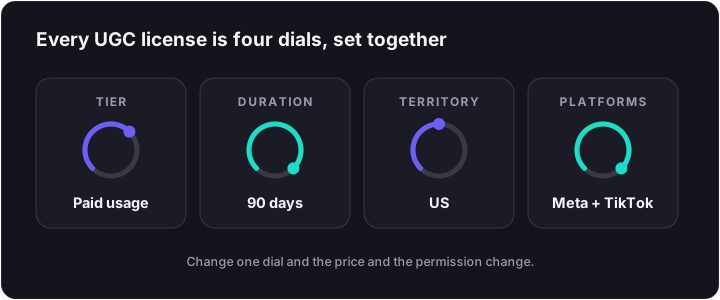
Beyond the tier, every UGC license has three more dials: duration, territory, and platform scope. When a time-limited license expires, you have a binary choice: renew and pay, or pull the content immediately from active campaigns. There is no third option.
Duration. Most DTC brands license in cycles that match the creative's lifecycle. Testing windows run 30, 60, or 90 days. The scaling standard for proven winners is 6 to 12 months. Perpetual licenses exist but many professional creators now refuse them, because they do not want to be tied indefinitely to a product they may stop using.
Territory. A US-only license is cheaper but breaks the moment you point an EU campaign at the asset. If you ship internationally, worldwide rights are mandatory, and they carry a real premium (often a 1.5x to 2x multiplier on the total project fee).
Platform and derivative scope. A tight contract names exactly which platforms the asset can run on (e.g., Meta and TikTok, not YouTube or CTV). If the contract is silent on edits, assume you cannot re-cut, crop, add captions, or chop a 60-second video into three 15-second hooks without going back for permission. Raw-footage access is a separate paid add-on, typically a 30% to 50% surcharge on the base creation rate.
The legal traps that turn a $200 UGC video into a seven-figure problem
Most UGC blowups come from five recurring traps. Five old laws catching up with marketing teams that moved at TikTok speed and skipped the clearance step.
- Platform sound libraries are licensed for personal use. Running them on a brand account is infringement.
- A model release is required for any identifiable person, even a celebrity caught organically with your product.
- A license expires. Leaving the ad up afterwards is "willful," which is the expensive damages bucket.
- Tagging your brand or using your hashtag is not a license. The copyright sits with the photographer and the right of publicity sits with the person in the frame.
- If your paid influencer used an unlicensed song, the record label can sue you, not them.
None of this is new law. Statutory damages for willful music infringement run up to $150,000 per work. Right-of-publicity verdicts have crossed seven figures on a $4,800 original license. And brands are being held vicariously liable for what their influencers posted on their own personal accounts.
Music is the trap that catches the most brands
The misread is simple. Platforms license trending audio to USERS for personal feeds. The instant a business account uses the same track to sell, that platform license stops covering it, and both the record label and the music publisher are owed money.
A commercial track carries two underlying rights, and you need both: a sync license (the underlying composition) and a master-use license (the specific studio recording). You source them direct from the label and publisher, or through a clearinghouse like ASCAP, BMI, or the Harry Fox Agency.
The safe paths for ugc music licensing are short:
- The platform's Commercial Music Library tab (TikTok and Instagram both have one, scoped to business accounts).
- A commercial library subscription (Epidemic Sound, Artlist, Audio Network).
- A directly licensed track, cleared through the appropriate rightsholders.
That is the entire safe set. A few things that do not clear a track:
- Crediting the artist in the caption.
- Re-uploading the song labelled as "original sound" so the bot does not catch it. That tactic appeared in the Crumbl pleadings and is treated as evidence of willful infringement.
- Asking a creator to "just use a trending sound." That puts the brand directly into the contributory-liability column.
Enforcement is automated. AI-driven detection from services like Pex and Audible Magic scans the platforms 24/7. The labels are no longer hunting; the bots find the videos and the lawyers send the complaint.
What "willful" costs in practice
| Brand | Plaintiff | What got sued | Reported exposure | Status |
|---|---|---|---|---|
| Bang Energy (Vital Pharmaceuticals) | UMG and Sony Music | ~286 videos on TikTok, Instagram, YouTube with unlicensed recordings; the "TikTok made it available so it's licensed" defense was rejected | Multimillion (UMG won on vicarious infringement) | Ruled against Bang |
| OFRA Cosmetics | Sony Music | ~329 promo videos by paid influencers using tracks by Mariah Carey, Harry Styles, others | Up to ~$50M in statutory damages | In litigation |
| DSW (Designer Shoe Warehouse) | Warner Music Group | 200+ recordings and compositions in social posts and paid influencer partnerships | >$30M sought | Filed May 2025 |
| Crumbl Cookies | Warner Music Group | 159 recordings by Dua Lipa, Taylor Swift, BTS across 286 instances; the brand allegedly uploaded tracks as "original sound" | Up to ~$23.85M | Agreement in principle May 2026 |
Figures are court filings and reported damages. Statutory damages can reach roughly $150,000 per work for willful infringement under the U.S. Copyright Act.
What "safe music" actually looks like
If you just want the rule: the commercial-music-library tab inside the ad-account version of the platform, a commercial library subscription, or a direct license. Anything else gets the brand into the table above.
Same rules apply to the background music inside a creator's video. Which is why the brief has to forbid trending audio explicitly and require pre-cleared or original tracks only, the no-trending-audio clause that belongs in the brief.
Likeness: a tagged photo is not a yes
The rule. Every identifiable face in a brand asset needs a signed model release that names the scope, the duration, the platforms, and the territory.
Two doctrines stack on top of each other. The Right of Publicity is state law that gives a person control over the commercial use of their name, image, voice, and likeness. The Lanham Act is federal, and it adds a false-endorsement claim if the post implies the person backs the product.
Both apply whether the person is a celebrity or a regular customer caught in the wild. The moment a corporate account posts a person's face to push a product, "we were just sharing" stops being a defense. The venue itself, a brand account, commercializes the message.
What it has cost brands when they skipped the release
| Brand | Person | What the brand did | Reported claim |
|---|---|---|---|
| Duane Reade | Katherine Heigl | Posted a paparazzi shot of her holding the store's bags on the official Twitter and Facebook with a brand caption | $6M (Lanham Act false advertising + NY Civil Rights misappropriation); settled out of court via a charitable donation |
| Samsung | Dua Lipa | Used a festival photo on the TV's retail packaging via a third-party content partner; consumers online began calling it the "Dua Lipa TV Box" | $15M filed May 2026 (right of publicity, false endorsement, trademark) |
| Maree Inc. | Giannis Antetokounmpo | Posted an Instagram photo of him on the bed and called him "our client" in the caption | Suit filed 2023 after ignored cease-and-desist letters; confidential settlement |
Facts as pleaded. Identity rights apply to a recognizable face regardless of how public the original photo was. Samsung's "we got it from a third-party content partner with explicit assurances" defense did not stop the suit.
The two rights inside one photo
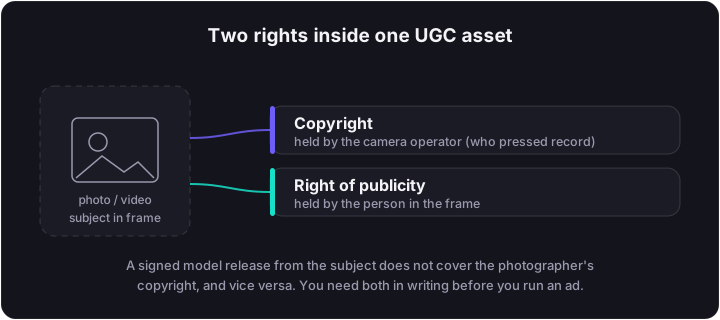
A single UGC photo carries TWO separable rights. The photographer holds the copyright to the image. The person in the frame holds the right of publicity to their face. You need both, in writing, before you publish.
A release from one is not a release from the other. Industry-standard templates exist for this purpose (ASMP, Getty-style); use them.
The expiration trap: yesterday's hit ad is today's lawsuit
A UGC license is a rental with a clock, a map, and a platform list. When the clock runs out, the obligation is binary: renew it (pay) or pull the asset from every channel it ever ran on.
Courts have shown little patience for "we forgot." Leaving a profitable ad running past expiry is treated as willful infringement, which is the maximum-damages bucket. The fail mode is operational, not legal. A media buyer pulls a winning video out of a shared drive months after the license lapsed and reactivates it. The industry calls these zombie ads.
The duration, territory, and platform dials above set the clock. Tracking it is where brands fail.
Generative AI has made the trap worse. Brands are now using AI tools to "extend" an old shoot by inventing new poses or scenes of the same model. That is not a fresh asset. It is an unauthorized derivative work, and it adds reputational-harm claims on top of the IP claim. The honesty rules for synthetic content live in the AI UGC POV, and the limits of what current generators actually output sit in the AI tools breakdown.
Named cases worth knowing
Jason Olive vs GNC. A $4,800 one-year print license in 2010 with an optional second year. GNC brought advertising in-house, missed the renewal, and kept using Olive's image on billboards, kiosks, and social after expiry. When Olive caught it, GNC tried to negotiate a $150,000 extension. He refused. A jury awarded $1.123M: $213,000 in actual damages plus $910,000 for emotional distress.
The Olive takeaway: courts now recognize the personal violation of being forced to be a brand's face against your will, and the damages reflect that.
Francheska Pujols vs Rainbow Shops (May/June 2026). Pujols completed a catalog shoot under a contract that allowed minor edits but forbade new images. After the contract expired, Rainbow allegedly used AI to generate hyper-realistic new poses of Pujols in different settings without consent or compensation. She sued under the New York Fashion Workers Act, claiming the synthetic images, including one of her straddling a barstool, tarnished her reputation.
The Pujols case is the cautionary tale for every brand considering AI as a "free" extension of an old asset. The expired contract did not create permission for synthetic derivatives. It created the cause of action.
Organic UGC: the hashtag is not a license
A customer using your branded hashtag or tagging your account is not granting you a commercial license. The moment a customer hits record, copyright vests in them automatically.
The platform has a license to host the content. That is why Instagram can show it inside the app. The brand does not have one. To repost a customer's photo or video as a paid ad, or even on a product page, you need explicit, documented permission from the copyright holder AND from any identifiable person in the frame.
The consent protocol that holds up: a direct DM or email, plain language, naming exactly where the content will run, requiring an affirmative reply (for example "reply with #BrandYes"). The screenshot of consent is the asset, not the post itself. The acquisition workflow for sourcing customer content this way sits in the customer UGC playbook.
When the brand owned the contest and still lost
Kayla Kraft vs Anheuser-Busch. A friend photographed Kraft drinking a Natural Light beer in a fake mustache. She posted it to Facebook. Anheuser-Busch allegedly obtained the image, possibly through its "Natty Rewards" Facebook contest, and used it on physical coasters and posters for the "Every Natty Has a Story" campaign. She sued for copyright infringement, misappropriation of likeness, and invasion of privacy, seeking actual damages, punitive damages, and disgorgement of profits.
Schroeder and Sumida vs Volvo (2019, settled 2021). Photographer Jack Schroeder did a personal shoot featuring a Volvo S60 with model Britni Sumida and posted to his public Instagram. Volvo asked to use the images for free. Schroeder offered a license fee. Volvo ignored him, then downloaded the photos and reposted them on its official Instagram and Pinterest months later. When Schroeder and Sumida sued, Volvo argued that having a public Instagram and tagging the brand created an "implied non-exclusive license." Volvo even countersued the photographer for trademark infringement over the Volvo logo visible in his own photo of a Volvo. The legal community ridiculed the defense. Statutory damages up to $150,000 per image were sought.
Public visibility is not public domain. A tagged post is not a usage right.
What to scan before you republish
Before any republish, paid ad, PDP photo, or packaging, scan the content for landmines:
- Competitor logos in background or foreground.
- Copyrighted artwork on a wall, a screen, or a t-shirt (album covers, posters, art prints).
- Identifiable third parties (bystanders, kids, pets that read as "someone's").
- Music carried in from the original edit that you cannot clear.
If the UGC was incentivized in any way (contest entry, free product, discount code), confirm the creator included proper FTC disclosure (#ad or #sponsored) on the original post. Missing disclosures land on the brand.
You can be sued for what your influencer did
Hiring an influencer does not move the legal risk to them. Courts have repeatedly held brands directly, contributorily, and vicariously liable for IP violations committed by paid creators on their own personal channels.
Three definitions, plain:
- Direct. The brand posts infringing content to its own account.
- Contributory. The brand knew or should have known and helped (for example, directed the creator to use a specific trending song, or reviewed and approved the video before posting).
- Vicarious. The brand had the right to supervise (could withhold payment, pause campaigns, terminate) and got a direct financial benefit from the infringement.
If your contract gives you approval over the creator's posts, or you pay them based on performance, or you reshare what they made, you almost certainly meet the supervision and financial-benefit tests. The "we didn't know what the influencer did" defense has been losing in court.
What that has actually cost
UMG vs Bang Energy. The court ruled UMG had successfully shown Bang held the requisite control over its TikTok influencers to be vicariously liable for the music infringement. The supervisory hook: Bang reviewed influencer videos beforehand and had the power to withhold payment.
Sony vs OFRA Cosmetics. Sony's case relied heavily on OFRA "actively reviewing, selecting, copying, re-posting, and sharing" the infringing influencer videos. The brand's stated authority to suspend or terminate non-compliant influencers was the supervisory hook the labels needed.
A brand that pays an influencer to make content is legally entangled with that content. The fix is contractual, not after-the-fact, which is what the contract clauses in the vetting workflow are for, and why the ad-format choice in Spark vs Partnership changes which rights stack you are buying.
The pre-flight check before you press launch
One rule per line. Following them prevents the cases above.
- Music: only the platform's Commercial Music Library tab, a commercial library subscription, or a directly licensed track. No trending audio. No "original sound" re-uploads.
- Likeness: signed model release for every identifiable face, covering scope, duration, platforms, and territory. Templates exist (ASMP, Getty-style); use them.
- Two-rights check on every UGC photo: the photographer's copyright and the subject's right of publicity are separate. Get both, in writing.
- Expiration: every licensed asset goes into a tracker with its expiry date. Renew or pull before the clock runs out; "we forgot" is treated as willful.
- Organic UGC: tagging is not consent. Get explicit, documented permission from the copyright holder AND every identifiable person, naming the exact placements.
- Third-party IP scan: no competitor logos visible, no trending audio carried in from the creator's edit, no protected artwork in the background.
- AI alterations: do not use generative tools to extend an expired asset or modify a model's likeness without a fresh, written waiver. That is the Pujols trap.
- FTC: any incentivized content (paid, gifted, discounted) requires proper disclosure (#ad or equivalent). The brand and the creator are jointly liable.
- Influencer contracts: written clauses requiring proof of cleared rights before posting, the right to audit, and indemnity from the creator if a third-party claim lands.
The license tiers and durations above feed this checklist, whitelisting adds its own monthly access fee, and the place these rules get written into the production process is the creator brief.
When to call an actual lawyer
This is orientation for brands, not legal advice. Anything specific goes to qualified counsel before publication: a takedown notice received or sent, a contested model release, a campaign featuring celebrity talent, an international run, a regulated category (health, finance, legal), or any AI-generated likeness.
An hour of clearance review is decimals of a percent of the exposure on a single Warner-scale suit. This is a strict-liability environment with AI-powered detection running 24/7, and the cost of the wrong assumption has decisively moved past "minor oversight."
UGC usage rights handled inside production
Honest diagnosis. A careful brand can manage rights with templates and a spreadsheet for a handful of assets. At ad volume, dozens of licensed videos in rotation, music cleared per cut, expiries staggered across creators, influencer contracts that actually shift exposure, the rights layer becomes a job. One missed renewal or one trending-audio slip is far more expensive than getting help.
If you want the music, releases, and renewals handled inside the production process instead of bolted on afterwards, see how we run UGC production with the legal layer built in.
You
Can you look at our ads?
Want this read on your own ads?
We pull your live ads from the Meta Ad Library, set them next to the longest-running ads in your category, and send back what we'd change and test next. The teardown is free.
Get my free creative teardownWe usually reply within one business day.