AI UGC for Ecommerce: Where It Works, Where It Backfires
When AI UGC actually earns its place (and when it costs you the sale)
AI-generated UGC is the cheapest way to test a lot of ad ideas fast, and a reliable way to lose the conversion if you point it at the wrong stage of the funnel. The honest rule the best DTC teams run: use AI to find the winning angle, use a real human to scale it. AI for volume, humans for hero.
"AI UGC" here means synthetic-creator or AI-avatar video that mimics handheld, shot-on-a-phone UGC, generated by tools instead of a person on camera. It is a testing and amplification layer, not a replacement for the human asset that closes trust-sensitive sales.
Two forces decide each call. Cost and speed pull you toward AI hard, since per-unit costs collapse roughly 90% and turnaround drops from weeks to minutes. The trust and conversion penalty pulls you back to humans, especially when skepticism is highest at checkout. Funnel stage and product category decide which force wins on any given asset.
The real question is the decision, not the tool list. If you want the matrix of AI UGC tools and what each one can actually render, that lives elsewhere.
What AI UGC genuinely does well
When the job is "produce many message variants cheaply and fast," AI wins outright, and it is not close. Four capabilities do most of that work.
- Volume and variant testing. Dozens of hook, angle, and avatar permutations from a single base script in a few hours, with near-zero marginal cost per extra variant.
- Cost collapse. Per-video effective cost drops to roughly $1 to $30 once spread across a SaaS subscription, versus $150 to $500 base (and $280 to $815 fully loaded) for a human creator.
- Speed. Minutes to hours from prompt to render, versus 7 to 21 days for traditional UGC. That matters because ad novelty burns out in roughly 7 to 10 days on Meta and TikTok.
- Localization. A single English video translated into 100-plus languages with the original voice preserved and lip-sync rebuilt at the pixel level, which turns global expansion from a dubbing project into a toggle.
AI vs human UGC: the baseline tradeoff
| Dimension | AI-generated UGC | Human-produced UGC |
|---|---|---|
| Per-video cost | ~$1 to $30 effective | ~$150 to $500 base, ~$280 to $815 fully loaded |
| Turnaround | Minutes to hours | 7 to 21 days |
| Hook rate / CTR | Roughly matches human (~85 to 110% of human CTR) | The historical baseline |
| Bottom-of-funnel CVR | Lower; trails by ~15 to 30% on trust-led concepts | Higher; converts the trust-sensitive sale |
| Best funnel stage | Testing, hook discovery, high-volume rotation | Closing, scaling proven heroes |
These are relative findings from 2025 to 2026 DTC field tests (notably the AdProofEngine and segwise.ai aggregates) and vary by AOV and vertical. Cost is effective per-video at volume, not list price. The line-by-line breakdown of human UGC costs is in its own post.
The one place the numbers nearly tie: the hook
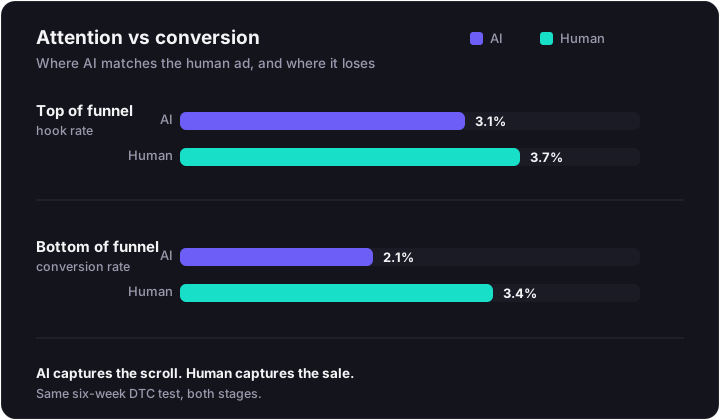
At the top of the funnel, the first three seconds, AI and human content perform within a hair of each other. One widely cited six-week DTC split test put human creators at a 3.7% hook rate and 1.7% CTR while AI-generated creatives hit 3.1% and 1.4%, close enough that the lower production cost wins on math.
The real advantage is not that any one AI ad beats a human ad. It is that AI lets you test 30 to 50 hooks for the price of a single human shoot, which surfaces statistical outliers a slower workflow would never find. Industry estimates put cost-per-hook-tested around $400 with humans and under $5 with AI. The batch sizing and kill thresholds belong in the testing at volume writeup.
Where AI UGC backfires: the trust deficit
AI closes attention but loses the sale when trust is the deciding variable. At checkout, skepticism is highest, and the consumer brain registers micro-expression failures, off lip-sync, and a boardroom-smooth cadence as a forgery. That is the uncanny valley, and it taxes conversion subconsciously before the cart page even loads.
The empirical gap shows up consistently. Across trust-led concepts, traditional human creators win on pure conversion by roughly 15 to 30%. A larger 2025 cross-account analysis cited by Zocket put Tier-1 human UGC CVR at 2.3% to 3.1% versus 1.8% to 2.2% for high-quality AI creative, and inbeat.agency framed authentic UGC as driving up to a 161% lift relative to the worst synthetic comparators (a wide range, but the direction is steady).
The second-order penalty is worse. A December 2024 NielsenIQ EEG and eye-tracking study found visibly synthetic ads pushed memorability into the bottom 25% of assets tested and damaged the broader brand halo on appeal, credibility, and emotional impact. A Kantar Media Reactions report measured a 39-point perception gap: 71% of marketers were unbothered by AI ads, while 44% of consumers were actively bothered and 57% expressed concern over fake GenAI testimonials.
The "AI Info" label is its own tax
Beyond the uncanny tells, the platform-required AI label itself deters buyers. Sybrid's read of 2026 ad data found the mandatory "AI Info" tag can cut engagement 15 to 30% on ultra-realistic synthetic video, and a Billo-cited consumer study put it bluntly: 52% of viewers say they reduce engagement with content they suspect is AI-generated. Even a flawless synthetic ad pays a disclosure tax at the top of the feed.
What AI still physically can't fake
The "product in hand" moment, rubbing in serum, twisting a cap off a bottle, a real skin reaction, is exactly where AI breaks. Current video models lack physics grounding, so hands fuse fingers, product labels scramble into illegible glyphs, and a bottle can morph mid-rotation. For any ad whose proof IS the physical demonstration, a human is still mandatory. The technical tells and which tools (Kling 2.6 Pro, MakeUGC, EzUGC) actually reduce them are covered separately.
The decision: when to reach for AI, when to book a human
The AI-versus-human call is not a taste question, it is a lookup against four variables. Pull the right one for each asset and the budget stretches. Pick wrong and you either spend $500 to test a hook (wasteful) or trust a synthetic avatar to close a $200 supplement sale (worse).
AI or human: a quick lookup
| Variable | Lean AI when... | Lean human when... |
|---|---|---|
| Funnel stage | Cold prospecting, hook testing, top-of-funnel volume | Conversion, retargeting, deep testimonials, hero scale |
| Product category | Low-trust, visual, lower-ticket (fashion, accessories, basic home, apps, SaaS) | High-trust, ingested or applied, premium (skincare, supplements, fitness, pet health, luxury). Strictly human for regulated services (finance, medical, legal) |
| Creative's job | Throwaway test asset (80% will lose anyway) | The proven hero that gets most of the budget |
| Spend tier | Bootstrapped (under $10k/mo) where human test minimums are unaffordable | Scaling and enterprise; at $10k to $50k/mo, a 70/30 AI-to-human split reserves human dollars for the hero |
These are defaults, not laws. AOV, margin, and brand maturity move the line, and regulated categories are a hard human rule for compliance reasons (FINRA, FTC, state medical boards), not aesthetics. Whether UGC pays off for your margin and AOV at all is a separate, earlier question.
The category line matters in particular. App marketers using AI UGC have reported up to 350% higher engagement and 46% lower cost per install (Superscale data), because the buyer cares about price and aesthetic, not the emotional authenticity of the presenter. A supplement buyer cares about exactly the opposite. This is also why human-led creator content carries the trust premium it does.
Why the smart play is sequenced, not either/or
The hybrid that actually works runs in order, not in parallel.
- AI testing layer. Generate 30 to 50 cheap variants across hooks, angles, avatars, and demographics. Push them live.
- Cull on TOFU metrics. After 48 to 72 hours of spend, kill the bottom 50 to 80% based on hook rate and CTR. The algorithm tells you which message wins.
- Extract the script. Pull the exact pacing, opening line, and visual structure of the AI winner into a tight creator brief.
- Human reshoot for the hero. A real person executes the validated concept. Because the script is already market-proven, the risk on the human budget drops to near-zero.
Agencies running this loop report human UGC produced AFTER an AI validation phase converting roughly 28% higher than human content shot on intuition, with human acquisition costs dropping roughly 30% on the same accounts (Reddit-aggregated agency teardowns and AdProofEngine). State the principle here. The creative pipeline post handles the operating mechanics: batch sizing, naming, kill thresholds, cadence.
Where AI quietly belongs even on a winning human ad
Even when a human shot the hero, AI does the unglamorous amplification work most teams skip. Re-cut aspect ratios for every placement, generate b-roll cutaways to boost the 3-second hold rate (Mammoth Agency teardowns put that lift around 25%), clone the voice to test new verbal hooks over the existing footage, and localize the asset into more languages. This is the lowest-risk, highest-yield AI use, and most brands underuse it. What re-cuts matter between platforms is its own writeup.
The disclosure rules you cannot skip
Undisclosed AI is no longer a gray area. It is an account-and-legal risk. Three things must happen on every synthetic asset.
- Double disclosure on sponsored content. Label both the paid relationship AND the synthetic nature. In Meta Ads Manager, flip the "AI Info" checkbox. In TikTok Ads Manager, apply the AI Disclosure tag. For organic branded content, also enable the in-app AIGC toggle and the "Paid partnership" toggle.
- No first-person experience claims from a synthetic persona. The FTC's Final Rule on fake reviews (in force since October 2024) bans an AI avatar from saying "I lost 15 pounds" or "this cleared my acne," because no such person exists or used the product. Script in third person: "Customers report measurable weight loss," "Clinical studies show..."
- Burn an on-screen AI label into the asset. Platform metadata alone does not satisfy New York's Synthetic Performer Disclosure Law (in force June 2026) or the EU AI Act's Article 50 transparency provisions (August 2026). Hardcode a visible label into the first three seconds, and embed C2PA Content Credentials in the file.
The stakes are not abstract. Each FTC violation now carries a maximum civil penalty of $53,088, and the agency stood up a dedicated AI enforcement unit in early 2026 (the Air AI matter settled at $18 million, largely suspended). On the platform side, the failure mode is faster: ad rejection on submission, a policy strike, a 24-hour account hold on a second Meta violation within 90 days, and on TikTok a retroactive flag triggering a 35 to 45% reach penalty.
Disclose it right: Meta vs TikTok
| Step | Meta (FB / IG) | TikTok |
|---|---|---|
| The toggle | "AI Info" checkbox in Ads Manager; advertiser self-declaration | "AI Disclosure" tag at the ad level; plus the in-app AIGC toggle for organic |
| Penalty if you skip it | Ad rejection + policy strike; 24h account hold on a second violation within 90 days | Takedown, posting restrictions, ~35 to 45% reach penalty if retro-flagged, escalating to bans |
| First-person experiential claims from a synthetic avatar | Banned (FTC + platform policy) | Banned (FTC + platform policy; virtual influencers explicitly prohibited) |
Rules reflect 2026 platform policy and the FTC Endorsement Guides. Verify current language before launch.
The deeper statutory map (the NO FAKES Act, Tennessee's ELVIS Act, California AB 2602 and AB 1836, music licensing) lives in the likeness and cloning post. The contract clauses to secure before any creator (human or cloned) appears in an ad live in the usage rights writeup, including the AI-likeness clause every 2026 brief now needs.
One honest caveat: the false-positive problem
The detectors are not perfect. Independent benchmarking puts AI-detector false-positive rates at 2 to 15% on typical content, scaling to 61% under adversarial conditions, and heavy edits, smartphone HDR, and computational photography routinely trip the classifiers on entirely human-shot footage. A wrongful "AI Info" label still depresses engagement, and TikTok's lost-reach window is not reinstated even when an appeal succeeds. Keep raw files, dated production logs, and BTS photography on every shoot. That is the evidence pack the appeal process actually requires.
Getting AI and human UGC to work together
AI did not kill the human creator. It changed the job. The brands winning in 2026 run a disclosed, sequenced hybrid: AI to find the angle and amplify the winner, humans to carry the trust-sensitive moments and the regulated categories where a synthetic spokesperson is a non-starter.
The hard part is operational, not philosophical. Knowing which of the four variables says AI versus human on each asset, building the testing layer so the AI tier actually surfaces winners, and handling disclosure with enough rigor that an account does not get throttled the week your scale ad lands. That is the work we run for DTC brands inside our UGC agency workflow: AI and human together, sequenced and disclosed.
You
Can you look at our ads?
Want this read on your own ads?
We pull your live ads from the Meta Ad Library, set them next to the longest-running ads in your category, and send back what we'd change and test next. The teardown is free.
Get my free creative teardownWe usually reply within one business day.