Why Creative Is the New Targeting in Paid Social
For a decade, performance creative was the payload and the audience was the lever. You picked the cohort with interests, lookalikes, and demographic gates, and the ad was whatever you shipped into that box. By 2026 that arrangement has inverted. Meta's Andromeda and TikTok's Smart+ now read the ad first and pick the audience themselves.
The mechanism matters more than the craft here: how the retrieval engines actually evaluate your ads, why two visually similar creatives are treated as one ad, and why angle volume (not asset volume) is the lever left on the dashboard. The 12-format playbook, the testing structure, and the spend-tier production math live on their own pages.
The answer in two lines
Meta's Andromeda and TikTok's Smart+ now read the visual, textual, and semantic signals of your ad and pick the audience themselves. The remaining lever is angle volume: 15 to 50+ semantically distinct creatives running at once, refreshed every 7 to 11 days.
Targeting got automated away
Three things happened in sequence.
First, deterministic tracking broke. Apple's App Tracking Transparency in iOS 14.5 and the rolling iOS updates that followed severed the feedback loops that populated interest and lookalike audiences. Across Meta and Google, CAC has inflated by up to 40% year over year as a direct consequence.
Second, the platforms pivoted to probabilistic intent modeling. If you cannot follow a user around the web, you have to infer intent from how they behave on your platform: a 2-second scroll pause, sound-on, a click. On-platform engagement became the highest-fidelity signal available, which made the ad itself (the thing being engaged with) the most informative input the system has.
Third, every major buying surface absorbed targeting into a black box. Meta shipped Advantage+ Shopping and the Lattice discovery engine. Google leaned into Performance Max. TikTok launched Smart+. The "targeting knobs" quietly disappeared from the dashboard.
The punch line is simple. When every advertiser is buying through the same automated system, the only lever any of them controls is the creative payload fed into it.
A note on what does NOT substitute. Server-side data plumbing (CAPI, conversion event quality) is now table stakes because the algorithm uses those signals to value your ad. Get that wrong and even great creative gets misjudged. Get it right and you still need angle diversity to scale. The pixel and the canvas are different problems. More on the data layer in server-side tracking, and the CAC math context in customer acquisition cost.
How Meta Andromeda actually reads your ads
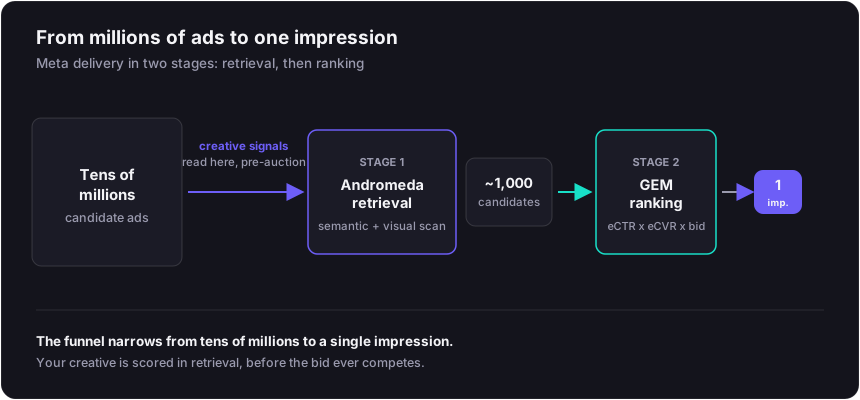
Andromeda split Meta's delivery into two stages, and the order of those stages is what matters.
Stage 1 is retrieval. Andromeda is the gatekeeper, built on NVIDIA Grace Hopper Superchips, sifting tens of millions of candidate ads in a few hundred milliseconds. Per Meta's own engineering writeup, the upgrade delivered a 10,000x increase in model complexity and 100x faster feature extraction. It narrows the field to roughly 1,000 candidates per impression opportunity.
Stage 2 is ranking. The Generative Ads Recommendation Model (GEM) takes those 1,000 candidates, calculates expected value (eCTR, eCVR) factored against the advertiser bid, and picks the auction winner.
Andromeda evaluates the creative BEFORE the auction. It uses computer vision and semantic analysis to read visual format, opening hook, tone, and subject matter, then predicts which specific users will find it relevant in that moment. The advertiser-defined audience is no longer a hard constraint. It is a soft bias.
Tight targeting is now actively harmful. Narrow age brackets and niche interests shrink Andromeda's exploration space, prevent it from finding cheaper user pockets, and drive CPMs up. The system needs room to roam.
The campaign architecture that protects this exploration space (and the ABO shells used to test new creative without poisoning the learning phase) sits on account structure.
How TikTok Smart+ does the same thing
TikTok built parity with Meta's retrieval logic but leans even harder on engagement velocity. TikTok behaves less like a social graph and more like a broadcast medium, so Smart+ amplifies content strictly based on watch time, completion rate, comment velocity, and shares.
Smart+ rolled fully through 2025. It pairs with TikTok's generative suite, Symphony, which powers Recommended Creatives, Auto-select, and auto-dubbing of top performers into other languages. Drop a product URL into a Smart+ web campaign and the system can generate scripts, voiceovers, avatars, and a rotating gallery of variants on its own.
Two operational pre-reqs sit underneath all of that. Smart+ requires downstream event optimization (purchases or subscriptions) and a strict minimum of 50 conversion events per week to exit learning.
The punch line: if your creative does not earn engagement in the first hours of distribution, it will not be distributed further, no matter what you bid.
| Specification | Meta Advantage+ Shopping (ASC) | TikTok Smart+ |
|---|---|---|
| Core AI engine | Andromeda (retrieval) + GEM (ranking) | Neural retrieval + Symphony generative suite |
| Retrieval methodology | Semantic intent clustering (Entity ID by visual/textual meaning) | Engagement velocity matching (watch time, share rate, comment volume) |
| Primary targeting lever | Diversified visual formats, varied psychological angles | High-volume, native-feeling short-form video |
| Creative lifespan | ~21 days before severe fatigue | 7 to 10 days at peak |
| Recommended refresh | 10+ active creatives; 2 to 4 refreshes/month | Deep rotating pool; 3 to 5 new variants/week |
Entity ID: the fingerprint that decides whether your ads compete or collude
Every ad you upload gets scanned by Andromeda and assigned an Entity ID, a semantic fingerprint based on visual meaning, messaging, and stylistic similarity. The system slots ads into a hierarchical tree by that fingerprint.
This breaks the testing math most teams still use.
One hero image with six headline variants is not six tests. Andromeda categorizes all six under a single Entity ID. You ran one ad, six times, and split the budget against yourself.
In late 2025 Meta surfaced this backend logic directly in Ads Manager via two new metrics: the Creative Similarity Score and Top Creative Themes, which buckets ads into categories like humor, nostalgia, and savings. Practitioner data from that period puts the penalty threshold at a Creative Similarity Score above 60%. Above that line, the system triggers retrieval suppression.
The prescription (how to design genuinely different angles, the format mix, the messaging matrix) sits on creative strategy.
Branch-Cutting: why one ad eats 95% of your budget
Branch-Cutting is the routing rule that follows from Entity ID. When the system identifies a cluster of semantically similar ads, it evaluates the cluster and unilaterally kills delivery to all but one. The metaphor Meta practitioners reach for is a gardener pruning a tree: instead of letting redundant branches compete for water, the algorithm snips them and redirects the budget to the thickest one.
Inside a high-Similarity ASC, Branch-Cutting can funnel up to 95% of the budget into a single hero ad. The other ads receive zero spend. Three consequences for the buyer:
- An artificial ceiling on scale, because only one creative is being delivered.
- Auction cannibalization spiking CPMs, because your own ads are bidding against each other for the same impression pool.
- Wasted production cost on the variants that never see distribution.
The fix is not "ship more ads." The fix is to introduce a creative with a Similarity Score below 60% relative to the current winner. That is the actual lever to break a plateau.
A worked example. You have a winning UGC video of a creator using your product in a kitchen. You shoot five additional clips: same creator, same kitchen, same product, different opening lines. Andromeda fingerprints all six as one Entity ID. Branch-Cutting picks the strongest and starves the other five. To break the ceiling you need a structurally different angle (a founder-led origin story, a comparison-style breakdown, a before/after transformation) that earns its own fingerprint and opens a new audience pocket.
Angle volume is the real scaling lever
To give Andromeda and Smart+ enough data points to map distinct audience pockets, an optimized account needs 15 to 50+ active, semantically distinct creatives running at once. Practitioner correlations are stark: accounts testing 20 or more genuinely distinct ads per month report up to 65% higher ROAS than accounts testing fewer than 10, with a 32% efficiency lift and an 8% incremental reach improvement against accounts running similar creatives.
The math underneath that is unforgiving. A 2026 benchmark from Sepia analyzing more than 550,000 ads and $1.3 billion in spend across 6,000+ advertisers found that only 5 to 8 percent of ads become statistically significant winners. Roughly 6 percent of ads drive the majority of total spend. About half of all ads launched receive zero or minimal delivery, regardless of production effort.
Volume is mathematical, not optional. If the win rate is fixed in the single digits, the only path to more winners is more shots on goal.
| Diversity tier | Reported ROAS impact | Reported efficiency / reach impact | CPM behavior |
|---|---|---|---|
| 20+ distinct ads/month | Up to 65% higher ROAS | 32% efficiency lift; 8% incremental reach | Stable; algorithm has room to explore |
| Fewer than 10 distinct ads/month | Baseline | Baseline | 15 to 40% CPM rise for low-diversity campaigns under 50 conversions/week |
Concept volume by spend tier (sub-$10k all the way to $1M+) is the scaling page's job. Full tier-by-tier production math is on scaling paid social, and the testing structure that turns raw volume into validated winners is on creative testing.
What "semantic diversity" actually means (and what it doesn't)
The phrase "more creative" gets misread as "more variations." It is not.
Diversity is angle-level, not asset-level. The mental model that practitioners use is P.D.A. (Persona, Desire, Awareness), mapping each ad to a distinct combination so the system reads it as a separate Entity ID. Background-color swaps, font tweaks, and minor headline rewrites do not earn separate fingerprints.
Two concrete examples, same product:
- Angle A: social status for a younger buyer. Creator-led, fast cuts, peer validation framing.
- Angle B: time-saving utility for an older buyer. Founder explainer, walkthrough pacing, "before/after" of a daily routine.
Same SKU, same offer, different fingerprints. Andromeda treats them as two creatives mapped to two audience pockets. Now the algorithm has somewhere to send each one.
The full 12-format matrix (founder-led, UGC, BTS, anti-ad, comparison, VSL, and the rest) and the funnel-stage mapping for each format sits on creative strategy.
The fatigue clock is shorter than the playbook you remember
Because Andromeda reads creative patterns directly, it identifies repetition faster than the legacy systems did. The old 14 to 30 day refresh rule is dead.
A 2026 analysis of 47 ad accounts spanning $5,000 to $180,000 in monthly spend puts the median time-to-fatigue at 8.3 days for static assets and 11.7 days for video. Meta's own frequency thresholds reinforce the same compression: above 2.5 the algorithm throttles delivery, and a 7-day frequency above 3 compounds fatigue dramatically.
The operational rule that falls out of that:
- 3 to 5 net-new concepts injected every 7 days, or
- 2 to 4 major refreshes per month.
The diagnostic detail (hook rate decay as the leading indicator, CTR decay 3 to 5 days behind it, CPM creep above 10%, and the low-thumbstop / high-CTR vs. high-thumbstop / low-CTR diagnostic matrix) belongs on the testing framework. The hybrid architecture that injects new creative through ABO test shells without resetting ASC learning phase sits on account structure.
So what do you actually change?
Six adjustments fall directly out of the mechanism.
- Stop over-constraining audiences. Hand Andromeda a wide exploration space. Tight targeting is now a tax, not a precision tool.
- Invest in a pipeline that ships distinct angles weekly, not asset variants. The unit of testing is the concept (P.D.A. coordinates), not the file.
- Use separate ABO test shells for unproven creative so failures do not reset your ASC learning phase. Graduate winners into the primary campaign only after they prove out.
- Diagnose with leading indicators. Hook rate and CTR decay tell you a creative is dying 7 to 14 days before ROAS does. Waiting for the lagging metric burns budget you do not need to burn.
- Treat server-side tracking as table stakes. CAPI signal quality is what the algorithm uses to value your ad. Clean signal in, sharper retrieval out.
- Measure win rate at the CONCEPT level. A single concept often needs 4 to 6 iterations to isolate the variable that drives conversion. Counting assets misses that compounding.
Each of those threads has its own page. Start with how to build distinct angles, the testing structure that validates them, the scaling mechanics that absorb more volume, the account architecture that protects learning, and the signal layer feeding all of it.
Where this is going (and what stays true regardless)
Meta's GEM is moving toward full multimodal evaluation, processing text, imagery, audio, and video together inside the same recommendation pass. The practical implication for advertisers is that platform capacity to absorb and optimize creative variation will become functionally limitless. The constraint will move further down your own org chart.
The downstream economic note from the practitioner research is already visible: DTC budget is rotating from polished media-buy overhead toward creator-led, in-house content engines, because shipping 100+ concepts a month favors agility over polish. Embedded creators and nano/micro-influencer networks are absorbing the spend that used to fund production retainers.
What stays true regardless of the next model release: the lever is the creative, and the constraint is angle volume. Every algorithmic upgrade in the last two years has reinforced that, not weakened it.
The question this leaves you with
The mechanism is now public. The math is unforgiving. The hard part is the production cadence.
You have two roads. Staff and operate a pipeline capable of shipping 30 to 80+ genuinely distinct concepts per month, with the briefing, casting, editing, tagging, and diagnostic loop that turns raw volume into validated winners. Or partner with a team built to do exactly that, like our UGC agency for creator-led concepts.
If the pipeline question is where you are stuck, that is the work we do at our performance creative practice. If the gap is the angle work itself (which concepts to brief, and why), that is creative strategy rather than production. If you suspect the leak is upstream of production (account structure, signal, fatigue management, or where budget is actually going), start with a paid media audit before adding more output to a system that cannot absorb it.
You
Can you look at our ads?
Want this read on your own ads?
We pull your live ads from the Meta Ad Library, set them next to the longest-running ads in your category, and send back what we'd change and test next. The teardown is free.
Get my free creative teardownWe usually reply within one business day.