Meta CAPI for DTC: Server-Side Tracking That Scales
Server-side tracking for ecommerce is the difference between an algorithm that can see your buyers and one that can't. In 2026, browser-based Pixels routinely lose 20% to 40% of conversion signal to iOS ATT, Intelligent Tracking Prevention, and ad blockers, and Meta's optimization engine can only act on what it sees. The fix, in build order: hybrid Pixel + Conversions API, hashed Advanced Matching, an Event Match Quality score above 7, and the right routing layer for your scale.
What server-side tracking actually does
Server-side tracking sends purchase and event data from your store's server straight to Meta, bypassing the browser. The Pixel still fires; CAPI runs alongside it; hashed PII matches the buyer server to server; a shared
event_idprevents double counting. The payoff is signal the algorithm can actually optimize against.
Three jobs, in order of impact: recover the events browsers drop, raise Event Match Quality so Meta can connect those events to real users, and feed enough volume into each ad set that the learning phase actually ends.
Everything downstream, every dashboard, every model, every scaling decision, depends on this layer being clean.
Why weak signal starves the algorithm
The browser is hostile territory. Safari's ITP truncates cookies, Chrome is deprecating third-party cookies entirely, iOS ATT killed cross-app deterministic tracking, and ad blockers intercept Pixel scripts before they fire. The cumulative loss runs as high as 40% of actual conversions, depending on traffic mix.
That gap matters because Meta's ad sets need roughly 50 conversion events per week to exit the learning phase and stabilize delivery. Lose 30% to 40% of your signal and a $30 CPA ad set that should be hitting that threshold on a $1,500 weekly budget will look learning-limited indefinitely. CPMs climb, delivery wobbles, and the system never gets a clean look at who actually buys.
This is the same diagnostic frame that drives account consolidation: thin signal forces simpler structure, and broken data is one of the most common reasons brands hit a wall in paid-social scaling.
How Meta CAPI works (the three-part contract)
Every CAPI implementation, whether you build it yourself or pay a managed router, satisfies the same three requirements. Skip any one of them and the pipe leaks.
Standardized event names
Meta expects the literal string Purchase. TikTok expects CompletePayment. Custom event names work technically but quietly opt you out of the platform's automated bidding optimizations, because the algorithms are trained on the standard taxonomy. Use the canonical names or accept that you are flying with one engine.
SHA-256 hashed PII payload
Because the server bypasses browser cookies, Meta needs alternative identifiers to match a conversion to a user in its graph. The platform accepts SHA-256 hashed personally identifiable information: email, phone, first and last name, city, zip, plus weaker identifiers like IP address and click ID.
SHA-256 is a one-way cryptographic fingerprint. The raw email never crosses the wire; Meta receives the hash, recomputes the hash on its own user records, and matches if they line up. This is the single biggest lever for raising your Event Match Quality score.
Event deduplication via event_id
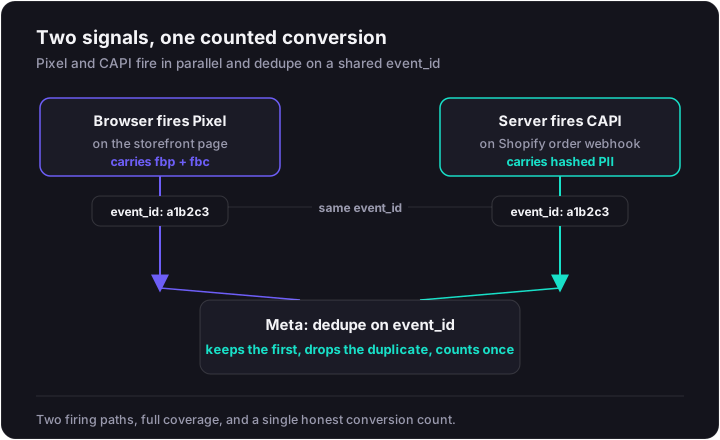
The recommended deployment runs Pixel and CAPI in parallel. Both fire, both send the same conversion, and both payloads carry an identical event_id. Meta processes the first arrival and discards the second.
Skip the shared event_id and Meta will count one purchase as two. TikTok in particular does not handle dedup natively, so any mismatch produces immediate over-reporting and the inflated ROAS that comes with it.
Event Match Quality: the score that decides whether CAPI was worth it
Event Match Quality, EMQ, is a 1-to-10 score Meta assigns each tracked event based on how well it can connect that event to a real user. A clean CAPI pipeline that sends only an email hash will sit around a 4. A pipeline that sends email, phone, name, city, zip, IP, fbp, fbc, and external_id, all hashed correctly, can push past 8.
Your target is 7.0 or higher on Purchase, then on AddToCart and InitiateCheckout. Below 7, Meta is matching slowly and incompletely, learning phases drag, and the cost benefit of CAPI collapses.
The lift is real when the score is real. Advertisers running properly configured CAPI report an average 17.8% lower cost per result on Meta compared to Pixel-only setups, and TikTok's Events API delivers roughly 13% more captured events. Those numbers assume strong match quality, not just a pipe that exists.
What drags EMQ down: sparse Advanced Matching fields, raw rather than hashed values, missing IP or click ID, and aggressive EU consent gating that strips identifiers before they ever reach the server. The last point matters for any brand with meaningful EU traffic; GDPR compliance requires the Consent Management Platform to extend to server-side signals, not just the browser.
Advanced Matching: what to actually send
More identifiers per event means a higher match rate. Send everything you have, hash it correctly, and let Meta's matching engine do the rest.
| Field | Strength | Source in a Shopify checkout | Mandatory or recommended |
|---|---|---|---|
| Email (hashed) | Strong | Customer object on order | Mandatory |
| Phone (hashed) | Strong | Customer or shipping address | Mandatory |
| First / last name (hashed) | Medium | Billing address | Recommended |
| City (hashed) | Medium | Billing address | Recommended |
| Zip / postal code (hashed) | Strong | Billing address | Mandatory |
| Country (hashed) | Weak | Billing address | Recommended |
| IP address | Medium | Request headers on checkout | Mandatory |
| User agent | Weak | Request headers | Mandatory |
| fbp (browser ID cookie) | Strong | First-party cookie set by Pixel | Mandatory |
| fbc (click ID cookie) | Strong | URL parameter on ad click | Recommended when present |
| external_id (hashed customer ID) | Medium | Shopify customer ID | Recommended |
If a field is empty for a guest checkout, leave it out rather than sending blanks. Meta scores on what arrives, not on what was attempted.
The hybrid Pixel + CAPI architecture
Pixel and CAPI are not alternatives. They are complements, and the strongest setups run both at once.
The browser-side Pixel fires on the storefront page. It captures the things a server cannot see directly: the fbp cookie, the fbc click-ID parameter, the user agent, the page context. The server-side CAPI fires on the Shopify order webhook, the moment the transaction is confirmed, and it carries the hashed PII the browser does not always have time to surface. Both payloads share the same event_id. Meta processes whichever arrives first and drops the duplicate.
The result is coverage the browser alone cannot deliver. Pixel handles the easy cases; CAPI rescues the ones blocked, truncated, or dropped by ITP, ATT, or an ad blocker. Together they outperform either alone, and the deduplication keeps your reported conversion counts honest.
Picking the routing layer: managed vs. GTM vs. native
You can hand-code CAPI against the Meta endpoint, but most brands route through a managed layer. The right choice depends on Shopify fit, monthly volume, and who on your team can maintain it.
| Option | Best fit | Monthly cost | Who runs it | Anti-use |
|---|---|---|---|---|
| Meta One-Click CAPI (native) | New / low-volume brands, non-technical teams | $0 | Native in Events Manager | No custom events; limited control |
| Stape (server-side GTM hosting) | Brands with GTM expertise, mid-market | ~$17-$20 | In-house GTM owner or agency | No GTM skill in the building |
| Admaxxer / SignalBridge-class | SMB to mid-market, no dedicated data eng | ~$9-$29 | Marketing ops, no-code | Complex multi-property routing |
| Elevar (managed) | Shopify Plus, subscription stacks, $1M+ GMV | $0-$950+ by order volume | Managed with light agency support | Non-Shopify storefronts |
| Custom-coded in-house | Enterprise, headless, unusual stack | Engineering cost | Internal data engineering team | Anything that fits the options above |
Meta's One-Click CAPI, launched in 2026, removed the financial and technical barrier for small brands and is universally cited as the right starting point when nothing custom is required. Stape carries a 4.0/5 on Trustpilot and a 73% five-star rate on Shopify but assumes you can configure GTM containers. Elevar is the Shopify Plus default because it handles Markets, headless, and subscription tools like Recharge and Skio out of the box, and reduces clean-store onboarding to one or two hours.
A clean implementation here is usually step one in any paid media audit we run before touching ad structure, and it sits in the base scope of our paid media service.
TikTok Events API, briefly
Same three-part contract, different gotchas. TikTok requires the CompletePayment event name. It does not handle deduplication natively, so any event_id mismatch between Pixel and Events API produces over-reported conversions and inflated ROAS. The same managed routers, Stape, Elevar, Funnel, cover TikTok alongside Meta.
The rule is simple: wire it if and only if you have real TikTok spend. The implementation effort is non-trivial and tools like Event Inspector exist mostly because debugging missing event IDs is the standard pain point.
The mobile blind spot: SKAN and MMPs
Web CAPI does nothing for a native iOS app. Apple's App Tracking Transparency collapsed IDFA-based deterministic attribution, and SKAdNetwork plus AdAttributionKit replaced it as the privacy-preserving framework for app installs and in-app conversions.
App-driven brands work through a Mobile Measurement Partner: AppsFlyer is the market leader, with Adjust, Branch, and Singular as the other serious options. The MMP handles deep linking, SKAN postbacks, cross-device attribution, and fraud filtering. The web CAPI stack still matters for your storefront, but the app layer sits on top of it, not inside it.
What good looks like: a concrete before-and-after
A mid-market apparel brand scaling from $15,000 to $40,000 per month on Meta is a clean illustration of how much rests on this data layer.
Before: legacy Pixel only, 16 ad sets stretched across 5 segmented campaigns, budgets so thinly spread that no single ad set hit 50 weekly purchases. Ad sets sat in learning-limited status. CPA was stuck at $65 and platform ROAS hovered around 1.8x.
The rebuild started with the plumbing. They integrated CAPI alongside the Pixel, passed full hashed Advanced Matching on every event, verified deduplication in Events Manager, and pushed Event Match Quality on Purchase to 8.2. Only then did they consolidate the account: one Advantage+ Shopping Campaign holding 70% of budget, a separate CBO sandbox for creative testing, and a small DPA campaign for 7-day cart abandoners.
Inside six weeks, with no change to creative quality, CPA dropped 23% to $42 and delivery stabilized. The consolidation is what's usually credited, but the consolidation only worked because the data layer could finally support it. Pooling 100+ weekly conversions into a single campaign is meaningless if a third of them are invisible to the algorithm.
The same rebuild is what makes both consolidated structure and creative-led targeting viable. Andromeda reads the asset and matches it to audience pockets, but it can only learn from events it actually sees.
Implementation order: what to wire, in what sequence
A prioritized checklist beats a one-shot rebuild every time. Work top to bottom.
- Stand up the browser Pixel cleanly as the baseline.
- Turn on Meta One-Click CAPI or install a managed router (Elevar, Stape, or Admaxxer-class).
- Pass hashed Advanced Matching fields on every event, not just Purchase.
- Mirror Pixel events server-side with a shared
event_idfor every fire. - Verify deduplication in Meta Events Manager before declaring victory.
- Push EMQ above 7 on Purchase, then on AddToCart and InitiateCheckout.
- Add the TikTok Events API if spend on the channel justifies it.
- Layer an MMP (AppsFlyer or Adjust) only if a native iOS or Android app is in play.
Run these in order. Skipping ahead, for example wiring CAPI before the Pixel is clean, creates dedup problems you will spend weeks unwinding.
Where this fits in the wider measurement stack
Server-side tracking is the plumbing. It does not replace attribution platforms or qualitative validation; it feeds them.
Triple Whale's Triple Pixel, Northbeam's clicks-plus-deterministic-views model, Rockerbox's omnichannel resolution, and Prescient AI's daily MMM all degrade when the underlying event data is full of holes. So do post-purchase surveys from KnoCommerce or Fairing; they tell you why a customer bought, but the what fired still has to come from a clean event layer. Garbage in, expensive dashboards out.
This pipe sits underneath every attribution model you run, and it feeds the metric stack that decides where the next dollar of budget goes.
Get the data layer right before you scale spend
Most paid-social problems below the surface are data problems, not creative ones. Learning-limited ad sets, climbing CPMs, ROAS that drifts down without an obvious cause: more often than not, the event layer is leaking.
If you don't yet know what's broken, start with a paid media audit: we map the event pipeline, score EMQ on every standard event, and flag the gaps that are starving the algorithm. If you already know the rebuild is the job, hand it to a performance creative team that owns the data layer alongside the ads, because the two only work when they work together.
You
Can you look at our ads?
Want this read on your own ads?
We pull your live ads from the Meta Ad Library, set them next to the longest-running ads in your category, and send back what we'd change and test next. The teardown is free.
Get my free creative teardownWe usually reply within one business day.