Why Your DTC Ads Stopped Scaling: A Diagnostic
If you are staring at Ads Manager trying to work out why ads stopped working, the worst move you can make is the obvious one. Pausing the bleeding ad set. Briefing a new round of creative. Cutting spend 30 percent and waiting it out. Each of those resets a learning phase, masks the actual failure, and burns another week of cash.
Paid social broke in 2026 in ways the old playbook does not catch. Meta's Andromeda engine reads the creative itself as the targeting signal, manual audience layering is mostly dead, and third-party tracking is mostly dead. The order in which you check things now decides whether you fix the right problem or quietly make the bleed worse.
The diagnostic in one screen
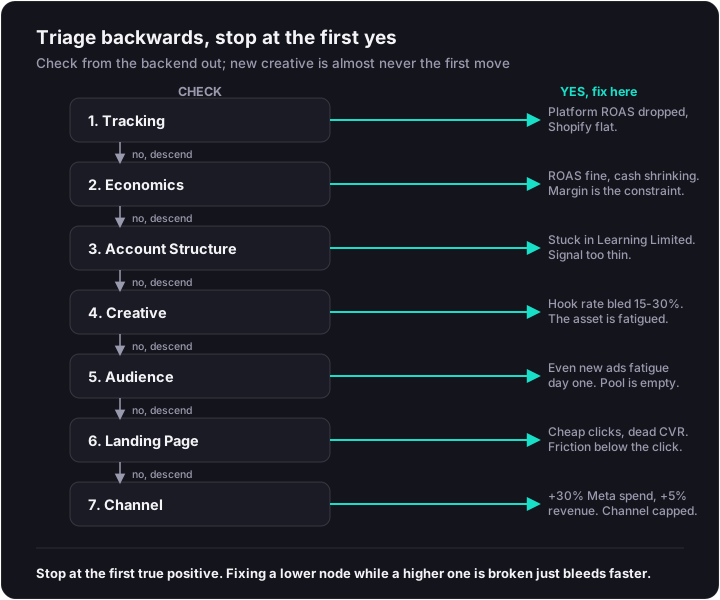
When you're trying to figure out why ads stopped working, the order you check things matters more than the checks themselves. Triage from the backend out: tracking, then economics, then account structure, then creative, then audience, then landing page, then channel. New creative is almost never the right first move.
- Tracking. Platform ROAS dropped, Shopify daily revenue is flat. It is an attribution illusion, not a media problem.
- Economics. ROAS looks fine, cash is shrinking. Contribution margin, not media buying, is the constraint.
- Account structure. Daily CPA is volatile and ad sets stay in Learning Limited. The AI is starving for signal density.
- Creative. Hook rate has bled 15 to 30 percent over two weeks. The asset is fatigued.
- Audience. Every ad, including brand-new ones, fatigues on day one. The pool is empty.
- Landing page. Cheap clicks, dead conversion rate. Friction lives below the click.
- Channel. Lifting Meta spend 30 percent moves revenue 5 percent. You have capped a single rented platform.
The rule that saves the most money: triage backwards
Premature reactions reset the Meta learning phase. Every manual tweak to a campaign that just relaunched forces the algorithm to start its 50-conversion stabilization window from scratch. Founders who panic into "new creative" while the bleed is actually a misconfigured CAPI or an undefined existing-customer cap on Advantage+ Sales pay twice: once for the wasted spend, once for the production cost of assets the algorithm cannot use.
Treat this as a decision tree, not a checklist. You stop at the first true positive. If tracking is broken, fixing the account structure underneath will not save the campaign, because the algorithm is still being fed a corrupted feedback loop. If unit economics are broken, swapping creative just lets you lose money faster.
Branch 1: tracking is lying to you
The most common reason a founder makes the wrong call is that the dashboard, not the campaign, is what is broken. Meta rewrote its attribution model in early 2026: click-through now requires an actual link click to a destination URL, and engage-through expanded to credit non-click signals like 5-second video views and saves inside a 24-hour window. If your reporting was not updated, conversions just moved columns. Layer on the slow death of client-side tracking and an account running a bare Meta pixel is operating on a roughly 40 percent view of its own customer journey.
The clean signature: Meta reports a 20 to 40 percent drop in purchases, Shopify's daily revenue is dead flat, and outbound clicks look normal. That is a measurement failure, not a marketing one.
The fastest test is the Event Match Quality panel. Inside Meta Business Suite, open Events Manager, select the dataset, click the Purchase event, and read the EMQ score on the right. Below 6 of 10 means hashed identifiers (email, phone, fbc, fbp) are not making it back to Meta, and the algorithm is optimizing blind. The fix is technical, not creative: deploy server-side tracking via the Conversions API with hashed identifiers and click parameters, opt into engage-through at the account level, and stop comparing a 7-day click window to a historical 28-day click window.
| Symptom | Test | Threshold | Fix |
|---|---|---|---|
| Meta ROAS down 20 to 40 percent, Shopify revenue flat | Export weekly orders and blended CAC from the backend | Drop must show up in both, or it is an illusion | Stop pausing campaigns on platform reporting alone |
| Event Match Quality score | Events Manager, click the Purchase event, read the EMQ panel | Below 6 of 10 is severe signal loss | Deploy CAPI, pass hashed email, phone, fbc, fbp |
| Attribution window mismatch | Compare current report window to historical default | 7-day click and 28-day click are not the same number | Standardize windows before drawing conclusions |
| Missing engage-through credit | Check account-level attribution setting | Off means 5-second video views never count | Opt in at the account level |
If tracking is clean, descend. If not, fix it before anything else and rebuild your baseline using a blended view like MER before you re-judge the channel. The full attribution stack sits behind this one branch.
Branch 2: you're growing broke
The gross margin lie is the most expensive failure mode on this list, because it is celebrated until the bank account contradicts the dashboard. ROAS measures revenue per ad dollar. It does not see COGS, shipping, processing, returns, or discounting. A 4x ROAS on a product with a 40 percent margin and rising CPMs can be cash-negative on every order.
2026 CPMs sit between $12 and $18, up 13 to 20 percent year over year. That increase passes straight through to CAC unless AOV moves with it. Heavy promotional discounting makes it worse, because it trains the algorithm to find bargain hunters with low LTV, permanently degrading your acquisition pool.
Run four checks before you touch a single ad:
- POAS by SKU. Contribution margin (revenue minus COGS, shipping, processing, returns, allocated discounts) divided by ad spend. Below 1.0x and the campaign is actively losing money on each order.
- Blended MER. Total revenue divided by total marketing spend. Healthy DTC mixes sit in the 2.5 to 4.0 range. Trending down while channel ROAS holds means paid is cannibalizing organic.
- LTV:CAC. Below 2:1 is structurally broken. 3:1 is the working minimum. 4:1 to 5:1 buys you the headroom to scale.
- CAC payback. Past 90 to 120 days and the brand runs out of liquid cash before profit catches up, which puts a hard ceiling on growth regardless of ROAS.
| Metric | Healthy band | Danger threshold | What it means |
|---|---|---|---|
| POAS on the scaled SKU | Above 1.5x | Below 1.0x | Every order is losing money even if ROAS looks fine |
| Blended MER | 2.5 to 4.0 | Trending down while channel ROAS holds | Paid is cannibalizing organic, not adding |
| LTV:CAC | 3:1 minimum, 4:1+ to scale | Under 2:1 | Acquisition model is structurally broken |
| CAC payback | Inside 90 days | Past 90 to 120 days | Cash runs out before profit catches up |
| Contribution margin per order | 25 to 40 percent | Under 20 percent | No room to absorb a CPM hike, scale is capped |
The fix takes courage: switch the daily KPI from ROAS to POAS and blended MER, raise AOV with bundles and a higher free-shipping threshold, kill margin-eroding discounts, and ruthlessly pause any SKU under 40 percent contribution margin. The deeper logic of the master ratio and the cash math behind CAC payback live one click away.
Branch 3: your account structure is choking the algorithm
Most structural failures are self-inflicted. Andromeda and Advantage+ Sales need broad, unconstrained data pools to exit Meta's 50-conversion-per-week learning threshold. A founder who keeps 30 ad sets alive, layers interest stacks on top, and tweaks budgets every other day has built a machine that cannot learn.
The signatures:
- Chronic "Learning Limited" warnings across most ad sets, which means daily budget is fragmenting under 50 weekly conversions per ad set.
- CPA swings 30 to 50 percent day to day with no creative change.
- An Advantage+ Sales campaign quietly routing 40 to 60 percent of budget to existing customers because the Existing Customer Budget Cap was left undefined. Returning buyers are statistically the cheapest conversions, so the algorithm hunts them by default.
- Performance crashing every time someone touches the budget, because manual edits restart the learning phase.
Three audits resolve it. First, open the ASC settings and check the Existing Customer Budget Cap. If it is empty, the AI is silently cannibalizing your own list. Second, pull 7-day conversion counts per ad set. Anything under 50 is signal-starved. Third, check for legacy manual prospecting campaigns running against the same geo as Advantage+: they are forcing you to bid against yourself.
The fix is consolidation, not optimization. Collapse the account to one broad Advantage+ prospecting campaign, one creative testing sandbox, and a single retargeting campaign capped under 5 percent of spend. Upload a comprehensive customer list and set the Existing Customer Budget Cap to 5 to 25 percent so the AI is forced to spend the majority hunting new buyers. Then hold the structure still for 7 to 10 days, and when you do scale, move budget no more than 20 to 30 percent every 3 to 5 days. The mechanics of safe scaling sit downstream of this one rule.
Branch 4: the creative is fatigued (and creative IS the targeting)
In 2026 the creative does the targeting. Andromeda uses multimodal machine learning to read the pacing, visuals, audio, and text of an ad and match them to predictive behaviors. A stale creative does not just bore the audience: it breaks the targeting signal itself. Reframe the asset and you are reframing what the algorithm goes hunting for. The thesis behind this shift, why the targeting mechanism now lives inside the asset, is its own rabbit hole.
Fatigue is the slow bleed. Saturation is the cliff. The difference is what you do next, so name it carefully.
Fatigue signatures over 10 to 14 days:
- Hook rate (3-second views over impressions) down 15 to 30 percent from the rolling 7-day baseline.
- Ad-level frequency, not campaign-level, climbing past 2.5 to 3.0 on cold audiences.
- CPM rising 10 percent or more while CTR drops 15 percent, even though competition is flat. That is the auction penalizing relevance.
- First-Time Impression Rate (reach over impressions) sliding under 50 percent.
| Signal | Healthy | Fatigue threshold | Action |
|---|---|---|---|
| Hook rate decay | Within 5 percent of 7-day baseline | Down 15 to 30 percent over 10 to 14 days | Swap the first 3 to 5 seconds, leave the body |
| Ad-level frequency (prospecting) | Under 2.0 | 2.5 to 3.0 and climbing | Rotate the asset before CPM penalty kicks in |
| CPM drift | Flat or moving with auction competition | Up 10 percent while CTR drops 15 percent | Refresh now, the platform is downranking the ad |
| First-Time Impression Rate | Above 50 percent | Below 50 percent | Either fatigue or saturation, run the Branch 5 isolation swap |
The cheapest fix is the hook swap. Keep the body of the video that already converts and replace the first 3 to 5 seconds. Industry teardowns put recovery at 60 to 80 percent of the original performance without a reshoot. Run a 10 to 14 day rotation, allocate roughly 10 percent of monthly budget to a dedicated testing sandbox, and shoot modular assets (interchangeable hooks, body, CTA) so one production day yields 15 to 20 variants instead of one polished spot.
Format diversification is the other half of the loop. Comparative teardowns find UGC converting around 3.4x better than studio photography, founder stories driving 2.7x higher engagement at 41 percent lower CPM and 85 percent lower production cost than traditional campaigns, and before-and-after statics carrying near-zero new production cost for skincare and cleaning brands. The disciplined version of all this lives in a real testing framework and a documented creative direction.
Branch 5: the audience pool is empty
Saturation is fatigue's evil twin, and the cure is opposite: widen, do not refresh. The dashboard signal is nearly identical, which is why so many brands blow their reshoot budget on the wrong problem.
The cleanest test is the isolation swap. Duplicate the supposedly fatigued ad into a fully unconstrained broad or Advantage+ Audience. If performance recovers, the creative was never the problem. The previous ad set's audience was already fished dry.
Other tells:
- Frequency climbing across every active asset, including brand-new ones that just launched.
- Rolling 7 and 28-day unique reach plateaus while daily spend stays constant or rises.
- Performance degrades linearly when you double the budget. The campaign is profitable at $100 a day and crashes at $200 because the pool cannot absorb the liquidity.
- First-Time Impression Rate stuck under 50 percent even after you ship fresh creative.
Placement breakdowns are the other lever. If an ad is fatigued on Instagram Reels but still converts on Facebook Feed, the saturation is format-specific, not total.
The fix is uncapping. Strip restrictive interest layers. Expand lookalikes from 1 percent to 5 or 10. Drop unnecessary age and gender constraints. Turn on Advantage+ Audience so your inputs act as a suggestion the algorithm can hunt outside of. If the core product audience really is tapped, scale horizontally: a supplement brand saturating "fitness enthusiast" can build a fresh angle for "overworked corporate professionals seeking focus" and unlock a distinct cohort without changing the product. The full mechanics of broad-audience scale depend on a clean architecture underneath.
Branch 6: the ad works, the landing page doesn't
The ad's job is to sell the click. The landing page's job is to sell the product. When the first half works and the second does not, founders waste weeks tuning Ads Manager and ignoring the bleed downstream. Fixing that half is conversion rate optimization work.
The shape of the problem:
- Healthy CTR and cheap CPC but website CVR under 2 to 3 percent.
- Link Clicks far exceed Landing Page Views, which means users bounced before the page rendered.
- Add-to-cart looks normal but checkout abandonment is unusually high.
Walk the funnel like a customer. Compare the ad's hook, offer, and aesthetic to what the user sees above the fold. If the ad promotes "30 percent off Spring Sale" and the LP shows full-priced items with no banner, the message match is broken. Read your own ad comments. If anyone is asking "is this a scam," your trust signals are not strong enough, especially for a newer brand. In Shopify, go to Analytics, then Reports, open Sales over time, and filter Sales channel name to Online store. That isolates true site drop-off from your other channels.
Then test page speed. The threshold is a Largest Contentful Paint under 2.5 seconds on mobile, measured in Google PageSpeed Insights. Industry data has every 1-second improvement worth roughly 7 percent in conversion, and pushing past 3 seconds losing 53 percent of mobile visitors immediately.
| Friction point | Test | Threshold | Fix |
|---|---|---|---|
| Largest Contentful Paint (mobile) | Google PageSpeed Insights | Under 2.5 seconds | Compress, lazy-load, defer scripts |
| Hero image weight | Inspect file size in the network tab | Under 200 KB, WebP format | Re-export and replace |
| Render-blocking JavaScript | PageSpeed Insights diagnostics | Zero blocking scripts above the fold | Defer, async, or remove the widget |
| Message match | Compare ad hook to LP hero copy and offer | Same headline, price, image style | Rebuild the hero to mirror the ad |
| Trust signals | Read your own ad comments | If users ask "is this a scam," you have a deficit | Add reviews, return policy, recognized payment marks |
If technical friction is clean and intent is clearly high but buyers balk at the price, the lever is the offer itself. Test a BOGO bundle, a free gift threshold, or a real deadline tied to an event before assuming the ad is broken. The free-shipping and bundle math here intersects directly with per-order margin, so test the offer at the margin you can actually sustain.
Branch 7: you've hit the ceiling of a single platform
A brand that runs 80 to 90 percent of paid budget through Meta hits a wall around the $100k to $300k monthly revenue tier. Lifting Meta spend 30 percent moves total revenue 5 percent. The diagnosis is not media buying. It is portfolio.
Meta is exceptional at generating demand. A meaningful share of that demand then leaves the platform, searches the brand or category on Google days later, and gets harvested by a competitor running Performance Max. Brands running both stacks see roughly 20 to 40 percent higher blended MER than Meta-only peers, because PMax catches downstream intent across search, shopping, and YouTube.
Three signals confirm concentration:
- Meta sits above 80 to 90 percent of paid spend with no real Google presence.
- Email and SMS contribute under 25 to 40 percent of total revenue.
- 12-month repeat purchase rate sits under 20 percent, which forces paid to constantly fund cold acquisition just to keep the topline flat.
The fix is an ecosystem, not a campaign. Deploy Google Ads (PMax first) alongside Meta, manage the portfolio on blended MER rather than per-channel ROAS, and aggressively build owned audience through identity resolution and audience appending. First-party data is immune to iOS attribution and CPM shocks, and a robust retention program lets you sustain a 20 to 30 percent higher front-end CAC at identical contribution margin. TikTok Shop is worth a controlled test for brands chasing the 30 to 40 percent lower CAC lane that platform currently offers, with full awareness of the thinner per-order margin. The strategic logic for splitting demand-gen versus capture lives in the search-versus-social split, and the broader channel map shows what comes after PMax.
The gray areas: when two signals contradict
Three scenarios deadlock the tree if you treat it as a strict pass or fail. Resolve them like this:
- EMQ borderline at 6.0 to 6.5 with falling ROAS. Tracking is not catastrophically broken, but it is underfueling the AI. Do not pause campaigns. Proceed to economics, and fix the CAPI integration in parallel so the score climbs above 7.
- Ad-level frequency past 3.0 but CPA still profitable. Do nothing to the winner. High frequency with stable conversions usually means a rabid high-intent segment. Treat it as a ticking clock and start the hook-swap pipeline now, so you are not scrambling the day CPA breaks.
- High CTR, verified 2.1-second page speed, sales still flat. Test offer elasticity directly with a 48-hour aggressive bundle (BOGO or a real-deadline urgency play). If conversion surges, the bottleneck is pricing. If it stays flat, the brand is short on foundational trust signals.
A worked example: Aura Athletics
To ground the sequence, take an illustrative mid-market activewear brand, "Aura Athletics," scaling past $350k a month. ROAS plummets from a steady 3.2x to 1.4x over three weeks. The agency pitches a $15k reshoot.
The founder runs the tree instead.
- Tracking. Shopify confirms the revenue drop is real, not an attribution illusion.
- Economics. A 1.4x ROAS on a 40 percent margin product is cash-negative on every order. The crisis is real and immediate.
- Structure. The agency had been tweaking budgets every two days. The Advantage+ campaign is permanently Learning Limited.
- Creative vs audience. Hook rates are down only 5 percent. Not fatigue. But First-Time Impression Rate has crashed to 40 percent. Meta is serving engaging creative to a depleted pool of past purchasers, inflating CPA.
The fix takes no new production: enforce a strict 10 percent Existing Customer Budget Cap and expand to a fully unconstrained Advantage+ Audience. Inside 8 days First-Time Impression Rate jumps to 85 percent and ROAS stabilizes at 2.9x. The $15k reshoot would have hit the wrong problem.
When to stop self-triaging and bring someone in
Self-triage works when one branch is the clear culprit and you have the bandwidth to execute the fix. It stops working in four situations:
- Two or more branches show red at the same time. The interactions get hard to isolate from inside the account.
- The same symptom returns within weeks of every triage you run, which means the root cause is not where you keep looking.
- The real fix is "ship 15 to 20 new concepts a month" and there is no creative pipeline standing up behind it.
- The account is past $5M and the structural and measurement layers have outgrown a single person's attention.
The distinction worth keeping straight: the triage above is the founder's own, run with what they can see inside Ads Manager. A formal paid media audit is an outside review with the whole account open and the historical data exported. A performance creative agency is the production engine you need when Branch 4 turns out to be the real diagnosis. The full-stack engagement handles all three at once.
Next step
Two honest paths from here.
If you have localized the bleed to creative volume or fatigue, the next read is the thesis behind why the creative is the targeting and the production system that resolves it. If you cannot localize it, or three or more branches lit red while you read this, skip the self-triage and book a paid media audit. The point of the audit is to open the account with someone whose only job that week is to find the bleed you cannot see from the inside.
You
Can you look at our ads?
Want this read on your own ads?
We pull your live ads from the Meta Ad Library, set them next to the longest-running ads in your category, and send back what we'd change and test next. The teardown is free.
Get my free creative teardownWe usually reply within one business day.