Direct Response Copywriting: Copy as a P&L Line
Direct response copywriting is the only kind of copy a DTC brand can defend on a spreadsheet. It treats the words on a page as a profit-and-loss line item, not a mood board. Every sentence either earns its place against conversion rate, AOV, scroll depth, and time on page, or it gets cut.
This post lays out the worldview, then the architecture: the long-form sales page in four phases, with the diagnostic ladder for fixing one that misses.
What Direct Response Copywriting Actually Is
Direct response copywriting is copy evaluated as a P&L line. Every sentence has to justify itself against on-page operational metrics (conversion rate, AOV, scroll depth, time on page) or it gets deleted, no matter how clever it reads. The flagship asset of this worldview is the long-form sales page, built as a four-phase psychological sequence:
- The Lead secures attention and emotional buy-in.
- The Mechanism gives the logical brain a specific reason the product works.
- The Proof eradicates skepticism with quantified, sourced evidence.
- The Offer engineers a frictionless, low-risk transaction.
Everything that follows hangs on that sequence. For the broader craft layer that sits underneath it, see conversion copy.
Direct Response vs Brand Copy: The Worldview Split
Brand copywriting is an investment in ambient association. It plays for top-of-mind awareness, sentiment, and recall over months and years, and it is measured (where it is measured at all) by proxy metrics: brand recall surveys, follower growth, sentiment analysis. It is the language of mission statements and lifestyle imagery.
Direct response asks for an action right now. A click, an email submission, a purchase. Words are a financial asset, and the feedback loop is so short that ego has nowhere to hide. If a beautifully crafted sentence depresses CVR, it dies.
The mattress example makes the split concrete:
- Brand approach: sunlit couple, headline "Awaken to a Better Tomorrow," copy about sustainability and peace, CTA "Discover Our Story."
- Direct response approach: "Tossing and Turning Because Your Mattress Traps Heat? How Our Proprietary Air-Flow Latex Lowers Core Body Temperature by 2 Degrees for Deep, Uninterrupted Sleep." Then agitate the insomnia, introduce the latex mechanism, stack the clinical proof, offer a 100-night risk-free trial. CTA: "Start Your Risk-Free Sleep Trial Today."
| Feature | Brand Copywriting | Direct-Response Copywriting |
|---|---|---|
| Primary goal | Ambient association, top-of-mind awareness | Immediate, measurable transactional action |
| Timescale | Months to years | Minutes to days |
| Key metrics | Sentiment, brand recall, organic follower growth | CVR, AOV, LTV:CAC, scroll depth |
| Psychological function | Emotional resonance, lifestyle alignment | Problem agitation, logical reframing, risk mitigation |
| Required evidence | Aesthetic harmony, narrative consistency | Clinical data, VoC testimonials, quantitative proof |
The 2027 context makes this split urgent rather than philosophical. Generative AI has collapsed the price of competent generic content to fractions of a cent per thousand words, so a pleasant brand manifesto no longer separates a brand from anything. At the same time, blended DTC CAC sits roughly in the $21 to $87 range depending on category (call it $25 to $40 for strong beauty brands, $35 to $55 for apparel, $40 to $60 for supplements). At those acquisition costs, paying for traffic that merely browses bleeds capital. The DR worldview is mandatory because the math is unforgiving.
When the contrast turns on outcome specificity, the wider lens is your value proposition.
Read the Reader Before You Write: Awareness + Sophistication
Before drafting a sentence, a direct-response copywriter maps two things: where the reader sits on the awareness spectrum, and what claims competitors have already trained that reader to ignore. Skipping this step is the single most common way a sales page dies on arrival.
The Five Stages of Awareness
- Unaware. The prospect does not know they have a problem. Copy here must be narrative, slowly revealing the pain.
- Problem-Aware. They feel the friction ("my back aches every morning") but do not know a solution exists. Copy agitates the pain to prove empathy.
- Solution-Aware. They know they want a category of fix ("a better ergonomic chair") but do not know your specific product. Copy bridges desired outcome to your category.
- Product-Aware. They know your product exists but are comparing it to competitors. Copy leads with differentiation, proof, mechanism.
- Most Aware. They know and trust the brand and are waiting for a reason to act. Copy here is brief and leads with the offer.
Pitching the wrong stage is fatal. An Offer Lead ("Save 20%") on Problem-Aware traffic flops because there is no emotional context for the discount to land in. A long Story Lead on Most-Aware traffic insults a buyer who already wanted to click. The deeper diagnostic playbook lives at awareness stages.
The Five Stages of Market Sophistication
Eugene Schwartz's second framework tracks not the reader but the market. What have competitors already promised? What is the audience tired of hearing?
- First to Market. Naked claim works ("Lose Weight").
- Early Competition. Enlarge the claim ("Lose 10 Pounds in 7 Days").
- Skepticism Sets In. Subordinate the promise to a new mechanism ("Lose Weight Through Metabolic Thermogenesis").
- Elaboration. Competitors copy the mechanism. You quantify and refine it.
- Dead Market. No claim is believed. Copy shifts to identity and deep emotional resonance.
By 2027 virtually every DTC niche, skincare to supplements to apparel to electronics, sits in Stage 3 or Stage 4. The practical implication is brutal: naked benefit claims like "get clearer skin" trigger instant skepticism. Copy has to lead with the mechanism, the specific logical reason the benefit is achievable. That craft is its own discipline at unique mechanism.
The Sales Page Architecture: Four Non-Negotiable Phases
The long-form sales page is the digital descendant of the direct-mail sales letter. The medium changed, the architecture did not. Joe Sugarman called it the slippery slope: the only job of the headline is to get the first sentence read, the only job of the first sentence is to get the second sentence read, and so on, all the way down to the guarantee.
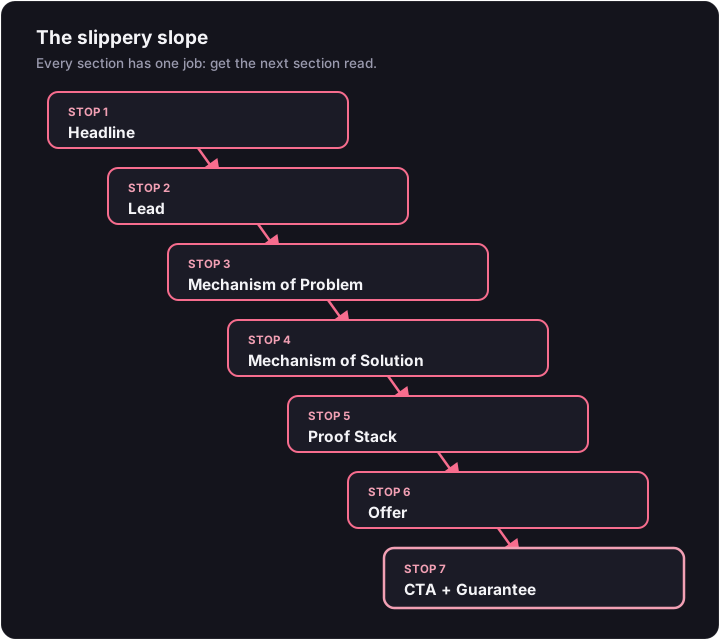
The four phases each do one job:
- Lead: secure attention, prove empathy, promise a transformation.
- Mechanism: explain why the product works in a way no competitor has.
- Proof: anchor every claim with quantified, authoritative, or VoC evidence.
- Offer: wrap the product in price, bonuses, urgency, and risk reversal.
The lighter scaffolds you may already know (AIDA, PAS, the 4 Ps) sit underneath this architecture as paragraph-level patterns. The catalog lives at copy formulas.
Before Drafting: The DR Workflow
Direct response copywriters do not stare at a blank cursor. They assemble. The standard workflow is four steps:
- Voice of Customer mining. Hours inside Reddit threads, Amazon reviews, and support tickets, pulling the exact unpolished language real buyers use for their pain and their relief.
- Wireframing the Lead. Draft multiple hooks and headlines against the inferred stage of awareness. Pick the single Big Idea that can carry the page.
- Constructing the mechanism and proof stack. Define the specific reason the product works, then aggressively source the studies, clinical data, and testimonials to back every claim.
- Assembling the offer and risk reversal. Wrap the product in price anchoring, bonuses, authentic urgency, and an ironclad guarantee.
Each phase below maps to one of these assembled artifacts.
Phase 1: The Lead
The Lead is the headline, the sub-headline, and the first 100 to 600 words. It is the single highest-stakes section of the page. Fail here and no one reads the mechanism, the proof, or the offer.
AWAI's canonical framing is the Power of One:
- One Big Idea that reframes the reader's worldview.
- One core emotion (frustration, fear, hope, vanity) that the Lead pierces.
- One captivating story that makes the transformation feel real.
Three Lead archetypes, mapped to the awareness stage of the traffic:
- Problem-Solution Lead for Problem-Aware traffic. Vividly describe the current reality, agitate the pain, introduce a glimmer of a solution.
- Story Lead for Unaware or highly skeptical traffic. Bypass the brain's ad-defenses with a vulnerable narrative where the customer is the invisible protagonist.
- Offer Lead for Product-Aware or Most-Aware traffic. Skip the emotional setup, lead with a massive promise or an irresistible deal.
The premium anti-inflammatory dog food example makes this concrete. The owner knows their senior dog is limping but does not know what to buy (Problem-Aware). An Offer Lead ("Save 20% on Premium Kibble") fails because there is no context. A Story or Problem Lead lands:
"Why the 'Healthy' Store-Bought Kibble in Your Pantry is Secretly Accelerating Your Dog's Joint Decay."
"It starts subtly. A slight hesitation before jumping onto the couch. A slower walk up the stairs. You tell yourself it's just old age. But the truth is, the commercial kibble you've been feeding them for years contains a hidden inflammatory agent that is actively eroding their cartilage..."
A contrarian Big Idea, a core emotion of guilt and love, and a question (what is the agent?) that drags the reader downhill. Opener selection has its own playbook at leads and openers, and headline craft at headline writing.
Phase 2: The Mechanism
Once the Lead has the reader's emotional buy-in, the logical brain pushes back: "I've tried products like this before and they did not work, why should I believe this one will?" The Mechanism is the answer. Without it, every claim on the page is hype.
The canon dictates two interlocking mechanisms:
- The Mechanism of the Problem. A new villain that absolves the prospect of past-failure guilt. If they believe the failure was theirs ("I just did not diet hard enough"), they will not buy. The copywriter introduces a hidden cause: "It is not your fault you could not lose weight. You were suffering from undiagnosed cellular insulin resistance."
- The Mechanism of the Solution. The specific, proprietary way the product solves that exact new problem. "Unlike standard diets that crash your metabolism, our bio-active alkalizing compound specifically reverses cellular insulin resistance, allowing your body to burn stored lipids for energy."
Three flavors a mechanism can take:
- Actual Mechanism. A genuinely unique patented ingredient, manufacturing process, or algorithm.
- Unspoken Mechanism. A process common to the industry that no competitor has bothered to name and explain. Being first to name it lets you own it in the consumer's mind.
- Transubstantiated Mechanism. Taking an ordinary feature and elevating it through precise, scientific-sounding language.
The hyperpigmentation serum shows what mechanism copy reads like in practice. The naked claim, "fades dark spots in 14 days," triggers skepticism. The mechanism version splits the work:
- Problem: "Most dark spot correctors fail because they only bleach the surface layer of the epidermis. But hyperpigmentation is not a surface issue. It is caused by overactive melanocytes deep within the basal layer."
- Solution: "Our serum uses a proprietary Micro-Encapsulated Tyrosinase Inhibitor. The active molecules are housed in lipid-based micro-capsules that bypass the surface entirely, penetrating directly into the basal layer to switch off the melanocytes at the source."
The prospect now has a logical scaffold to justify the emotional desire for clear skin. The full mechanism playbook lives at unique mechanism; the brand-level framing of differentiation is value prop.
Phase 3: The Proof Stack
The rule of the proof phase is simple: never let an abstract claim stand alone. Every promise gets anchored, instantly, by a specific piece of evidence. A well-built page weaves three kinds:
- Quantitative and clinical proof. Specificity is the lever. "A 97.4% reduction in systemic inflammation over 28 days" is exponentially more believable than "a massive reduction in inflammation." Numbers, named compounds, defined timeframes.
- Authority proof. Borrowed credibility. Doctor endorsements, expert panel reviews, household-name media mentions. If the brand lacks authority, it rents it.
- Social proof and VoC. The lived language of real buyers. Compare a fabricated testimonial ("This product is amazing! Five stars!") to a VoC-grounded one ("For three years I dreaded walking down the stairs because my left knee felt like it was grinding on glass. After two weeks of taking this, I actually jogged to the mailbox yesterday without thinking about it"). The unpolished one converts.
By 2027, text testimonials are read with intense suspicion because AI has made them trivial to fabricate. The workhorse of modern social proof is Creator Product Discovery: unscripted UGC of a real creator finding and testing the product for the first time, the digital equivalent of a friend on FaceTime excitedly showing you what they just bought. The unpolish is the point.
A nootropic for professionals demonstrates the sandwich:
- Setup: "When your brain is starved of acetylcholine, afternoon brain fog is not just likely, it is a biological certainty."
- Clinical proof: "That is why our formula includes 600mg of Alpha-GPC, the exact dosage shown in a double-blind, placebo-controlled study to increase cognitive processing speed by 18% in healthy adults."
- Social proof: Embedded Creator Product Discovery video of a recognizable tech founder explaining how they replaced their afternoon Adderall with the supplement.
- Synthesis: "You are not gambling on an unproven theory. You are leveraging the exact neuro-compound trusted by top-tier executives to maintain absolute focus at 3:00 PM."
The mechanics behind that sandwich live at persuasion devices.
Phase 4: The Offer and the Close
A line worth carving into the wall: the Product is not the Offer. The product is the physical thing (a jar of cream, a pair of shoes, a software subscription). The Offer is everything wrapped around it: price, payment terms, bonuses, shipping speed, guarantee. Two brands can sell the same product and have completely different offers, and the offer is what conversion turns on.
Four moving parts to assemble:
- Value proposition and price anchoring. Establish that the value of the transformation vastly exceeds the price asked. Anchor against the cost of inaction (continued pain, medical bills, lost productivity) or the cost of competing solutions. By the time the $100 price appears, it reads as a bargain against a $1,000 anchor.
- Risk reversal. A skeptical buyer is afraid of looking stupid. The brand absorbs 100% of that risk. A 30-day return policy is weak. A weaponized guarantee reads: "Try it for 90 days completely risk-free. If you do not experience the deepest, most restorative sleep of your life, send back the empty bottles and we refund every penny. No questions asked. We pay return shipping."
- Authentic urgency and scarcity. Not fake countdown timers. Real inventory or production constraints, time-limited bonuses, fast-action gifts. The reason has to be true, because buyers can smell the manufactured kind.
- The Call to Action. Blindingly clear physical instructions. "Click the yellow button below, enter your shipping details on the secure checkout page, and your package leaves our warehouse within 24 hours."
Joanna Wiebe's adjacent-objection rule: as the buyer hovers the mouse, neutralize the final wave of doubt right next to the button. Too expensive, justify the price. Doubts about fit, list the specs. Does not trust the company, reiterate the guarantee.
The matcha "Jitters-to-Genius Protocol" packages all four:
- Product: 30 cans of a matcha-infused energy drink.
- Offer: 30 cans plus a free stainless steel frother, a digital guide on morning circadian rhythm optimization, free expedited shipping, and a "Love It Or It's Free" money-back guarantee.
- Urgency: "Due to the specialized 40-day fermentation process of our matcha, we can only produce 500 batches a month. Secure your allocation before we go on backorder."
A beverage purchase has been transformed into a risk-free, high-value, time-sensitive system. Button copy lives at CTA copywriting, objection neutralization at objection handling, and the checkout-line layer at microcopy.
Where the Sales Page Lives
A long-form direct response page does not belong on the brand's homepage. It does not belong on a collection page. Those spaces are designed for catalog browsing, not deep persuasion, and the navigation bar alone leaks too much attention.
The natural home is a standalone landing page built on a dedicated platform (Unbounce, Replo, a Shopify headless setup), with the top nav stripped, no related-products carousels, no footer link soup. The buyer's only choices are scroll down or close the tab.
Because the overwhelming majority of DTC traffic now arrives from mobile social feeds, the page has to be architected mobile-first: dominant headlines, frequent paragraph breaks, generous spacing, no horizontal complexity. The slippery slope literally becomes a downward thumb scroll, and any friction in that scroll costs revenue.
Troubleshooting a Sales Page That Misses
No sales page ships perfect. It ships as a hypothesis. When ROAS or LTV:CAC comes in light, the diagnostic ladder uses on-page behavior to localize the failure to one of three layers.
| Symptom | What it means | Where to fix |
|---|---|---|
| High bounce rate, low time on page | The Lead is not landing. No emotional resonance. | Rewrite the Lead. New hook, new Big Idea, new opening 100-600 words. |
| Deep scroll, low add to cart | They read it but did not believe it would work or felt the risk was too high. | Fortify the Proof Stack and strengthen the guarantee inside the Offer. |
| Clicks to checkout, high abandonment | Persuasion worked, logistical friction killed it. | Tighten price anchoring, simplify the form, reiterate security and shipping promises adjacent to the final CTA. |
The recovery layer for that third row (and a meaningful chunk of revenue on its own) is email copy.
Quality Gates: How DR Pros Filter Their Own Prose
Three filters every sentence has to clear before it survives a second draft.
Specificity and quantification. Every claim carries a number, a proper name, or a defined timeframe. "Our shoes are incredibly comfortable for long walks" is brand fluff. "Engineered with 40mm of EVA foam to absorb 3x your body weight, allowing you to walk 10,000 steps across concrete without lower back fatigue" is direct response. The specificity gate is where most generic copy dies. The same gate applied at catalog level is the entire job of PDP copy.
The "You" rule and conversational empathy. Sentences are framed around the word "you," not "we" or "our brand." The tone reads like an intimate letter from a passionate, highly informed friend across a coffee table, not a corporate press release or an academic white paper. The structure is engineered. The voice is human.
The LTV horizon. DR is not high-pressure one-shot extraction. With monthly subscription churn above 10% to 15% considered fatal to the LTV:CAC ratio, copy that browbeats a buyer into a regrettable purchase actively destroys the business. The Lead, Mechanism, and Proof must be honest and educational enough that the buyer adopts the brand's philosophy, not just buys the product once. The sales page is also the indoctrination mechanism for the next twelve months of repeat revenue.
When You Need a Direct-Response Copywriter (Not a Content Writer)
The entry-level market for generic content writing collapsed under AI. Producing a competent product description or a pleasant brand manifesto now costs fractions of a cent per thousand words. What did not get commoditized is the ability to architect a structured, psychologically compelling argument that converts skeptical traffic into paying customers.
Where the market puts the value tells you what the market believes. AWAI's 2026 pricing guide shows skilled direct response copywriters commanding $5,000 to $25,000 in flat fees per sales letter, supplemented by performance royalties of 2% to 5% on gross sales generated by the asset. Those numbers are not paid for prose. They are paid for engineered persuasion that moves a P&L.
If you are weighing the role-hire question more broadly, see do you need one, what copywriters charge, or our creative strategy service. If you want the craft layer that sits underneath the sales page, the depth is at conversion copy.
Get a Sales Page Built This Way
Direct response copywriting is copy treated as a P&L line, architected in four phases: lead, mechanism, proof, offer. We ship sales pages built that way, with VoC-grounded proof stacks, mechanism copy your competitors are not running, and offers engineered to make the no feel foolish.
Start at conversion copywriting, on its own or bundled with creative.
You
Can you look at our ads?
Want this read on your own ads?
We pull your live ads from the Meta Ad Library, set them next to the longest-running ads in your category, and send back what we'd change and test next. The teardown is free.
Get my free creative teardownWe usually reply within one business day.