Chance Ecom Get my teardown

Creative strategy agency for DTC The brief and the cut, in one room.

We decide what the next ad argues, to whom and why, then make the static, AI-video and AI UGC ads against that decision in house. For live-action video and UGC, we write the briefs and scripts and your creators shoot them.

Get my free teardown

Rather work out the angles yourself? Good ecommerce creative strategy decides what an ad says and why before anyone films.

Chance EcomCreative agency, DTC

A typical first conversation

  1. You

    Our production partner ships a pile of new ads every month. Results are flat.

  2. Chance Ecom

    New cuts of the same angle. The algorithm groups lookalikes and shows them less.

  3. You

    So we just need more variety?

  4. Chance Ecom

    You need someone deciding what the next ad argues before anyone makes it. Customer research, one hero concept, then the angles.

  5. You

    And who makes the ads?

    Seen

  6. Chance Ecom

    We do: static, AI video and AI UGC, in house. For live action we write the brief and the script, and your creators shoot it.

You

Why do our new ads keep flopping?

Your ads stopped saying anything new.

Targeting is automated. The platforms match ads to buyers on creative signal, so generic creative gets weak distribution and lookalike creative gets clustered and shown less. When an account stalls, it's usually one of three setups:

Each of those setups skips the same step: deciding what to make and why before production starts.

  • A production shop shipping one angle

    Dozens of variants of the same idea, dressed in different fonts. The algorithm reads them as one ad.

  • A media buyer doing strategy on the side

    In the ten minutes between bid changes.

  • A founder writing briefs at midnight

    From gut feel and yesterday's swipe file.

You

So what do you actually deliver?

Message strategy plus finished ads, in one place.

What's missing in all three setups is the upstream layer: someone whose job is to decide, from data and customer voice, what the next sprint argues. Four tracks run in parallel.

The core

Message architecture

Voice-of-customer research from reviews, support tickets and post-purchase surveys, turned into the decisions every ad runs on.

Avatar and hero concept
One foundational insight about the customer and the category. Not a headline.
Angle matrix
The hero split into distinct entry points, so the algorithm gets diverse signal. The angles that sell come from customer reviews, not a brainstorm.
Mechanism and awareness
Why the product works, and where the buyer sits on the awareness ladder. Name the mechanism behind it, the reason it works that no rival can discount.
all three tracks run on it

  • Static ads

    Hooks, headlines, image direction, on-image copy and format variety. Produced in house against our briefs.

  • AI video and AI UGC

    Synthetic video and AI UGC-style variants for hook and format permutation at volume, produced in house to the same message spec.

  • Live-action video and UGC

    Founder-led, lo-fi raw, premium lifestyle, real-creator UGC, VSL and advertorial structures, written as briefs and scripts. Your team or your creators shoot them; we don't film live action.

    The opening line does the most work, and the right lead for a cold buyer can be a story, a problem or an offer.

You

How does it work?

Angles and briefs in week one. Then a steady loop.

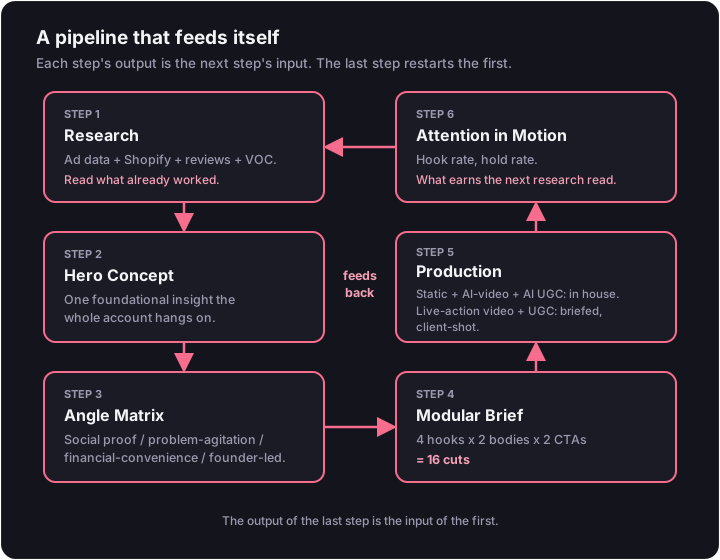
Each step's output is the next step's input, and the last step feeds the first.

  1. 1

    First week

    A first read of the account, then the angle map and the first briefs.

    • Ad account, Shopify, GA and reviews, read back
    • Social proof, problem, financial, founder-led
    • First briefs, ready to produce
  2. 2

    Go deeper on the customer

    Weeks 2 to 4. Their own words sharpen the hero concept.

    • Surveys, interviews, support tickets
    • The awareness stage and the mechanism
  3. 3

    Modular briefs

    Person, desire, awareness: the logic of each cut.

    • Four hooks, two bodies, two CTAs
    • Sixteen distinct ads from one production day
  4. 4

    Produce, ship, read

    Static, AI video and AI UGC made in house; live action briefed and client-shot.

    • Hook rate and hold rate read after launch

the read feeds the next round of research

A closed-loop flywheel of six steps that feeds itself: Research from ad data, Shopify, reviews, and voice of customer, then a Hero Concept on one foundational insight, an Angle Matrix of social-proof, problem-agitation, financial-convenience, and founder-led entry points, a Modular Brief of four hooks by two bodies by two CTAs for sixteen cuts, Production where static, AI-video, and AI UGC are made in house while live-action video and UGC are briefed and client-shot, and Attention metrics in motion (hook rate, hold rate) that feed back into Research.
The last step's output becomes the first step's next input.

You

What do you need from us?

The data, the customer's words, and your buyer.

Four things before the first brief. The research runs on them.

  • Data access: ad accounts, Shopify, GA and support ticket logs
  • The customer's voice: reviews, post-purchase surveys and customer interviews
  • Brand assets and past creative, with what won and what flopped
  • A shared workspace for briefs and asset review, such as Notion or Asana
  • Your media buyer, for a weekly sprint on the next test and last week's read

You

How do you judge the work?

On attention first. Never on a promised ROAS.

Attention metrics are read separately from the buyer's bidding, so the message gets its own scorecard.

  • Hook rateTwo-second video views over impressions. Did the entry point stop the scroll?
  • Hold rateThruPlays or six-second views over impressions. Did the body survive the curiosity gap?
  • LTV:CACRead across a real payback window. Not a 7-day ROAS snapshot.
our read

High hook, low hold: the visual worked and the body needs a rewrite. Low hook: the angle has to move. The buyer keeps bidding. We keep the message tight.

Those reads only mean something when the strategy behind each ad decided what it argues first.

What we won't do

  • Guarantee a specific ROAS number.
  • Ship volume for volume's sake.
  • Take credit for a buyer's bid optimization.

Also on the scorecard: conversion lift on rewritten landing and product pages, and revenue per recipient on email and SMS.

You

Is this for us?

Built for brands with a buyer, a product that sells, and nothing new to say.

A good fit

  • Product-market fit. Baseline organic sales and repeat purchase already there.
  • A media buyer who needs feeding. In-house or agency, with no upstream layer deciding what to test.
  • Differentiation is the lever. The obvious angles are saturated and the message has to carry the account.

Not a fit

  • Before product-market fit. Message architecture can't save a product the market isn't asking for.
  • Too little spend to test angles. No statistical room to read them.
  • Commoditized dropshipping. Nothing real to argue.

Prefer to build the role in-house? Hiring a creative strategist comes down to the judgment AI can't replace.

You

A few more questions

Ask away. These come up on most first calls.

What does it cost?

Pricing depends on scope. Tell us what you're running and we'll quote after the free teardown.

Do you film live action?

No. For live-action video and UGC we write the brief and the script; your team or your creators shoot it. Static, AI video and AI UGC we make in house.

Why not keep strategy in-house?

An in-house team sees one product line all day and drifts into echo-chamber thinking. We bring cross-category pattern recognition and keep it tight to your data.

Keeping it in-house works best when the strategist you hire brings judgment, not just output.

Can you guarantee a ROAS?

No, and be wary of anyone who does. We frame results on hook rate, hold rate, conversion lift and LTV:CAC over a real payback window.

You

Let me read first

Fair. Pick the one that sounds like your account.

Written by Camille Chen, a creative strategist here. No gated PDFs, no email wall.

You

OK. Look at our ads.

Tell us what's broken. We'll tell you what we see.

A few short fields. The last one matters most: the more honest you are about what's not working, the more useful the audit.

  1. You

    Sent. Here's our brand and what's stuck.

  2. Chance Ecom

    Got it. We pull your live ads from the Meta Ad Library, set them next to the longest-running ads in your category, and send back what we'd change and test next. We usually reply within one business day.

Then, the scoping call

If we go further, send three things:

  • Your paid-social spend per month
  • Your creative cadence, in variants per week
  • The one metric that's stuck

Back comes a scoped engagement shape and the first message hypothesis we'd test.

We usually reply within one business day. Not ready to send it? Read the blog first.