Creative Strategy for Ecommerce: What to Make and Why
Creative strategy is the upstream work of deciding what an ad says and why, before anyone storyboards, films, or opens Ads Manager. In 2027 the algorithm stopped reading your interest stack and started reading your concept, hook, and script to decide who sees the ad. That makes the creative the targeting, and the fix for climbing CPMs and ads that burn out in days is upstream, not in the bid. The prescription that follows is a four-step pipeline: concept, angle, framework, brief. It is the upstream layer our creative strategy agency owns for DTC brands.
The Upstream Growth Lever
Creative strategy is the upstream work of deciding what an ad says and why, before anyone storyboards or films. In 2027 it is the primary growth lever because algorithmic delivery reads creative as targeting, so the concept on the page determines who the ad reaches.
Start with the diagnostic map. The pipeline runs concept (the foundational insight) into angle (the psychological entry point) into framework (the structural logic) into brief (the modular targeting spec).
Creative strategy is NOT:
- Media buying or bid management
- Ad design or video editing
- Copywriting in isolation from research and data
- Picking demographic checkboxes inside the ad platform
Why Creative Is Now the Targeting
Between December 2024 and October 2025, Meta rolled out the Andromeda retrieval engine alongside Advantage+ Shopping campaigns, and the targeting paradigm inverted. The platform now reads ad copy, visual hooks, and underlying psychological intent to decide who should see the ad. The creative asset itself is the targeting mechanism.
The old model worked like a librarian. A media buyer manually shelved your ad inside "Women, 25 to 34, urban centers" and waited for the right reader to walk into the right aisle. The new model works like a matchmaker. The algorithm scans your hook, your script, and your visual pacing, then hands the ad to whichever users are showing live behavioral signals that match the content, regardless of what shelf they sit on.
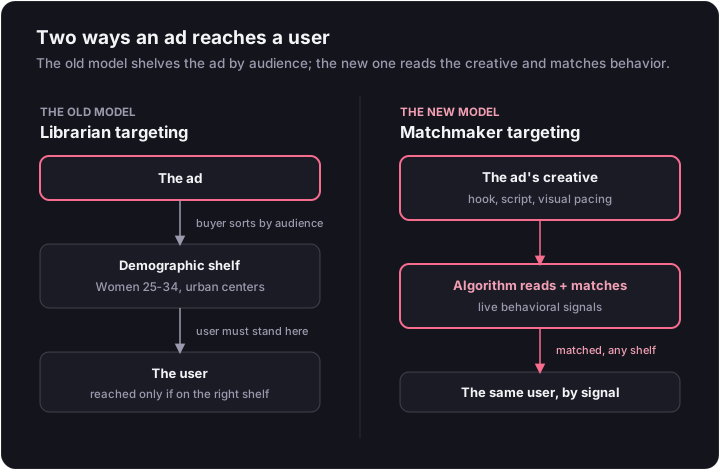
If a video opens on "postpartum snack cravings are brutal," the platform tags that intent and finds the slice of users (often the top 1 to 5 percent of high-intent converters) whose life stage and behavior match the signal. A generic concept upstream creates broad, inefficient delivery downstream. There is no media-buying knob that fixes this.
Platforms also actively cluster and suppress redundant formats to protect feed retention. EU regulators have pushed this further by letting users opt out of algorithmic ranking entirely, which drops organic brand reach for anyone on chronological feeds. Diverse signals are now a survival requirement.
This is the math behind the Q1 2027 squeeze: CPMs spiked 28 percent year over year, and high-ticket ROAS collapsed by 31 percent. Bid tweaks cannot rescue an account whose creative is asking the algorithm to deliver the same message to the same people. The fix is upstream. The visual hook that opens your ad is now a hook signal the platform indexes against millions of users, so it has to be sharp.
What Creative Strategy Is, and What It Is Not
The role gets conflated with design, copywriting, and media buying constantly. The boundary that matters is between the upstream decision layer (hypotheses, angles, frameworks, modular briefs) and the downstream functions that act on its output.
| Functional Area | Creative Strategy IS (Upstream) | Creative Strategy IS NOT (Downstream) |
|---|---|---|
| Objective setting | Generating falsifiable hypotheses about buyer psychology and messaging effectiveness | Dictating bid caps, budget splits, or campaign consolidation |
| Audience targeting | Encoding psychological intent, desires, and pain points into the creative architecture | Selecting demographic checkboxes, interests, or custom audiences |
| Asset planning | Designing modular component libraries (hooks, bodies, CTAs) to prevent format fatigue | Filming UGC, editing video, designing layouts |
| Performance integration | Analyzing patterns across hook type, format, angle, and fatigue curves to dictate production | Watching daily ROAS to pause losers and scale winners |
| Competitive research | Mining intelligence tools for format trends, messaging gaps, and profitability signals | Swiping trending audio or copying surface aesthetics without intent |
Creative strategy is analytical and prescriptive, and it opens before any camera or design tool. When a creative director wants minimalist polish but the data says lo-fi UGC testimonials are the signal the algorithm rewards, the strategist overrules taste.
The cleanest way to place it: design owns how the ad looks, media buying owns where and when it runs, and copywriting owns the words inside the structure the brief defines. Strategy owns the hypothesis (who is being talked to, what they want, why they would buy) and sits upstream of all three. It is not swiping a viral aesthetic without a hypothesis, and it is not daily ROAS triage; pausing losers is the buyer's job, deciding what to brief next is the strategist's.
The Four-Step Upstream Pipeline
The pipeline is deductive. It narrows from a broad market insight into a specific production instruction, and skipping a step produces shallow ads that fatigue inside a week.
1. The Hero Concept
A hero concept is a researched insight about your customer and the market, not a headline or visual gimmick. It is the strategic core message and the proof point that makes the claim credible.
Take Who Gives A Crap, the eco toilet paper brand. They tested 375+ concepts across formats and grew the UK market 70 percent. The hero concept that anchored the work was not "show the toilet paper looking soft." It was: supermarket toilet paper is a hidden ecological disaster and a bulky inconvenience you forget to restock.
Strategists generate that insight by mining the competitive landscape with tools like AdLibrary, Foreplay, and Atria, building swipe files of long-running winners, and identifying gaps the rest of the category is not exploiting. The concept becomes the anchor for every angle that follows. For depth on that step, see ad angles.
2. The Messaging Angle
An angle is the specific psychological entry point you use to express the hero concept. Same concept, different doorway.
Using the Who Gives A Crap insight above, three angles fall out:
- Social proof: UGC unboxings of the wrapped rolls staged in a modern bathroom.
- Problem and agitation: an "ugly ad" (raw, text-heavy, lo-fi) on the volume of plastic waste from supermarket purchases.
- Financial and convenience: the math of bulk ordering, framed as removing a recurring micro-stress.
Each angle encodes a different intent signal. Riding a single angle limits the slice of buyers the algorithm can reach, because the system needs distinct content to match distinct people. The matrix that holds your angles is usually built in Notion, and when an angle hinges on a true differentiator it leans on a unique mechanism.
3. The Strategic Framework
An angle is an entry point. A framework is the structural logic that carries the viewer from attention to action. The three that dominate DTC briefs in 2027:
- PDA (Person, Desire, Awareness): force the strategist to name the specific person, the actual outcome they want, and how aware they are of the problem and the category. Sell clear skin, not a cleanser.
- Five Stages of Awareness: tone and structure follow the user's mental state, from unaware (humor, gentle problem introduction) to most aware (skip the story, lead with the offer). For the full mapping see awareness stages.
- Emotional Progression (Pain to Curiosity to Hope): the retention spine for short-form video. Open on a visceral pain, break expectation with a curiosity beat, resolve on the product's hope.
Pick the framework based on product, offer complexity, and the stage of the journey you are targeting. The frameworks themselves sit inside a direct response worldview and lean heavily on persuasion devices for the emotional beats.
4. The Modular Creative Brief
The brief is a targeting specification, not an art request. It explicitly says who the product is for, the problem it solves, and what the ideal customer should look like inside the creative, because all of that becomes algorithmic targeting once the ad goes live.
The shift that matters operationally is modular production. Instead of briefing one monolithic video end to end, the strategist briefs an interchangeable component library:
- 4 distinct visual hooks (the first three seconds)
- 2 bodies (the educational or narrative middle)
- 2 CTAs (the closing instruction)
That is 4 by 2 by 2, which gives the production team 16 genuinely distinct ad experiences from one brief. Done weekly, this is how teams move from roughly 5 monolithic assets per week to 80 to 100 modular variants per week.
| Mode | Assets per week | Distinct variants | Fatigue exposure |
|---|---|---|---|
| Monolithic (one brief, one ad) | ~5 | ~5 | High, single point of failure |
| Modular (4 hooks x 2 bodies x 2 CTAs) | 1 brief | 16 per brief, 80 to 100 weekly | Low, components recombine |
The brief also names the downstream metric each component is judged against, which is how the loop closes back to strategy. Hook craft pulls into hook copy, and closing instructions pull into cta copywriting.
How Strategists Measure Whether the Brief Worked
Media buyers own ROAS. Strategists own attention. The two metrics are decoupled by design, because the strategist needs to know whether the psychology worked independently of how the auction priced it.
Two numbers do almost all the diagnostic work, usually surfaced in Motion:
- Hook Rate = 2-second video views divided by impressions. Did the entry point disrupt the feed.
- Hold Rate = ThruPlays (or 6-second views) divided by impressions. Did the framework retain interest past the hook.
Crossed against each other, they form an Attention Quality Score that tells you exactly what to rewrite.
| Hook Rate | Hold Rate | Diagnosis | Brief-level fix |
|---|---|---|---|
| High | High | Hook and framework both working | Scale, refresh hook variants before fatigue |
| High | Low | Entry point lands, body loses them | Keep the visual hook, rewrite the body and framework |
| Low | High | Few people stop, those who do stay | Rewrite the hook on the same body |
| Low | Low | Concept or angle is wrong | Back to concept and angle, not a production fix |
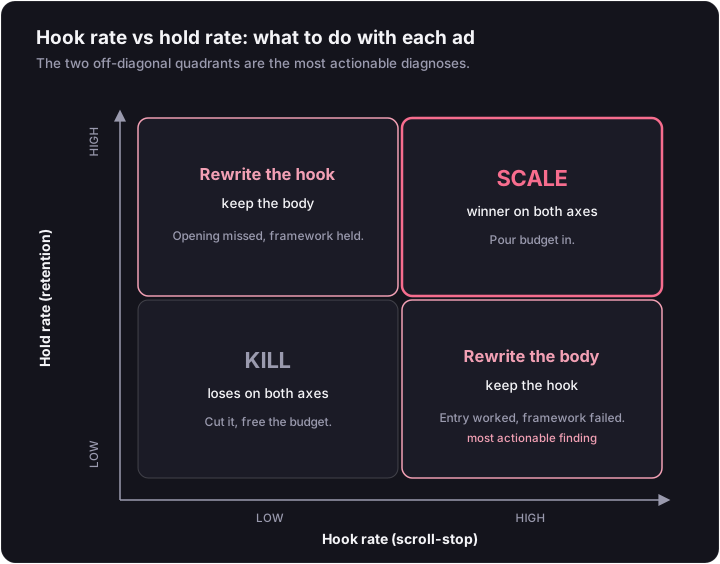
A high hook, low hold ad does not need a new edit. It needs a new PDA structure inside the body. That distinction is the difference between a strategist and a producer.
Who Owns What: Strategist, Buyer, Production
The complexity of algorithmic advertising broke the founder-plus-designer-plus-buyer setup. Expecting one person to read data, write briefs, run the auction, and edit video collapses creative velocity at scale every time. The modern DTC growth team runs as a triad.
| Dimension | Creative Strategist (Architect) | Media Buyer (Operator) | Production (Executor) |
|---|---|---|---|
| Core objective | Build falsifiable psychological hypotheses, define the creative architecture that targets | Orchestrate the AI ad systems, manage bids, validate demand | Manifest hypotheses into platform-native assets |
| Data owned | Hook Rate, Hold Rate, angle win-rates, fatigue patterns | ROAS, CAC, CPMs, Event Match Quality, attribution | Throughput, asset turnaround, visual fidelity |
| Output delivered | Modular briefs, format allocation plans | Campaign architectures, budget allocation, scaling | Edited video, design, UGC |
| Primary tooling | Motion, Foreplay, Magic Brief, AdLibrary | Meta Ads Manager, Performance Max, Triple Whale | Adobe Creative Cloud, CapCut, Figma, Air |
The strategist owns the signal. The buyer owns the system. Production owns the artifact. When CACs spike, the buyer cannot bid their way out, because no bid strategy salvages an ad people do not want to engage with. The buyer feeds performance data back upstream, and the strategist briefs the next round.
The signs the strategist seat is missing look the same across DTC accounts:
- The account stalls even though the media buyer keeps tuning campaigns and bids.
- One visual style or hook archetype has visibly fatigued and reach is collapsing.
- The media buyer is being asked to "also handle strategy" and is drowning.
- The founder briefs concepts, writes scripts, and reviews edits on the same day.
- Production output is high but the angles all read the same.
If two or more are true, the work is already happening, just bottlenecked on whoever is least equipped to do it. The staffing options sit in the hire decision.
The Upstream Tool Stack
A short, opinionated map of where the actual work lives. State what each one replaces in the workflow, not features.
- Research and swipe (AdLibrary, Foreplay, Atria): replace gut-based competitor monitoring with a queryable database of long-running ads, filtered by spend duration and format.
- Angle matrix and ops (Notion): replace scattered Slack threads and one-off Google Docs with a single source of truth for hero concepts and their angle splinters.
- Brief authoring (Magic Brief, Claude Projects): replace freeform briefs with templated, framework-driven structure that production can actually parse.
- Attention analytics (Motion): replace Ads Manager dashboards for creative diagnosis, because Ads Manager surfaces financial metrics and Motion surfaces attention metrics.
- Production handoff (Jira, Motion asset library): replace ad hoc handoffs with versioned asset tracking tied to the brief that produced them.
If a tool is not closing one of these loops, it is overhead.
When the Strategy Is Working
The diagnostic signals of a healthy upstream system show up in patterns, not single ads. The strongest ones to watch:
- A handful of ads running 60 or more days at 3 to 5 times your target CPA, which is the long-tail spend signal that the concept and angle have real fit.
- Weekly variant output sitting in the 80 to 100 range, which means the modular pipeline is actually compounding.
- Format diversification across UGC, founder, lo-fi, and premium lifestyle, with no single style above maybe 40 percent of spend.
- The attention-metric feedback loop running on a weekly cadence, where last week's Hook and Hold data shapes next week's briefs.
The inverse is the warning. Accounts stall not because the algorithm broke but because the upstream system is feeding it the same signal in different wrappers.
Common Failure Modes
Where DTC brands most often lose this game:
- The founder briefs one monolithic video and expects modular-scale output.
- The strategist role is folded into a designer or a buyer, and analytical work disappears.
- Aesthetic preference overrules data, lo-fi UGC gets killed because it feels "off brand," and the format that ranked is gone.
- A single angle gets ridden to fatigue because the angle matrix was never built. See angle generation.
- Briefs read like art requests instead of targeting specifications, so production manufactures beauty without psychology.
- Body copy fails to convert despite a strong hook because objections were never mapped. See objection handling.
Each of these has the same shape. Downstream effort papers over an upstream gap, and the cost shows up in CAC two to four weeks later.
Where to Go Next
Pick the path that matches what you are actually trying to do next.
- For more pipeline depth: ad angles, then awareness stages.
- For a team that runs this end to end: creative strategy services or bring on a strategist.
Work With Us
If your account is feeding the algorithm the same angle in a new wrapper every week, the fix is not a new editor or a higher bid. It is the upstream layer: hero concepts, angle matrices, frameworks, and modular briefs that give the platform diverse signals to work with. That is what we build with DTC brands inside creative strategy services, or as part of the broader creative and copy engagement when the copy layer needs rebuilding alongside it.
You
Can you look at our ads?
Want this read on your own ads?
We pull your live ads from the Meta Ad Library, set them next to the longest-running ads in your category, and send back what we'd change and test next. The teardown is free.
Get my free creative teardownWe usually reply within one business day.