UGC Creator Brief Template (+ What Goes In One)
What a UGC creator brief is (and the template you can copy)
A UGC creator brief is the one-page spec you hand a creator before they film: the objective, the customer, a hook to open on, a beat-by-beat script frame, the must-say and must-not-say lines, a shot list, the tech specs, and the usage terms. Get those eight sections right and you cut revision rounds, stay compliant, and get an asset you can actually run.
The eight sections, at a glance:
- Objective and target customer
- The hook to open on
- The script frame (beats, not a word-for-word script)
- Must-say and must-not-say
- Shot list and B-roll
- Technical specs
- Usage rights and deliverables
- FTC disclosure and the reshoot policy
The anatomy of each section is below, and a copyable, fill-in-the-blank template sits near the bottom of the page. The brief is one artifact inside a larger production process; for the full arc from casting to QA, see the end-to-end production workflow.
Why the brief is the highest-leverage hour you'll spend
Vague direction is what produces off-brand footage and revision cycles that never end. "Make it fun." "Be yourself." "Just talk about why you love it." That is not a brief, that is a wish, and the creator will fill the gap with their own assumptions about your customer, your category, and your claims.
The fix is one tight document. An hour spent sharpening the brief saves several hours of post-production back-and-forth and prevents shipping an asset you legally cannot run.
Industry research from MySocial puts the gap in numbers: detailed structured briefs are associated with roughly 73% faster project completions versus loose, informal instructions, and three to five fewer revision hours per project. At creator rates of $150 to $500 a video, one avoided reshoot pays for the time you put into the brief.
For the cost side of a wasted shoot, see what UGC actually costs. For how briefs feed a repeatable volume engine (the testing, the cadence, the 80/20 of optimization), that lives on the creative pipeline page. This page treats the brief as a single-asset spec.
The 80/20 rule: direct 80%, free the other 20%
Lock the strategic 80% in the brief: the objective, the mandatory claims, the hook to open on, the legal guardrails. Leave 20% to the creator's own wording, delivery, and improvisation.
Over-script and it reads like a TV ad, which kills the peer-to-peer trust that makes UGC work in the first place. Under-direct and the video misses the selling points entirely. That balance is the lens for reading every section below.
The eight sections of a UGC brief, one at a time
A usable brief is one to two pages, roughly 400 to 1,200 words, so a creator can absorb it in under five minutes. Each section below is "what it is for and what good looks like," with worked skincare and supplement examples where they sharpen the point. The fill-in version of the same shape sits in the template block lower on the page.
1. Objective and target customer
Open the brief by grounding the creator in one goal and one buyer.
State the single campaign objective so the creator does not cram five messages into 30 seconds. Pick one:
- Prospecting (cold audience, top of funnel): the video teaches the problem and introduces the product.
- Retargeting (warm audience that did not convert): the video answers a specific objection (price, efficacy, shipping).
- Social proof: an unfiltered testimonial, optimised for emotional connection over feature lists.
Then define the customer by psychographics and pain, not "women 25 to 34." Demographics help the media buyer, not the person speaking to the camera. A useful customer line for a dark-spot corrector reads more like: "A 30-something professional frustrated by lingering hyperpigmentation from old acne scars, who has tried expensive clinical treatments that irritated her skin, and wants a gentle daily option she can wear under makeup." That is what the creator can speak to with real empathy.
2. The hook to open on
The first three seconds decide the rest of the video. Hand the creator the opening; do not hope they find one.
Give three to five ready hook lines mapped to recognisable angles, and let the creator pick the one that fits their delivery. The four reliable angles:
- Curiosity gap: "Here's the one skincare mistake that's wrecking your barrier."
- Bold claim: "Stop buying heavy moisturisers if your skin is red and irritated."
- Relatable pain point: "If your skin feels tight and dry by 2pm every day, watch this."
- Visual pattern interrupt: a dropper held aggressively close to the lens, a sachet ripped open at the camera.
This is the brief's job. The deeper craft, the hook archetype library, the retention science behind the first three seconds, and why most hooks die, all live on the page on writing hooks that actually stop the scroll.
3. The script frame (beats, not a word-for-word script)
A rigid narrative frame, paraphrased in the creator's own voice, outperforms a full script that reads stiff on camera.
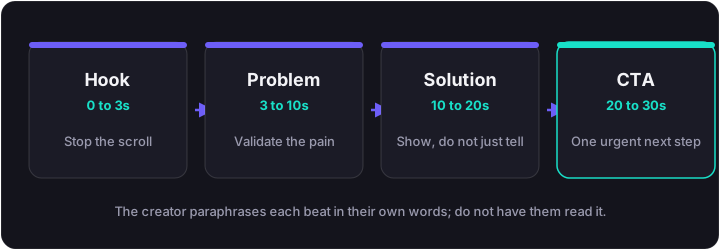
The standard direct-response arc has four beats: a hook that stops the scroll, a problem agitation that validates the viewer's frustration (use language pulled from real customer reviews), a solution shown not just described, and one simple CTA. The brief lays out the beats and rough timing. The creator owns the wording.
For the mid-video retention edits that keep viewers past the hook, route out to the craft page.
4. Must-say and must-not-say
Two short lists. The first protects the message, the second protects the brand.
Must-say is the non-negotiable selling points and claims that need to be in frame. For a serum: "five essential ceramides," "fragrance-free," "dermatologist-tested." Pick two or three; do not stack ten.
Must-not-say is the guardrail list, and in regulated categories (skincare, supplements, wellness) it is where the brief becomes a compliance tool. No "cures," "treats," "heals," or "prevents" any medical condition; use cosmetic language ("soothes," "calms," "reduces the appearance of"). No naming competitors. No profanity. For the deeper legal background on what gets brands fined, see the claims and disclosures rules.
5. Shot list and B-roll
A talking head alone is thin. The brief specifies the visual proof.
Four shot types cover most DTC briefs:
- Product intro: clean, well-lit, logo facing the camera.
- Texture or application macro: the serum dropping, the cream rubbed in, the capsule poured out. Skincare and supplement videos live or die here.
- Lifestyle integration: the product on the vanity, on the kitchen counter, in a gym bag.
- Silent B-roll: morning-routine setups, reaction shots, anything an editor can lay a voiceover over.
This is what gives the editor enough varied footage to keep the cut moving. The pacing itself (a cut, zoom, or angle change every few seconds) is craft territory; route to edit-pacing on the craft page.
6. Technical specs
The format constraints that make footage usable.
Lock the generic spec in the brief; the per-platform specifics live on the channel pages so this brief stays a single document, not a platform manual.
| Spec | What to require | Why it matters |
|---|---|---|
| Aspect ratio | Vertical 9:16, 1080x1920 | Horizontal footage is unusable in short-form feeds |
| Audio | Clean, quiet room, no echo or fan hum | Phone-mic failure in a noisy room is a top reshoot trigger |
| Lighting | Indirect daylight or a soft ring light, no harsh shadows | Bad light obscures the product and reads as low-trust |
| Framing | Face and product centred, inside platform safe zones | Off-centre product gets covered by captions and UI |
| Captions | Burned-in on the final edit | Most short-video viewers scroll with sound off |
| Filters | None. No beauty filters, no skin smoothing | Raw texture is the trust signal; smoothed skin reads as fake |
| Length | Raw footage that edits down into the short high-retention window | Every extra second raises the swipe-away probability |
Per-platform numbers (TikTok vs Meta length ranges, sound-on-by-default vs sound-off-by-default, channel-specific safe zones) differ enough that they belong on the channel pages: the TikTok vs Meta cut comparison, TikTok specs, and Meta specs.
7. Usage rights and deliverables
State plainly what the brand is buying.
Five things the brief must specify:
- What you receive: raw clips, edited cut, alternate hooks, or some combination.
- Exclusivity: can the creator sell similar footage to a competitor.
- Duration: 90 days, 6 months, 12 months, or perpetual.
- Where it runs: paid social only, organic, web, email, retail. Paid usage commands a higher rate than organic.
- Delivery method: Google Drive, Frame.io, or the creator posts to their own feed.
The brief states the terms; the licensing spectrum, whitelisting mechanics, and how each lever moves the price are the rights primer's job, see usage rights and whitelisting and how usage terms move the rate.
8. FTC disclosure and the reshoot policy
Two clauses that prevent expensive surprises.
FTC disclosure. The brief mandates a clear and conspicuous disclosure, both audible and on-screen, since many viewers watch muted. This applies even when the brand runs the footage in its own paid ads. Liability sits with the brand, not the creator: under the FTC's updated Endorsement Guides, the civil penalty stands at $53,088 per violation, and 2025 enforcement leaned hard on the health, wellness, supplement, and skincare categories. The brief's job is the mandate ("you must verbally acknowledge the partnership, we will add the on-screen #ad in post"); the full legal landscape sits on the FTC, music, and likeness page.
Reshoot policy. Define upfront that ignoring the tech spec, missing a must-say, or breaking a must-not-say (including FTC compliance) obligates a free reshoot. Accountability is set before filming, not negotiated after.
The brief in your workflow: contract, sign-off, then shoot
The brief is not an afterthought on an email thread. It sits inside the contract.
The creator signs that they have read the brief, accept the usage terms in Section 7, and acknowledge the reshoot policy in Section 8 before product ships or a single frame is filmed. Contracting tools like DocuSign or Deel, or UGC marketplaces like Billo, Insense, and JoinBrands, carry that signature. For the full arc from casting through delivery, see the production workflow and how to find and vet the creator you are briefing.
The UGC creator brief template (copy and fill in)
Lift the block below, swap the bracketed fields, and you have a working brief. The example fields use a placeholder skincare brand to model what good looks like; the same shape works for supplements, wellness, beverage, and most DTC categories.
[BRAND] Creator Brief: [Campaign Name]
Project overview and deadlines - Brand: [Brand] - Product: [Product name and size] - Deliverables: 1x edited vertical video (15–30s), 3x raw B-roll clips, 2x alternate hook readings - Draft deadline: [Date] - Final delivery: [Date] - Compensation: [$Amount], includes [duration] paid-media usage rights
1. Strategy: objective and target customer
Campaign objective: [Prospecting / Retargeting / Social proof]. We are targeting [audience temperature]. The primary goal is to [educate on the problem / overcome the X objection / build trust through testimonial].
Target customer profile: - Who they are: [Specific psychographic, not demographic] - Their pain points: [The frustration in their own language, the failed alternatives they have tried] - Their desire: [The outcome they want, stated as a feeling not a feature]
2. Hook options (pick one)
Speak directly to camera with high energy. Pick the line that feels most natural to you.
- Option A (curiosity): "[Curiosity-gap line tied to the customer's problem.]"
- Option B (bold claim): "[A disruptive statement that challenges what they already do.]"
- Option C (visual interrupt): [Action with the product held close to the lens.] "[The line that follows the interrupt.]"
3. Script frame (paraphrase, do not read)
- Hook (0–3s): Open on the chosen hook. To camera, high energy.
- Problem (3–10s): Show the problem visually. Validate the frustration in your own words. Reference what does not work.
- Solution (10–20s): Introduce [Product]. Demonstrate using it. Explain the mechanism in plain language.
- CTA (20–30s): Hold the product. "[Specific CTA line, e.g. "Tap the link below to try it."]"
4. Must-say and must-not-say
Must-say (include at least two): - "[Selling point one, e.g. a key formulation claim]" - "[Selling point two, e.g. a trust marker like 'dermatologist-tested']" - "[Selling point three, e.g. a sensory benefit]"
Must-not-say (critical): - Do not make medical claims. No "cures," "treats," "heals," or "prevents." Use cosmetic language only: "soothes," "calms," "reduces the appearance of." - Do not mention competitors by name. - No profanity.
5. Shot list and B-roll
Please deliver the following in your raw footage:
- Shot 1: Texture or application macro (the [product action] up close).
- Shot 2: Application or rub-in shot showing the finish.
- Shot 3: Lifestyle B-roll, 5 seconds, product on [vanity / counter / gym bag], no speaking.
6. Technical specs
- Format: Vertical 9:16, 1080x1920. Shoot on rear-facing phone camera.
- Length: Final edit 15–30 seconds; please shoot enough raw to cut to that.
- Lighting: Indirect natural daylight or soft ring light. No harsh shadows.
- Audio: Quiet room, no AC or fan hum, no street noise.
- Framing: Face and product centred, inside the safe zone (do not place product at the extreme top or bottom).
- Filters: None. No beauty filters, no smoothing.
7. Usage rights and deliverables
By accepting this brief and payment, you grant [Brand] [exclusive / non-exclusive] rights to use, edit, and distribute the content across [paid social on Meta, TikTok, YouTube / paid + organic / web + email] for [duration] from the date of final approval. You [are / are not] required to post the content on your personal channels. Delivery via the provided cloud-storage link.
8. FTC disclosure and reshoot policy
FTC disclosure (required): In the raw footage, include an audible disclosure of the partnership, e.g. "[Brand] sent me this to try..." or "I'm working with [Brand] to show you..." We will handle the on-screen #ad text on the paid deployment side.
Reshoot policy: One round of minor edit revisions is included. If the delivered footage ignores the technical spec, omits a must-say, or breaks a must-not-say (including FTC), a free reshoot of the affected elements is required.
A note on AI-generated UGC
A brief like this is built for a human creator. AI UGC tools change the inputs (you feed a script and pick an avatar) but the strategic spine, the objective, the hook, the claims, the disclosure, still has to be decided by you. For where AI fits and where it backfires, see the AI UGC overview.
Get your briefs (and the footage) handled
The brief is the leverage point. Writing a sharp one per concept, every week, while sourcing the right creator, managing rights, and handling the reshoot loop, is where most DTC teams stall.
If you would rather hand off the briefing-to-delivery cycle and just receive ad-ready cuts, see how we brief and produce UGC for DTC brands.
You
Can you look at our ads?
Want this read on your own ads?
We pull your live ads from the Meta Ad Library, set them next to the longest-running ads in your category, and send back what we'd change and test next. The teardown is free.
Get my free creative teardownWe usually reply within one business day.