How to Create UGC for Brands: The Full Workflow
What it actually takes to make UGC for a brand
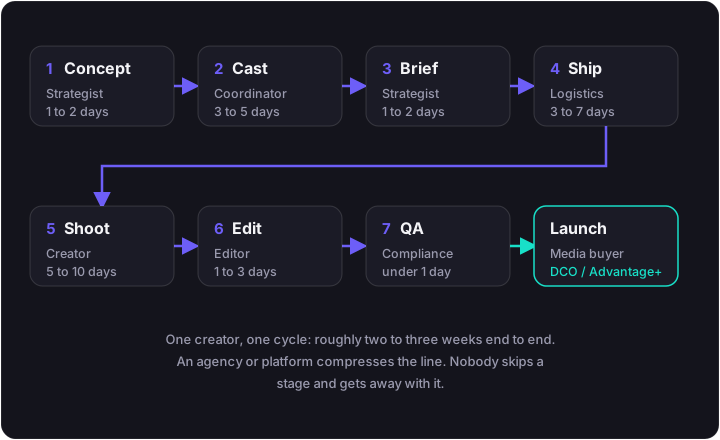
Creating UGC for a brand is a seven-stage production line: lock the angle, cast the creator, write a tight brief, ship the product, shoot it (creator at home, an agency content day, or AI), edit it into variants, and run a compliance check before launch. One creator, one cycle, lands at roughly two to three weeks, and the failure points are predictable at every stage.
The focus is how the asset gets made, not how to write the hook or how to test the ad once it is live. If you need the upstream question of why UGC ads work in 2026 paid social at all, that lives on its own page.
UGC here means commissioned creator-style video that a brand runs as a paid ad. It is not your customer's spontaneous Instagram post. It is engineered to look unproduced while being scripted, briefed, shot, edited, and legally cleared end to end. A brand can run all seven stages in-house, hand them to creators, or outsource the line to an agency, but the stages do not change.
Stage 1: Concept and angle
UGC that converts is scripted to an angle, not improvised on vibes. The angle is the underlying psychological approach: the skeptical buyer, the three mistakes you are making, the competitor switch, the wasted-money confession. Without one, the shoot produces a charismatic monologue that goes nowhere in paid auctions.
The output of this stage is a matrix, not a single script. Most teams write 10 to 20 distinct angles, then three to five different opening hooks per angle, which yields 30 to 60 hook variations heading into the shoot. The hook on each is a pattern interrupt or curiosity gap built for the first three seconds.
A strategist or growth lead owns it. With pre-existing brand frameworks and LLM-assisted scripting, this compresses to one or two days. The depth of hook craft and the operating system for running many angles at once live on their own pages.
Stage 2: Casting the creator
The casting bar is camera presence and demographic match to the buyer, not follower count, because the brand runs the video as its own ad and almost nobody sees it on the creator's profile. Creators under 5,000 followers often convert better in paid placements than macro-influencers because they read as relatable. The one signal that holds up across briefs is volume: a creator who has delivered 50-plus UGC videos tends to stress-test the brief, flag ambiguity, and understand what direct response actually wants.
Sourcing happens on creator marketplaces like Modash, Insense, and Influee, with rates for a 30 to 60 second video commonly sitting between $150 and $300. A creator coordinator or influencer manager owns it. Plan for three to five days through outreach, rate negotiation, and contract.
How to read a portfolio and what to look for in a paid test before you commit is a job of its own. If you want to skip third-party creators entirely and pull from existing buyers, customer UGC is the alternative source. The platform-versus-agency question is on its own page.
Stage 3: The brief and a clear definition of done
A vague brief guarantees a vague video and a revision spiral. The fix is an objective "definition of done" that turns approval into pass or fail rather than personal taste.
A working checklist looks like this:
- Hook delivered in the first two seconds.
- Product in-hand within five seconds.
- One key claim plus one proof point.
- No restricted claims, no competitor mentions.
- Delivered 9:16 vertical.
The failure mode is what one source calls the "vague authenticity trap": handing a creator loose guidelines and hoping charisma carries an unstructured ad. It does not. The other failure is the reverse, cramming so many value props into 30 seconds that the creator sounds rushed and robotic.
The strategist owns this, usually one to two days. The section-by-section anatomy of the document, with a fill-in brief template, lives on its own page.
Stage 4: Getting the product to the creator
Product seeding is the hidden bottleneck of the whole pipeline. Run it on spreadsheets and a roster of 20 creators silently stalls into a roster of 20 missed deadlines.
The automated version is fast: the creator picks a variant via a secure link, address is collected, a zero-dollar order fires in the fulfillment system, tracking syncs back to a creator CRM like Grin or Stack Influence. The unavoidable reality is creator "ghosting": the product ships, the content never does. The standard posture is automated 3-day and 7-day follow-ups, then a block in the CRM and a write-off as a marketing expense. Legal escalation almost never makes sense unless the item is high-value electronics.
A logistics manager or coordinator owns it, and timelines are entirely shipping-bound, three to seven days domestic. Where samples and shipping land in the overall UGC budget is on its own page.
Stage 5: The shoot
Over-production is punished. A video that looks like a television commercial triggers ad-blindness the moment it hits a vertical feed, which is why DSLR cameras, three-point studio lighting, and lavalier mics on a UGC shoot are usually a tell that the asset will underperform. The shoot's job is to deliver lo-fi, native-feeling footage that the editor can cut into variants.
The shoot happens one of three ways. Pick by the constraint you are solving for, not by what feels prestigious.
Three ways to shoot UGC
| Approach | Typical cost | Turnaround | Creative control | Output volume | Best when |
|---|---|---|---|---|---|
| Creator self-shoots at home | $150-$300 per video | 5-10 days after product arrives | Low. You rely on the brief. | Limited by one creator's bandwidth | Default. Broadest authenticity, most variety in environments. |
| Agency content day | High upfront (location, day-rates, catering) | One day | Absolute. On-site producer enforces the definition of done. | 100+ raw hook variations in a single day | You need volume and real-time direction. |
| AI-generated | Cents to a few dollars per clip | Under one hour | Full script and persona control | Effectively unlimited | Cheap top-of-funnel hook discovery. Not the hero converter. |
These are relative ranges, not quotes. The AI path also carries a viewer-trust penalty and a federal disclosure duty that the other two do not.
What "good" self-shot footage actually looks like
You do not need to become a cinematographer to judge UGC footage, but you do need a checklist a creator can hit and you can reject against. The brand-useful version is short.
- Shoot 4K, not 1080p. 4K captures roughly 8.2 million pixels per frame versus 2.07 million in 1080p, which means the editor can crop, zoom, and reframe by up to 200 percent in post without quality loss.
- Turn HDR off. Smartphones default to HDR, which looks vibrant on the device but imports as overexposed, blown-out skin tones in Premiere, CapCut, or directly inside TikTok.
- Use the rear camera, not the selfie cam. The rear sensor is physically larger and delivers a fundamentally better optical product. A clip-on magnetic mirror screen for around $32 to $42 solves the framing problem.
- Frame at eye level. Low angles read as dominating, high angles read as diminutive, eye level reads as peer.
- Keep the face and product inside the central safe zone. On a 1080 x 1920 canvas, restrict everything that matters to a 900 x 1400 central core so TikTok captions and the Instagram engagement stack do not bury the message.
- Vary the shots. Medium for talking, close-up for texture, over-the-shoulder for application. A single static frame held for 30 seconds induces fatigue.
Treat this as the reject list, not a film school. If the creator submits selfie-cam HDR with the product label half-hidden by the caption bar, send it back.
Why phone audio is the number-one thing that kills a UGC video
Native smartphone microphones are omnidirectional and built to capture a 360-degree room, which is exactly the wrong instrument for isolated human speech at filming distance. At three to five feet, the inverse square law turns voice into echo plus HVAC hum, and viewers read that hollow audio as cheap before they read the visual as anything.
The fix is a clip-on wireless mic close to the mouth. DJI Mic 3, RODE Wireless PRO, and Hollyland Lark MAX 2 all record 32-bit float internally, which is dynamic range so wide it is mathematically impossible to clip. State the rule in your brief: bad audio is an automatic reject, no revision attempt.
Showing the product so a viewer can almost feel it
The viewer cannot touch, smell, or feel an e-commerce product, so the demonstration has to substitute for that. The sequence that survives the scroll is ordered.
- Stage a real environment. Slightly imperfect kitchen counter, real bedroom, parked car. Sterile reads as commercial.
- Open on the problem, not the product. The problem qualifies the audience in the first three seconds; the product arrives as the solution.
- Product in-hand by roughly ten seconds. Burying the reveal past that line forfeits the consumer's attention threshold.
- Macro texture shots. Serum viscosity, fabric weave, the snap of a lid. This is how you substitute for touch.
- Synced product sounds. The crisp lid, the sizzle, the thud of a quality bottle on wood. Audio doubles the texture.
- Capture a genuine reaction. Surprise, a real smile, an involuntary "wow." This is the parasocial close.
This is the definition of done made physical. It is also what makes the same footage useful across five variants instead of one.
Batching: shoot the body once, shoot many hooks
The highest-ROI move on a shoot day is filming the 30-second body once, then capturing five distinct three-second opening hooks that all cut into it. Same lighting, same outfit, same body, different problem hook, curiosity hook, ASMR hook, reaction hook. One session yields five ads.
This is a production instruction: list the hooks in the brief, capture all of them in one continuous setup, and require raw, unedited footage as a deliverable so the editor and brand can recut later. The testing logic on top of this batch (how many to launch, when to kill, when to scale) lives on the testing cadence page, because Project Andromeda demanding 20 to 40 distinct variations per month is its own conversation.
When the shoot happens in software (AI)
Tools like Zoice, MakeUGC, EzUGC, and ImagineArt turn a script into a talking-head video with an AI avatar and cloned voice in under an hour, at as little as $0.69 per generated clip on the cheap end. The use case that holds up is cheap top-of-funnel hook discovery: fire 30 avatar variants into Advantage+, find the winning angle, then hand it to a human creator to film the actual converter.
One agency teardown reported AI-generated UGC at roughly $12 per creative with a 3.1 percent hook rate, versus human UGC at $280 with a 3.7 percent hook rate and a stronger 3.4 percent final conversion rate. Read that as a directional finding, not gospel: AI is fine for discovery, human still wins the conversion. The two non-negotiables are the uncanny-valley CVR penalty on close-up faces and the FTC rule that an AI persona cannot make first-person product claims. Where AI works and where it backfires and the tool-by-tool limits are routed.
Stage 6: Revisions without the spiral
Revisions are where timelines die and agency margins disappear. The discipline that holds is surgical: one round of revisions, a maximum of three specific, objective changes, reviewed against the definition of done and nothing else.
Feedback has to be actionable. "Re-record hook 2, your hand covered the product label" is a revision. "Make it sound more energetic" is a rejection of the brief, not the video. The other failure is late approval: waiting for the full edit instead of approving the concept or a rough take early, then trying to relitigate the angle at the eleventh hour. A creative director or QA lead owns the review, the creator executes, and the round runs two to three days through Frame.io or Shade.
Stage 7: Editing into variants
Raw footage is the material. The edit is where the ad gets built, and three moves carry most of the performance.
The first is cutting to native 9:16. Anything else is resized by the platform into something worse. The second is burning in hardcoded captions, because roughly 80 percent of social viewers watch with the sound off and a talking head with no text is a guaranteed drop-off. The third is variant production: one approved hero cut is sliced into five to ten distinct ads by swapping the first three seconds, the music, or the end-card CTA while the body stays identical.
AI helps here without owning the edit. Sora, Runway, and Pika are used for B-roll cutaways every four to six seconds so the human creator does not have to film complex macro inserts. ElevenLabs is used to dub a winning English ad into five languages with the same voice. An editor owns this, one to three days. The craft of the hook itself routes to what makes a converter.
Stage 8: The compliance and QA check before launch
The last gate is legal, not cosmetic, and the FTC has tripled enforcement actions since 2022. Civil penalties are capped at $53,088 per violation under the Endorsement Guides (16 CFR Part 255), and creator and brand carry joint liability. In one recent enforcement, the FTC levied an $11 million combined fine against five influencers for deceptive endorsements with hidden paid relationships.
Two checks catch most brands. First, on human UGC: the #ad or #sponsored disclosure has to be clear, conspicuous, and visible before the "see more" break, not buried at the end of the video. Second, on AI UGC: a synthetic persona cannot say "I've been using this serum for six months," because the avatar has never used the product. Pivot synthetic scripts to third person ("customers report"), and use the native AI-disclosure label on Meta and TikTok with a clear text overlay. Whoever owns compliance owns this stage, and it runs under a day.
The deeper questions of what rights you need to negotiate before any of this runs as an ad live on the usage rights page. The trickier territory of music licensing and likeness is its own legal write-up.
Producing UGC for the hard categories
The standard workflow bends in regulated and high-friction categories, and a brand that is selling supplements, fintech, premium-AOV goods, B2B SaaS, or anything visually unremarkable needs to know how before it briefs anyone. The shorthand: the harder the category, the more value moves out of polish and into scaffolding, legal, narrative, and social proof.
How the workflow changes by category
| Category | The core constraint | What to change in production |
|---|---|---|
| Supplements and skincare | FTC claims liability, FDA structure-function rules, TikTok category bans on "before and after" body images | Pre-approved claims list in the brief, every outcome framed as personal observation not guaranteed result, lean on "micro-solution routine" formats ("my 10-second morning skin routine") over banned transformations |
| Fintech and money | Steep trust barrier, FTC and CFPB and FINRA oversight, abstract product | Older authority-style creators in their mid-30s to 40s, confessional format, hyper-specific pain ("a $47 transfer fee" beats "save money"), conditional language built into the script ("could save you up to") |
| High-consideration and premium ($150+ AOV) | 30 to 90 day decision span, anxiety of losing money | Long-form testimonials over five-second soundbites, social-proof mashups of reviews and clips, founder-led origin story, risk-reversal (trial, warranty, BNPL) named on-screen |
| B2B and SaaS | Intangible product, logic-driven buying committee | Screen-recorded dashboard walkthroughs as the demo, customer case-study clips sliced into shorts, employee or practitioner advocacy on LinkedIn over Instagram |
| Low-visual or "boring" goods | No aesthetic hook, low organic shareability | On-screen listicle format with text overlays as the narrative, unspoken-drama skits between characters, post-purchase trust signals (shipping, warranty, real reviews near the buy button) |
The relative findings worth weighing: one premium tequila brand reported a 52 percent lift in add-to-cart from founder-led UGC discussing tasting notes; Bluemercury reported a 93 percent conversion increase from shoppable UGC video syndication on product pages; Blueland's process-ritual TikToks (a tablet dissolving in water) reportedly drive roughly 4x the conversion of traditional ads. Read those as documented category tactics from third parties, not as numbers Chance produced.
For the hard categories, the seven-stage pipeline does not change, but the brief, the casting, and the QA stage each get harder. A supplements brand cannot launch with the same brief a swimwear brand uses, and trying produces ads that either underperform or attract regulators.
Getting it produced without building the line yourself
You can run all seven stages in-house. The cost is the coordination, and it is rarely the cost a brand expects. Casting, briefing, shipping, revision discipline, and a real compliance check are each a job, and the failure points compound across them: a vague brief surfaces as a revision spiral, a missed FTC disclosure surfaces as an $11 million headline.
The case for outsourcing the line is not creative ego. It is that the production system itself, the 20 to 40 distinct variations a month Andromeda actually requires, is what produces results, and that system is what an agency absorbs. If you would rather hand the pipeline to a team than build it, this is what our UGC production is. The cost side, including where samples, creator rates, edits, and rights actually land in a realistic budget, is on the pricing page.
You
Can you look at our ads?
Want this read on your own ads?
We pull your live ads from the Meta Ad Library, set them next to the longest-running ads in your category, and send back what we'd change and test next. The teardown is free.
Get my free creative teardownWe usually reply within one business day.