CPC vs CPA: Which Number Should Run Your Ad Budget?
In CPC vs CPA, the first number is the price of a click and the second is the price of a sale. Only the second one shows up on your P&L.
Teams get cheaper clicks, call it a win, and miss that each sale got more expensive because the new traffic converts worse.
CPC vs CPA: the difference
CPC is the price you pay for a click. CPA is what each conversion actually cost you, and CPA = CPC divided by conversion rate. Bid on whatever the platform sells, but judge every campaign on CPA against your break-even.
In Google's own definitions:
- Cost per click (CPC): you pay for each click on your ad, and a click won't cost more than your maximum CPC bid. The amount you're actually charged is often lower.
- Cost per conversion (CPA): total cost divided by the number of conversions. It tells you what each conversion cost on average.
CPC is an input. CPA is the outcome. A low CPC can sit on top of a CPA that loses money.
| CPC | CPA | |
|---|---|---|
| What it measures | The price of one click | The cost of one conversion (a sale, lead, signup) |
| Formula | Cost / clicks | Cost / conversions, or CPC / conversion rate |
| Who sets it | The auction, capped by your max CPC bid | The result of your CPC and your conversion rate. You can set a target, but you rarely pay it directly |
| What moves it | The ad, CTR, auction competition | Everything that moves CPC, plus the landing page, offer and checkout |
| Where it misleads you | Cheap clicks from low-intent traffic look like efficiency | Platform-attributed CPA can look healthy while blended acquisition cost doesn't |
The formula that links them: CPA = CPC / conversion rate
When both numbers are measured over the same clicks:
- CPA = cost / conversions
- Split that into two parts: (cost / clicks) / (conversions / clicks)
- Cost / clicks is CPC. Conversions / clicks is conversion rate.
- So CPA = CPC / conversion rate.
The same chain runs one level up. CPC = CPM / (CTR x 1,000). That means a cheap CPM with a weak click-through rate can still give you an expensive click, and an expensive click with a weak page gives you an expensive sale. For what a healthy click-through rate looks like on each platform, see our breakdown of good CTR.
Worked example with hypothetical numbers
These numbers are illustrative, not client data.
- A $1.20 click at a 2.5% conversion rate = $1.20 / 0.025 = $48 CPA.
- Lift conversion to 3% with the same click price = $40 CPA.
- A $2.40 click at a 6% conversion rate = $2.40 / 0.06 = also $40 CPA.
You paid double per click and got the same cost per sale. If the pricier click comes from higher-intent traffic, it may well be the better buy.
The grid: cheap clicks that cost more per sale
Each cell is the resulting CPA. All values are hypothetical.
| CPC \ Conversion rate | 1% | 2% | 3% | 6% |
|---|---|---|---|---|
| $0.80 | $80.00 | $40.00 | $26.67 | $13.33 |
| $1.20 | $120.00 | $60.00 | $40.00 | $20.00 |
| $2.40 | $240.00 | $120.00 | $80.00 | $40.00 |
| $4.00 | $400.00 | $200.00 | $133.33 | $66.67 |
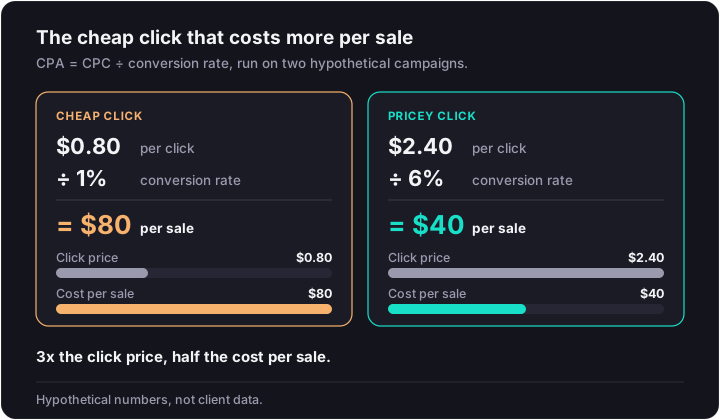
A $0.80 click at 1% costs $80 per sale. A $2.40 click at 6% costs $40. The click costing three times as much produces a sale at half the price.
Conversion rate moves CPA as hard as click price does. In most accounts it's the cheaper lever to pull, because you control the page and you don't control the auction.
Pricing model vs metric: what you're charged for vs what you judge on
CPA names two different things:
- The CPA pricing model: you only pay when an action happens. This is common in affiliate and network deals.
- The CPA metric: a ratio you calculate from spend and conversions, whatever you were billed for.
On the main ad platforms, you're usually billed for something other than the conversion:
| Platform | What you're typically charged for |
|---|---|
| Meta | Per impression (CPM) by default. Per link click only on some objectives, such as Traffic |
| Google Search | Per click (CPC), capped at your max CPC |
| Microsoft Shopping | Optional cost per sale: you pay only for a sale within 24 hours of a click on a product ad |
So for most brands, CPA is a target you set, not a price you pay. Microsoft's cost per sale on Shopping is the rare true pay-per-sale option. For a wider look at which networks bill how, see our comparison of PPC platforms.
Why platforms don't love selling you CPA
In the auction, per Microsoft's ad-tech documentation, CPC and CPA bids are converted into an effective CPM using historical click-through and conversion rates:
- $6.50 CPA goal x 0.0001 conversion rate x 1,000 = $0.65 eCPM
- $0.50 CPC x 0.001 CTR x 1,000 = $0.50 eCPM
The party paid per click or per conversion carries the risk, and the same documentation notes that sellers may charge a risk premium for it. That's why most inventory is sold by impression or click, and why "pay only for results" is the exception.
Which bid strategy buys clicks and which buys conversions
Every platform splits its bid strategies the same way. Some buy traffic. Some buy outcomes.
| Platform | Strategy | What it optimizes | Buys | Data requirement | Change |
|---|---|---|---|---|---|
| Manual CPC | Your set max bid per click | Clicks | None | None | |
| Maximize clicks | Most clicks within budget, optional max CPC limit | Clicks | None | None | |
| Target CPA | Most conversions at your target average cost per conversion | Conversions | Evaluate over 30 days with 30+ conversions | Renamed from "Maximize conversions with a Target CPA" in 2026 | |
| Microsoft | Maximize conversions with a Target CPA | Your target 30-day average CPA | Conversions | 30+ conversions in prior 30 days, conversion tracking required | Stand-alone Target CPA closed to new campaigns in 2025 |
| Microsoft | Cost per sale (Shopping) | Pay only for sales within 24 hours of a click | Sales | 30 to 50 conversions first | None |
| Meta | Highest volume (default) | Most results for the budget | Conversions | Not specified | None |
| Meta | Cost per result goal | A target average cost per result | Conversions | Not specified | None |
| Meta | Bid cap | A ceiling on each auction bid | Conversions | Not specified | None |
| Meta | ROAS goal | A target return on ad spend | Conversion value | Not specified | None |
Every target strategy is an average. Google says plainly that some conversions will cost more than your target and some less. Meta's cost per result goal works the same way, overshooting on some results and balancing across the campaign. Don't kill a campaign over one expensive day. Campaign setup itself sits in our guide to Google Ads for DTC.
The 2025-2026 changes you'll see in the interface
- Google: "Maximize conversions with a Target CPA" became plain "Target CPA" in 2026. The bidding behavior didn't change. Only the name did.
- Microsoft: since 2025, you can't create stand-alone Target CPA on new campaigns. You set it inside Maximize conversions with a Target CPA value.
- Meta: the four strategies are Highest volume (default), Cost per result goal, Bid cap and ROAS goal.
The data threshold: 30 conversions in 30 days
Conversion bidding needs conversions to learn from. Below the floor, you're asking an algorithm to guess.
- Google suggests judging Target CPA over the last 30 days with at least 30 conversions.
- Microsoft recommends at least 30 conversions in the previous 30 days and setting the target from your actual 30-day CPA.
- Expect a 1 to 2 week learning period, then give it 2 to 4 more weeks before judging.
- Microsoft advises adjusting targets within 10 to 15% up or down.
- Microsoft advises against it when most conversions land more than seven days after the click.
- Microsoft cost per sale is recommended only after 30 to 50 conversions.
When CPC still deserves your attention
CPA is the verdict. CPC is still useful evidence.
Watch CPC closely in three situations:
- Below the conversion floor. With fewer than 30 conversions a month, a click-based strategy like Maximize clicks with a bid limit is often more stable than a CPA target the algorithm can't learn.
- Brand-new campaigns. You don't have conversion data yet, and clicks are the first signal you get.
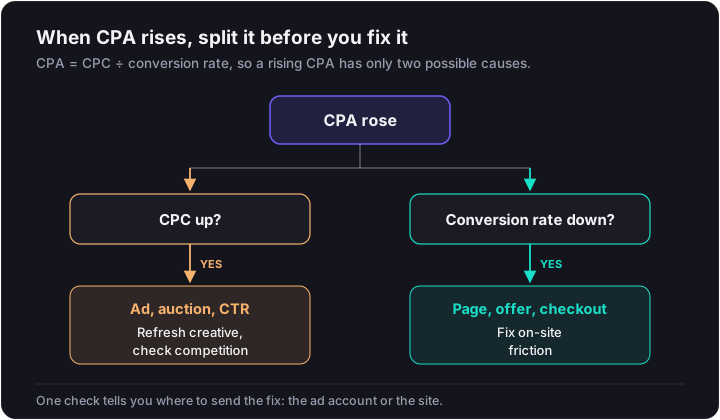
- Diagnosis. When CPA rises, split it into its two parts before you touch anything.
Since CPA = CPC / conversion rate, a rising CPA has only two possible causes. If CPC went up, look at the ad, CTR and auction pressure. If conversion rate went down, look at the page, the offer or checkout. One check tells you where to send the fix.
Page-side problems usually come down to landing page optimization first, then the broader conversion rate levers across the store.
The CPA you must beat: your break-even
A "good" CPA isn't a benchmark number. It's whatever CPA your margin can absorb.
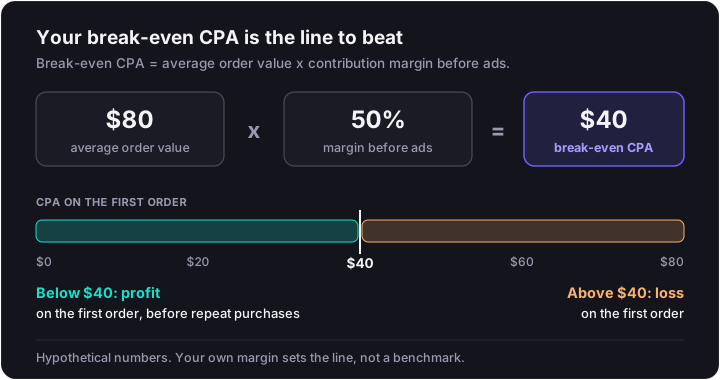
Break-even CPA is average order value times contribution margin before ads. With hypothetical numbers:
- $80 average order value x 50% contribution margin before ads = $40 break-even CPA
- Anything above $40 loses money on the first order.
- Anything below it is profit on the first order, before repeat purchases.
Rules of thumb like "CPA should be 30 to 50% of gross profit" don't trace back to a real source. Your own margin is the guide. Build the margin side properly with contribution margin, or run the same logic as a ROAS figure in the break-even ROAS calculator.
Search benchmarks, read with care
One broad dataset is LocaliQ and WordStream's 2026 search advertising report, covering thousands of Google Ads and Microsoft Ads campaigns:
- Average CPC: $5.42
- Average conversion rate: 8.18%
- Average cost per lead: $66.69, which fell overall for the first time in five years
A "lead" there means any contact action: a call, chat, form or email. The data leans heavily toward small-business lead generation, so it isn't a DTC purchase CPA. WordStream's prior-year report put average CPC at $5.26, though that figure came through a search index rather than the page itself.
Selected ecommerce-adjacent industries from the same 2026 report:
| Industry | Avg CPC | Conversion rate | Cost per lead |
|---|---|---|---|
| Shopping, Collectibles and Gifts | $4.14 | 4.01% | $49.40 |
| Apparel, Fashion and Jewelry | $4.44 | 4.50% | $97.51 |
| Beauty and Personal Care | $4.62 | 10.35% | $39.25 |
| Home and Home Improvement | $8.33 | 8.05% | $90.92 |
Use these to sanity-check your search CPC. Don't use them to set a CPA target. Meta and TikTok figures live in our paid social benchmarks.
CPA is not CAC
They sound similar. They answer different questions.
- Platform CPA is one channel's attributed cost per conversion, as that platform counts it.
- CAC is blended and fully loaded: total acquisition spend across every channel, divided by the new customers you actually gained.
A healthy in-platform CPA can sit on top of a CAC that doesn't work. Platforms can claim the same sale, retargeting can take credit for buyers who were coming anyway, and conversions aren't always first orders. Get the full picture with blended CAC, and see why platform numbers drift in our guide to good ROAS.
Next step: judge your ads on the number that pays
Bid on what the platform sells. Judge on CPA against your break-even. CPA also has two levers that never touch the bid: the creative that earns the click and the page that converts it.
Chance Ecom builds paid media in that order: creative strategy and conversion rate first, then the bidding, because a better ad and a better page lower CPA in ways a bid adjustment can't. See how that works in our performance marketing approach.
If you want a first read on your account, request a free creative teardown. We'll look at your current ads and tell you plainly where the cost per sale is leaking.
You
Can you look at our ads?
Want this read on your own ads?
We pull your live ads from the Meta Ad Library, set them next to the longest-running ads in your category, and send back what we'd change and test next. The teardown is free.
Get my free creative teardownWe usually reply within one business day.