Remarketing vs Retargeting: The Split That Matters for DTC
The remarketing vs retargeting distinction comes down to who you're reaching. Retargeting means paying for an ad that reaches an anonymous visitor your pixel tagged. Remarketing means messaging someone whose email or phone number you already have.
The two words barely differ anymore. What matters is where the data comes from, what each touch costs, and whether the ad changes what the buyer does.
Remarketing vs Retargeting: The Difference
Retargeting is paid ads to people who visited but didn't buy, built on pixel data. Remarketing is re-engaging known contacts and past customers, mostly through email and SMS. The words now overlap, so split by data source and test whether the ad changes behavior.
- Retargeting: paid ads served to people who visited or engaged but haven't converted, built on pixel, tag or cookie data.
- Remarketing: re-engaging known contacts or past customers using first-party data (email, CRM, customer lists), mostly through email but also through list uploads to ad platforms.
That vocabulary is a convention. What decides your spend is who you're paying to reach, and whether they'd have bought anyway.
Why the Two Words Got Tangled
The confusion started with a product name. Google called its audience-list feature "remarketing" for years, so "remarketing" came to mean paid ads to past visitors, the same thing other people called retargeting.
Google has since dropped the word. In Google Ads Help, remarketing lists are now "your data segments," which let you "re-engage people who have previously interacted with your brand." Customer Match, its list-upload tool, sits alongside them.
Meta never used either word. In Ads Manager you'll find:
- Website custom audiences
- Catalog ads, now labeled "Products from your catalog"
- Audience segments (existing customers, engaged audience, new audience)
The line between the two terms blurred once Meta and Google both accepted customer-list uploads, as Search Engine Journal notes. Your email list became an ad audience, and the tidy "ads vs email" split stopped holding.
The Split That Actually Matters: Data Source and Channel Cost
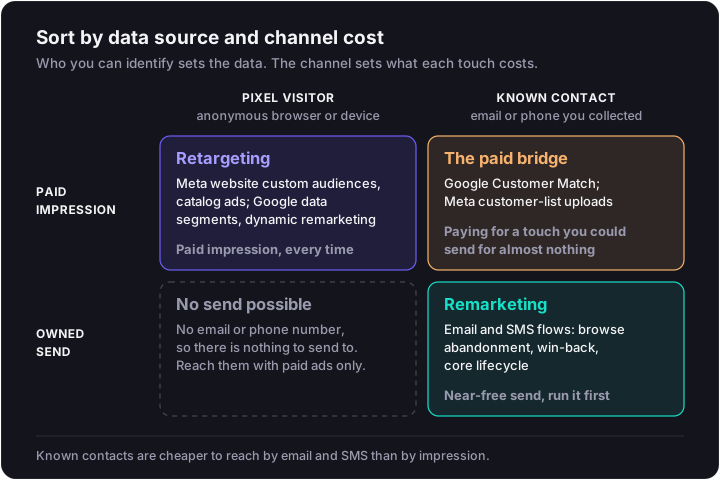
Drop the glossary and sort by two things you can act on. Pixel visitor or known contact. Paid impression or owned send.
| Retargeting | Remarketing | |
|---|---|---|
| Who you reach | Visitors and engagers who haven't bought | Known contacts and past customers |
| Data source | Pixel, tag, cookie | Email, CRM, uploaded customer lists |
| Channel | Meta, Google Display, Search, YouTube | Email, SMS, Google Customer Match |
| Identity requirement | None: anonymous browser or device | An email or phone number you collected |
| Cost per touch | Paid impression, every time | Near-free send (Customer Match is paid) |
| Max audience window | Google data segments 540 days (30-day default); Meta website custom audiences 180 days for standard events, 730 days for purchase events | Customer Match 540 days; email and SMS for as long as the contact stays subscribed |
| Minimum size | Google needs 100 active users in the last 30 days to serve on Display, Search and YouTube | No minimum for email or SMS sends |
| Platform names | Google "your data segments," dynamic remarketing; Meta website custom audiences, catalog ads | Google Customer Match; Meta audience segments and list uploads; email and SMS flows |
Reaching someone you already have an address for through a paid impression means paying for a touch you could have sent for almost nothing.
How Retargeting Actually Runs for DTC in 2026
Most DTC retargeting isn't a separate campaign anymore. It happens inside broad delivery by default. A standalone retargeting campaign is now a choice you make on purpose, not a box you tick at launch.
It's one part of your paid social system and your account structure, not a separate program.
Broad and Advantage+ Sales Already Reach Your Visitors
Meta renamed Advantage+ shopping campaigns to Advantage+ sales campaigns in 2025. After the 2025 update they include ad sets and accept custom audience exclusions.
So prospecting and retargeting can run in one campaign. Meta's delivery will find your recent visitors on its own because they're cheap to convert.
Exclusions are the lever, not separate campaigns. If you want to change who sees what, you shape the audience with exclusions rather than building a parallel retargeting campaign that competes with your broad one.
Catalog Ads: The One Retargeting Format That Earns Its Own Slot
Dynamic product ads are the retargeting tool that still pulls its weight for DTC.
- Google: dynamic remarketing shows past visitors ads that contain the products they viewed. You feed products through Merchant Center and tag your site with dynamic remarketing parameters. More on the Google setup in Google Ads for DTC.
- Meta: catalog ads, labeled "Products from your catalog" in Ads Manager, can either retarget people who took an action on your site or app, or run broad to reach people who never visited.
Catalog ads earn their slot even though broad already reaches visitors, because the creative is specific. A shopper who looked at a particular jacket sees that jacket, in their size range and colorway. A generic brand ad shown to the same person is just a reminder. The product ad picks up where they left off.
Windows: Short and Tiered by Intent
Retargeting windows run on folklore.
In a peer-reviewed field experiment (Sahni, Narayanan and Kalyanam, Journal of Marketing Research, 2019), a third of the first week's retargeting effect landed on day one. The effect decayed with time since the visit. Week-two ads worked better on people who had also seen week-one ads.
That evidence supports three rules:
- Short windows that hit hardest in the first days after a visit
- Tiers by intent: cart and product viewers get a tighter, heavier window than homepage bouncers
- Continuity: a sequence that starts early beats one that starts late
Google allows 540 days. Meta now holds purchase audiences for 730. That's a ceiling, not a recommendation. Long windows mostly buy impressions on people who've moved on.
Frequency Is a Test Variable, Not a Number
No "X impressions a week" rule has a primary source behind it. None.
Treat frequency as something you test against holdout lift. Don't copy a target from someone else's account.
The Existing-Customer Leak
A large share of what gets labeled retargeting spend pays to reach people who already bought. They're the easiest conversions in the account, so delivery goes looking for them. That flatters ROAS and inflates your blended CAC picture at the same time.
Meta used to offer an existing-customer budget cap on Advantage+ shopping campaigns. It was removed in 2025. Four controls remain:
| Control | What it does | Where it's set | What it depends on |
|---|---|---|---|
| Audience segments | Defines existing customers, engaged audience and new audience; shows spend and CPA by segment | Ad account settings | Your existing-customer definition (pixel, CAPI, uploaded lists) |
| Customer Lifecycle Strategy | Default reaches new and existing customers; a new-customers-only option filters past buyers | Ad set, in sales campaigns | The account-level existing-customer definition |
| Ad set exclusions | Excludes the custom audiences that define existing customers, the equivalent of a 0% cap | Ad set, manual sales campaign | Fresh, complete custom audiences |
| Split ad sets | Separates new and existing customers into ad sets with their own budgets | Ad set | Clean audiences on both sides |
Every control only works as well as your definition of "existing customer." If your pixel misses purchases or your list upload is three months stale, past buyers slip through as "new." Reliable server-side tracking is what makes these controls work.
Why Your Retargeting ROAS Overclaims
Retargeting does cause lift. It just causes far less than it gets credit for.
| Study | Method | Finding | What it means for your ROAS |
|---|---|---|---|
| Sahni, Narayanan, Kalyanam, JMR 2019 | Randomized field experiment | 14.6% more users returned within four weeks | Real causal effect, concentrated early |
| Johnson, Lewis, Nubbemeyer | Ghost-ads experiment on display retargeting | 17% lift in site visits, 11% in purchases | Lift exists, but it's a fraction of last-click credit |
| Gordon et al., Marketing Science 2019 | 15 Facebook randomized experiments | Observational methods generally overestimated ad effectiveness | Platform-reported results tend to run high |
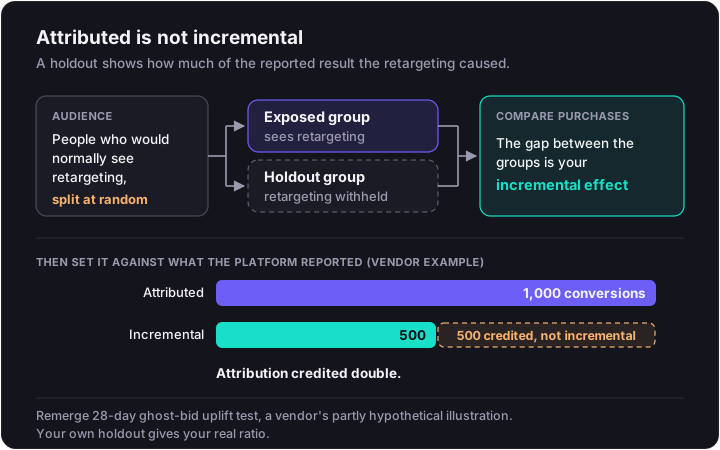
| Remerge (vendor example) | 28-day ghost-bid uplift test | 1,000 conversions attributed, 500 incremental | Attribution can credit double, though it's a vendor's partly hypothetical illustration |
Retargeting harvests buyers who were already on their way back. Attribution credits the last ad they saw. Some of those buyers needed the nudge. Many didn't.
Check platform numbers against blended results with MER vs ROAS, inside a wider attribution stack. Incrementality testing gives you the methods.
The Simple Holdout Check
Withhold retargeting from a random slice of the audience that would normally see it. Run both groups for a few weeks, then compare purchases between the exposed group and the holdout. The gap is your incremental effect. Set it against what Ads Manager reported for the same period. If the platform claims several times the lift the holdout shows, you know how much of that ROAS is real. For geo or conversion-lift versions, see how to run a holdout at that scale.
Remarketing: The Owned Half You Already Pay Less For
Known contacts are cheaper to reach by email and SMS than by impression. So run owned remarketing before you buy ads to reach someone whose address you already have.
Four flows do this work:
- Core lifecycle email flows
- Browse abandonment for product viewers who left
- A win-back flow for lapsed buyers
- SMS flows for time-sensitive nudges, with the channel trade-offs covered in email vs SMS
Customer Match is the bridge. It puts your owned lists into Google Search, the Shopping tab, Gmail, YouTube and Display. Customer Match lists don't work with manual bidding strategies.
Sensitive Categories Lose Most of the Toolkit
- Google: advertisers in sensitive interest categories can't use advertiser-curated audiences. In practice that means no remarketing lists.
- Meta: since 2025, health and wellness advertisers can't optimize on lower-funnel events like Purchase or Add to Cart, and event-based custom audiences are limited.
Classic site-visitor retargeting is mostly gone for these brands. Owned-channel remarketing and the ad itself carry the load, which is why creative as targeting matters most here.
Where to Spend: The Order That Protects Margin
- Owned remarketing first. Email and SMS reach known contacts at near-zero cost per touch.
- Catalog retargeting second, with short windows tiered by intent. Day one matters most.
- Existing-customer exclusions set and verified. Check the segment breakdown, not just the setting.
- A holdout before scaling any retargeting budget. Scale on incremental lift, not attributed ROAS.
Judge every step against your contribution margin, not platform ROAS. Pay for the ad only when it moves someone.
Get Your Retargeting Spend Diagnosed
Two questions decide whether retargeting earns its budget. How much spend is reaching people who already bought? How much of the reported retargeting ROAS would survive a holdout?
A paid media audit starts with those two. The fix is usually creative-first performance marketing: fewer ads paying for buyers you'd have won anyway, more ads doing the work of moving new ones.
Start with a free creative teardown and we'll show you where your retargeting is earning its keep and where it's taking credit.
You
Can you look at our ads?
Want this read on your own ads?
We pull your live ads from the Meta Ad Library, set them next to the longest-running ads in your category, and send back what we'd change and test next. The teardown is free.
Get my free creative teardownWe usually reply within one business day.