Agency vs In-House Paid Media for DTC: Pick by Spend
For DTC paid media, agency vs in-house comes down to monthly ad spend: an agency wins for most brands between roughly $15k and $50k a month, and loses above and below that band. Below it, agency minimums eat too much of the budget. Above it, percentage fees start outrunning the cost of a senior in-house bench.
Stop asking "should we hire an agency." Ask "what does our spend tier and creative throughput actually need." Those two variables decide the model. Headcount, founder ego, and the cost of a single salary do not.
Pick by Monthly Ad Spend, Not Headcount
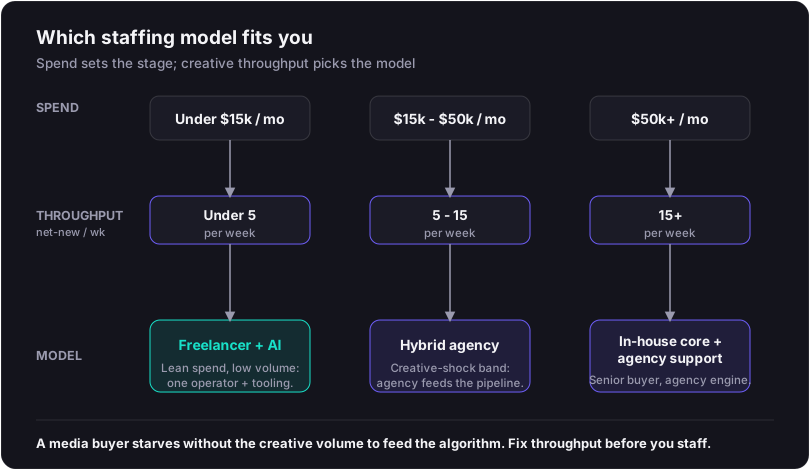
Under $15k/mo: freelancer or founder-led with AI tools. $15k to $50k/mo: a paid media agency on a hybrid retainer. $50k+/mo: in-house core with specialized agency or freelance support. The break-even where a fully loaded in-house team beats agency fees sits at and above $50k/mo in media.
At $30k in monthly ad spend, the honest annualized comparison looks like this: a specialized freelancer runs around $36k a year, a hybrid agency retainer lands near $60k, and a lean two-person in-house team is roughly $190.5k once you load taxes, benefits, and tools. The agency model is less than a third the cost of the internal build at that spend.
The load-bearing reason changes by tier. Below $15k it is pure capital efficiency. In the middle band it is absorbing creative shock that a single internal buyer cannot ship. Above $50k it is fixed-cost leverage: percentage fees on a $100k/mo media budget cross $180k/yr, which now funds an internal director plus a senior buyer outright.
| Monthly ad spend | Default model | Agency fee shape | Why this tier wins |
|---|---|---|---|
| Under $15k | Founder-led + freelancer + AI tools | Specialist retainer $1.5k to $3k | Agency minimums of $3k to $5k consume too much of a small budget |
| $15k to $50k | Paid media agency (hybrid) | $2k to $4k base + 8% to 12% of spend | Cross-brand pattern recognition and creative velocity at a fraction of in-house cost |
| $50k+ | In-house core + specialized agency support | Flat retainer for execution on secondary channels | Percentage fees now exceed the loaded cost of a senior internal bench |
The staffing call should be driven by your CAC math and unit economics, not by how an agency proposal feels next to a salary on a spreadsheet.
Why This Is a Cost Question, Not a Capability Question
The founder reflex, almost always, is "let's bring it in-house to save money." That reflex is an accounting error. Agency fees are a variable cost that flexes with spend. In-house payroll is a fixed cost that prices in 25% to 35% of overhead, three to six months of ramp, and a software stack the agency was previously absorbing.
A $75k base-salary media buyer functionally costs the business closer to $100k once you load payroll taxes, benefits, and equipment. Add $15k to $40k a year for the enterprise tools they need to do the job at parity with the agency (attribution, creative analytics, ESP, session recording). Add three to six months during which that hire is ramping while the agency or freelancer is still running the account. The "savings" disappear before the second quarter.
The capability question matters too, but it is not the lever most brands think. Internal teams can build incredibly fast iteration loops once seated. They also carry obsolescence risk: an internal buyer who loses the algorithmic edge suffers quietly for months. The question is whether your media spend is large enough to amortize the fixed cost of fixing that risk. Below $50k a month, it usually is not.
Hold this discipline against contribution margin and remember the M&A consequence: a premature in-house build can vaporize enterprise value at exit. We will return to that math at the end.
The Three Models, Honestly
Freelancer / Founder-Led
Freelancers bill $70 to $150 per hour or $1.5k to $3k a month on a project retainer. The strength is capital efficiency and the option to "test before hiring," treating an engagement as a long paid interview. A good freelancer ships fast because there is no internal review cycle to navigate.
The fatal flaw is two-fold. First, key-person risk: if your sole buyer gets sick, goes on vacation, or churns, your acquisition pipeline freezes. Second, there is no creative engine. A freelance media buyer paired with no production line hits a wall the moment the algorithm starts demanding 20 to 50 net-new variants a month.
This works below $15k/mo. Past that, a solo buyer managing your account architecture alone is one of the most common reasons brands hit the scaling wall earlier than the spend curve predicts.
Paid Media Agency
An agency aggregates media buyers, creative strategists, and analysts and rents fractions of their time across a portfolio. The advantages are concrete: cross-brand pattern recognition (they have seen what is working across dozens of accounts in your category), redundant staffing (a sick day does not halt your campaigns), and two to four week deployment versus the three to six months an internal hire takes to ramp.
The trade is split attention and a structural conflict of interest. If you pay the floor of their retainer (often $3k to $5k), you get junior talent rather than the seniors who pitched you. And on a percentage-of-spend model, the agency makes more money when you spend more, whether or not that spend is profitable.
Done right, this is the bridge to a focused creative engagement or a full-service performance marketing agency.
In-House Team
A dedicated W-2 team gives you depth of brand knowledge no external partner can replicate and decision loops that resolve in a ten-minute desk conversation. At scale, it is also mathematically superior: fixed cost beats variable percentage fees once spend crosses the right threshold.
The cost reality is brutal at the entry level. A baseline of one media buyer ($80k to $110k), one creative generalist ($60k to $80k), $15k to $20k of tools, and a 30% overhead load puts an entry team between $190k and $250k a year. A real five-person team for a brand doing $2M to $10M ranges $550k to $700k fully loaded. That number is often a fatal miscalculation for brands at $5M doing $30k a month in spend.
| Dimension | Freelancer | Paid Media Agency | In-House Team |
|---|---|---|---|
| Scope of work | Hyper-specialized; 1 to 2 channels | Comprehensive; full-funnel media, creative, analytics | Dedicated; deep brand integration across paid and owned |
| Scalability | Poor; manual patchwork as channels grow | Excellent; absorbs spend and creative volume instantly | Excellent once built; capital-intensive to scale |
| Key-person risk | Extreme; channel halts if they leave | Low; redundancy in the agency roster | Moderate; senior backfills take months |
| Onboarding time | 1 to 7 days | 2 to 4 weeks | 3 to 6 months |
| Ideal monthly spend | Under $15k | $15k to $50k+ | $50k+ |
The Real Bottleneck: Creative Supply
Media buying has been largely commoditized by Meta's Advantage+ and Google's Performance Max. The deciding variable now is creative throughput, and most in-house teams die because they refuse to model that line item honestly.
Meta's internal data shows a measurable drop in click-through rates once frequency surpasses 3.4 impressions per user per week. Industry benchmarks indicate brands refreshing creative every 7 to 10 days run CPMs 22% to 31% lower than brands refreshing monthly. Scaling DTC accounts on Meta and TikTok routinely need 20 to 50 net-new variants a month just to outrun fatigue, and most performance marketers say meaningful A/B testing requires at least ten new concepts a week.
Now do the production math. A single static ad from a mid-tier freelance designer runs $150 to $400 and takes two to five business days. A performing UGC video lands $300 to $900 and one to three weeks of procurement and editing. To hit ten new concepts a week with human production alone, creative ops become a $6k to $36k monthly line item before a single media dollar moves. A lone internal designer cannot ship that. The buyer sits idle waiting for assets, and the bottleneck silently shifts from media optimization to creative operations.
The mechanism is covered in depth in creative as targeting, the test design lives in the testing framework, and the spend mechanics live in scaling paid social.
What "Creative-Production-Included" Actually Buys You
When an agency proposal says "creative included," interrogate net-new concepts versus iteration count. A lower-tier shop takes one core video and ships ten "variants" with different text overlays. A real performance creative shop ships 15 to 30 distinct concepts a month at growth tier, and 100 to 300+ at enterprise via AI-assisted and creator-led pipelines.
The contract line that matters is "net-new concepts per month." Resizes do not move the algorithm.
Fully Loaded In-House Cost (Done Honestly)
Base salary is roughly 65% to 75% of the true cost of an internal hire. The rest is real money the brand has to spend.
Industry consensus loads 25% to 35% on top of salary for payroll taxes, health insurance, retirement contributions, and equipment. A $100k media buyer functionally costs the business up to $135k. Recruiting fees for a small specialist team run $20k to $40k. Training and ongoing development add $10k to $25k a year. The software stack the agency was absorbing (Triple Whale at $179 to $4,490 a month, Motion at $250+, AdCreative.ai at $39 to $999, Foreplay at $49 to $389, Klaviyo scaling $20 to $2,300+ by active profiles) adds $15k to $40k a year minimum.
Then add three to six months of ramp during which the agency or freelancer is still running everything and you are paying both.
| Role | Base salary | Loaded cost (+30%) | Tools fed from this seat | Annual all-in |
|---|---|---|---|---|
| Senior media buyer | $90k to $110k | $117k to $143k | Triple Whale, Motion | $130k to $160k with software |
| Creative strategist | $75k to $95k | $98k to $124k | Foreplay, Motion | $105k to $135k |
| Designer / video editor | $60k to $80k | $78k to $104k | Adobe, AdCreative.ai | $85k to $115k |
| Retention / analytics lead | $80k to $100k | $104k to $130k | Klaviyo, attribution layer | $115k to $150k |
| Entry team (2 seats + tools + overhead) | ~$190k to $250k | |||
| Full 5-person bench | ~$550k to $700k |
The metric stack sits on top of paid software that an in-house team has to fund out of payroll. That bill does not disappear when the agency leaves.
The Mid-Level Trap
The single most common $135k mistake: hiring one "Head of Growth" generalist to "run marketing" without a specialized creative budget, then expecting them to ship media, strategy, copy, and design. They become a lonely bottleneck. The brand pays for the title without the team behind it. If you cannot fund the seat plus the creative pipeline that feeds it, you cannot fund the seat.
Agency Pricing Models, Decoded
Percentage of Ad Spend (10% to 20%)
The historical default. The 15% figure is the median benchmark for mid-market DTC. Larger accounts negotiate sliding scales (for example, 20% on the first $50k, 15% on the next $50k, 10% above $100k). Almost every agency enforces a $3k to $5k floor regardless of spend.
The structural flaw is built into the math. Agency revenue grows when your spend grows, whether spend is profitable or not. That is the textbook principal-agent conflict and the reason this model fits best at lower spend where agency incentive and brand incentive are still pointing the same direction.
Flat Retainer ($1.5k to $25k+)
A fixed monthly fee regardless of spend. Predictable for the brand, friendly to highly seasonal categories where a percentage model would inflate fees during peak. The risk is complacency: once the retainer is secured, the agency's profit margin grows the less time they put on the account. Only safe with explicit deliverable cadences in the contract (meeting frequency, weekly reporting, net-new creative volume).
Performance / CPA / Rev-Share
Theoretically the perfect alignment. Practically broken in 2026. Post-iOS 14.5, roughly 75% of iOS users declined tracking, Meta lost IDFA-based deterministic matching, and platforms now lean on Aggregated Event Measurement and probabilistic modeling with 24 to 72 hour delays. Meta over-claims via modeling, Google over-claims via last-click, and your "agreed conversions" reconcile poorly to your Shopify deposits.
Pure performance contracts also create perverse incentives: an agency paid per conversion will harvest your loyal customers with deep retargeting discounts rather than do the hard top-of-funnel work that compounds. Reputable shops only take this model with $500k+/mo enterprise accounts or as a thin revenue share layered on a base.
This is exactly why blended MER is the contract-level metric, not platform ROAS, and why the supporting plumbing has to be real attribution running on server-side tracking.
Hybrid (Base + Performance Kicker)
The model that actually aligns. Roughly $2k to $4k base plus 8% to 12% of spend, or a base plus a bonus tied to hitting a target MER or CPA. The base pays the agency to do real strategy and creative under platform learning phases. The kicker rewards profitable scale rather than raw budget growth.
This is the default we recommend for any brand in the $15k to $50k band.
| Pricing model | Brand fit | Risk to brand | Incentive alignment | When to use |
|---|---|---|---|---|
| % of ad spend (10% to 20%) | Smaller brands ramping | Agency pushes budget regardless of margin | Misaligned at scale | Below $30k/mo, with sliding scale baked in |
| Flat retainer | Seasonal categories, predictable spend | Complacency once secured | Neutral; depends on deliverables clause | When deliverable cadence is contractually enforced |
| Performance / CPA / rev-share | Enterprise ($500k+/mo) only | Attribution distortion, short-term harvesting | Looks aligned, often is not | Rare; mature accounts with clean attribution |
| Hybrid (base + kicker) | $15k to $100k/mo growth brands | Lowest among the four | True alignment when bonus ties to MER/CPA | Default for the $15k to $50k band |
Setup Fees, Lock-Ins, and Asset Portability
A standard onboarding fee runs 50% to 100% of the first month's retainer. A $5k engagement typically carries a $2.5k to $5k one-time setup charge covering historical data audits, pixel configuration, and tracking architecture.
A 90-day initial lock-in is standard, after which most contracts shift to month-to-month with 30-day notice. The clause most brands miss until it is too late: who owns the Ad Account, Pixel, Custom Audiences, and historical performance data when the engagement ends. Get explicit ownership in writing before signing. If the agency owns the account, you do not have a vendor, you have a data hostage situation.
Hidden Costs Most Brands Forget to Budget
Industry data puts the hidden layer at 15% to 25% on top of headline retainer. The biggest line items:
- Attribution + analytics SaaS: Triple Whale, Northbeam, or Rockerbox at $500 to $2,000+ per month depending on order volume. Mandatory above $15k/mo in spend.
- CRO + session tools: Optimizely or VWO for A/B testing, Hotjar or Clarity for session recording. $200 to $1,000 per month combined.
- Email + SMS: Klaviyo bills by Active Profiles in 2025 onward. Free to 250 profiles, $20 at 500, $150 at 10k, $720 at 50k, around $2,300 at 250k. SMS billed separately. The active-profile billing structure quietly taxes list growth and demands rigorous hygiene.
- Creative overages: Most "creative included" contracts cap deliverables. Past cap, expect $300 to $1,000+ per finished asset.
- Raw UGC sourcing: Market average around $198 per deliverable. Add 30% to 150% for paid ad usage rights. Hook variations run an extra $50 to $100 each.
- Founder / director time: Senior marketers spend 20% to 30% of their time managing the agency relationship. On a $120k director, that is a $36k annual opportunity cost paid in lost productivity elsewhere.
Most of this stack feeds the metric layer and attribution either way. The question is whether you fund it through the agency's enterprise license or buy it yourself.
The Decision Framework by Spend Tier
Stage 1: $0 to $15k/mo (Founder-Led + Freelancer + AI)
Agency minimum retainers consume an irresponsibly large slice of the budget at this stage. A $3k floor on $10k of spend is 30% of marketing in management fees. You also lack the historical data an agency needs to optimize.
The playbook: founder owns the brand voice and message, a specialist freelancer audits and manages the primary channel (usually Meta), and AI creative tools (AdCreative.ai for static volume, Creatify or similar for UGC drafts) carry production load. Goal is not to "scale to the moon." Goal is to prove you can acquire customers at a sustainable CAC.
Before you add spend, fix the account architecture. The cleanest growth lever at this stage is removing the structural waste an undisciplined account is already creating.
Stage 2: $15k to $50k/mo (Paid Media Agency, Hybrid Retainer)
This is where lean in-house teams die. The algorithm wants 10 to 50 new variants a week and a single internal buyer paired with one designer cannot ship that. Agency infrastructure absorbs the creative shock. Agency playbooks also save you the "stupid tax" of learning iOS attribution changes and algorithmic shifts by trial and error.
Engage on a hybrid model: roughly $2.5k base plus 10% of spend, or a base plus a bonus on hitting a blended CPA or MER target. Insist on blended Cost Per Acquisition and Marketing Efficiency Ratio in reporting, not platform-reported ROAS.
The natural starting point in this band is a paid media audit to size the creative gap, followed by a creative engagement to fill it.
Stage 3: $50k+/mo (In-House Core + Specialized Agency Support)
At $50k/mo spend, an 18% agency fee is $108k a year. At $100k/mo, agency fees surge past $180k a year. That number now funds a Director of Performance, a senior buyer, a creative strategist, and a retention specialist outright.
Build the core internally. Keep an agency or specialized freelancer on a flat fee for secondary channels (TikTok Shop, programmatic, Amazon) or for pure execution where internal expertise is thin. Compensate the internal buyer on a base plus a quarterly bonus tied to MER hit. Static salary leads to stagnation. A $90k base plus a bonus pool tied to blended 3.0x MER gives you the hunger of an agency with the loyalty of a W-2.
This is the scaling phase. The LTV:CAC math now governs every hire decision.
| Spend tier | Internal headcount | External support | Total annual people + tools | What good looks like |
|---|---|---|---|---|
| Under $15k/mo | Founder + 0 to 1 freelancer | Specialist on primary channel | $30k to $60k | CAC inside target, repeatable test cadence |
| $15k to $50k/mo | 1 internal creative or brand lead | Hybrid agency retainer + creative pipeline | $90k to $180k | 15 to 30 net-new concepts/month, blended MER tracked |
| $50k+/mo | Director + senior buyer + creative strategist + retention | Flat-fee agency for secondary channels | $400k to $700k | Internal buyer beats agency CPAs in split tests |
How to Transition from Agency to Hybrid In-House (Without Breaking the Account)
The transition is where brands lose data, velocity, or both. Run it methodically.
- Secure ad-account asset portability before signaling intent. Review the MSA. Confirm explicit clauses that the brand permanently owns all Ad Accounts, Pixels, Custom Audiences, and historical data. If the agency owns any of it, negotiate transfer before announcing the move.
- Insource strategy and creative first. Hire a Director of Performance and a Creative Strategist. Do not fire the agency. Let the internal team dictate brand voice and high-level strategy while the agency executes against the new direction.
- Insource retention. Move Klaviyo entirely in-house. Lifecycle voice depends on deep brand narrative and is the worst function to outsource.
- Renegotiate the agency to flat-fee execution. Transition off the percentage model to a lower flat retainer covering pure media execution or secondary channels where internal expertise is still thin.
- Terminate only after split-test confirmation. Cut the agency only once the internal media buyer is consistently beating agency CPAs in head-to-head tests.
The handoff lives or dies on server-side tracking continuity and clean attribution through the switch. If either of those breaks, you will not be able to tell whether the new internal team is winning or losing for weeks.
The M&A Footnote Most Founders Miss
Private equity and aggregators value DTC brands on EBITDA multiples, typically 3x to 5x for profitable, defensible accounts.
Agency fees are an operating expense. Fully loaded W-2 payroll is a fixed cost that lives on your P&L. If a brand at $8M revenue runs a $250k a year hybrid agency relationship versus a $550k a year internal team, that $300k delta is lost EBITDA. At a 4x multiple, building the in-house team prematurely incinerates $1.2M in enterprise value at exit.
There is a secondary diligence effect that matters: clean, agency-managed dashboards proving LTV and CAC tend to defend a higher multiple than disjointed internal spreadsheets that buyers cannot reconcile. The "control" you bought with the in-house build can cost you on the way out.
Every staffing decision in this framework should respect the contribution margin math that ultimately drives that multiple.
The Honest Self-Diagnostic Before You Hire Anyone
Run this pressure test before signing any contract or posting any job.
- Can you ship 5+ performance-ready, net-new creatives per week today? If no, an in-house media buyer will starve. Either fix the pipeline first or hire a creative-led agency that brings it.
- Is your MER reliable? If you cannot trust the blended number, no compensation model and no pricing structure can be evaluated. Fix measurement before fixing staffing.
- Do you own your ad account, pixel, audiences, and historical data? If your agency or a previous freelancer holds them, your switching cost is artificially high and the staffing question is moot until ownership is corrected.
Stuck and unsure? Start with the reactive diagnostic if performance is already slipping, or a structured paid media audit if you want a clean baseline before deciding.
Where Chance Ecom Fits
We sit deliberately in the Stage 2 creative-shock band and as the specialized creative partner for Stage 3 in-house teams.
The premise is simple: we own the creative pipeline so your buyer, internal or external, is never the bottleneck. For a brand running $15k to $50k a month in media, that means we are the engagement that feeds the algorithm enough net-new concepts to keep CPMs honest and tests statistically meaningful. For brands above $50k a month with a real internal bench, we plug in as the creative engine sitting alongside your senior buyer, on a flat retainer scoped to throughput rather than spend.
Either way, the entry point is the same diagnostic. Route to the creative engagement if you already know the gap is production, or to the broader service if you need help scoping the build.
Size the Creative Gap Before You Staff
If you are in the $15k to $50k band and your in-house team is starving for creative, book a paid media audit. We will scope the gap honestly, show you the throughput math against your current spend, and recommend the engagement that actually fits, not the biggest one.
If you are above $50k a month and weighing the transition to a hybrid in-house build, the same audit doubles as a scoping conversation for the creative partnership that keeps your internal buyer fed during and after the switch.
You
Can you look at our ads?
Want this read on your own ads?
We pull your live ads from the Meta Ad Library, set them next to the longest-running ads in your category, and send back what we'd change and test next. The teardown is free.
Get my free creative teardownWe usually reply within one business day.