Programmatic Advertising Agency: What DTC Brands Should Ask
A programmatic advertising agency can put your brand on thousands of sites, apps and TV screens, but in the ANA's 2023 study only 36 cents of every dollar entering a DSP actually reached a consumer. Your Meta CPA is creeping up, someone pitches programmatic as the next source of reach, and the pitch leaves out the fee math. Get that math first. Then decide whether you're ready at all.
Programmatic Advertising Agency: What to Check
Only 36 cents of every dollar that entered a DSP reached consumers in the ANA's 2023 study. Before you hire a programmatic agency, get the other 64 cents explained in writing, and confirm Meta, TikTok and Google are tapped out first.
- Get the fee stack itemized. Agency margin, DSP fee, data fees and SSP costs as separate lines, not one blended rate.
- Ask whether they act as principal or agent. A principal resells you media at a markup you can't see. An agent buys on your behalf.
- Require inclusion lists and a written MFA policy. Made-for-advertising sites ate 21% of impressions in the ANA study.
- Ask who makes the creative and what conversion read you get. View-through credit flatters programmatic. Click and incremental reads don't.
- Make the readiness call before signing. For most DTC brands the answer is "not yet".
What a Programmatic Agency Actually Does
A programmatic agency plans and buys display, video, native, audio, connected TV and digital out-of-home through a demand-side platform (DSP). Then it manages the parts that decide your return: supply paths, private marketplace deals, site lists and brand safety.
The agency and the DSP are different things. The agency is service. A DSP is software, a seat that bids on inventory.
The four DSPs you'll hear most often:
- The Trade Desk: a self-service platform whose clients are agencies, advertisers and other service providers; its fee is generally a percentage of client spend.
- Display & Video 360 (DV360): Google's enterprise DSP, sold through "Talk to Sales".
- Amazon DSP: now part of Amazon Ads Agent, with programmatic sitting in DVA+ (Display, Video, Audio); open to brands that sell on Amazon and brands that don't.
- StackAdapt: tiered plans from Basic (self-serve) up to Enterprise, self-serve or managed.
Demand two things in writing before any proposal goes further: the name of the DSP they'll buy on, and the full fee schedule. A channel list (CTV, audio, DOOH, native) tells you nothing about cost or control.
The first real question is who holds the seat. Whose contract is the DSP account under, and who sees the log-level data? If the answer is "ours" to both, you're renting access to your own results. For TV specifically, the buying models and measurement work differently; more on connected TV.
Where Each DSP Dollar Goes
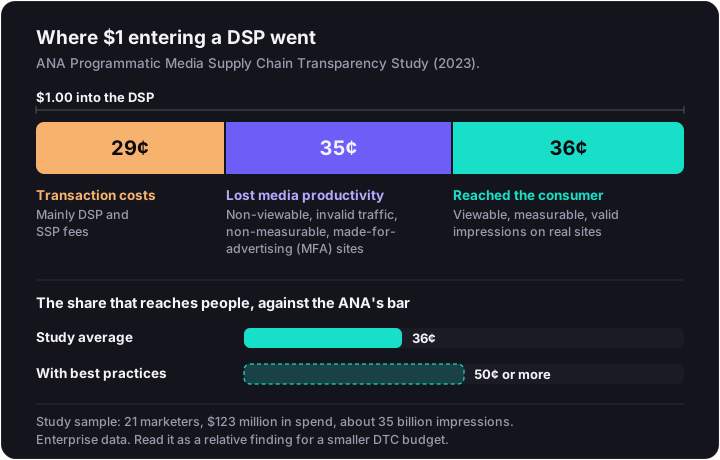
The ANA's 2023 Programmatic Media Supply Chain Transparency Study tracked 21 marketers, $123 million in spend and roughly 35 billion impressions. Its split of every dollar that entered a DSP:
| Where the dollar went | Share | What's inside it |
|---|---|---|
| Transaction costs | 29 cents | Mainly DSP and SSP fees |
| Lost media productivity | 35 cents | Non-viewable ads, invalid traffic, non-measurable impressions, made-for-advertising sites |
| Reached the consumer | 36 cents | Viewable, measurable, valid impressions on real sites |
Two more findings from the same study point straight at waste you can control:
- The average campaign ran on 44,000 websites. The ANA says fewer than 5,000 "will probably be sufficient".
- Made-for-advertising sites took 21% of impressions and 15% of spend in the subset measured.
The ANA sized the efficiency opportunity at $22 billion across $88 billion of open-web spend.
The UK picture looked similar. ISBA and PwC's 2020 study found publishers received about 51% of advertiser spend, and a 15% "unknown delta" couldn't be attributed to anyone, about a third of all supply chain costs. DSP fees averaged roughly 8%, with individual variation. ISBA's 2023 follow-up reported the unknown delta down to 3% and 65% of spend reaching media owners.
Public filings add a ceiling check. The Trade Desk's FY2025 10-K shows revenue of $2,896.3M on gross spend of $13,394.7M. That's roughly 21.6% by our arithmetic, and gross spend includes data and services, so it isn't a pure platform fee.
These are enterprise-scale studies. Read them as relative findings. A DTC brand spending far less has less leverage on fees, not more.
The Benchmark Is Improving, Slowly
The ANA and TAG TrustNet now run a quarterly Programmatic Transparency Benchmark. The Q2 2026 numbers:
- TrueAdSpend: 45.1%, up from 43.3% in Q1 2026
- Transaction costs: 27.2%
- Non-viewable spend: 10.1%, down from 13.3%
- Invalid traffic: 0.1%
Higher performers converted 52.3% of spend into TrueImpressions. Lower performers managed 31.1%.
The ANA says best practices can lift effective value to 50 cents or more on the dollar. Use that as the bar. An agency that can't show you how it gets near 50 cents is selling reach, not efficiency.
Agency Fees and DSP Minimums
Agencies charge three ways: a flat fee, a percentage of spend, or a hybrid. ISBA found those remuneration models "prevent direct cost comparisons of agencies", which is exactly why you need every fee line separated before you compare two proposals. For how these models work across paid media generally, see agency pricing.
Directory listings give a rough market range. On Clutch, programmatic agencies list minimum project sizes from $1,000+ to $25,000+ and hourly bands from $50-$99 up to $150-$199. That's self-reported market data, not a quote.
The DSPs themselves publish no minimums.
| DSP | How you get access | Public pricing or minimum | Self-serve or managed |
|---|---|---|---|
| The Trade Desk | Self-service platform; clients include agencies and advertisers | None published; fee generally a percentage of client spend | Self-service |
| DV360 | "Talk to Sales" through Google Marketing Platform | None published | Enterprise, sales-led |
| Amazon DSP | Through Amazon Ads Agent (DVA+) | None on the page; minimums set by Amazon's sales team | Self-service and managed options |
| StackAdapt | Tiered plans (Basic, Grow, Scale, Accelerate, Enterprise) | Plans listed without prices | Self-serve or managed |
Two contract rules protect you:
- Itemize margin on media separately from tech fees. A single "all-in" percentage hides the principal-based markup.
- Avoid long lock-ins before value is proven. Agencies can impose minimum monthly spend. Push for a short test window with an exit.
Questions to Ask a Programmatic Agency
The ANA's own report lists questions for media decision-makers. Add four DTC-specific ones and the fee stack surfaces in a single call.
| Question | Why it matters | Red-flag answer |
|---|---|---|
| Why would you buy MFA sites? | MFA took 21% of impressions in the ANA study | "Our algorithm optimizes for performance, so site type doesn't matter" |
| Why 44,000 sites when fewer than 5,000 would do? | Long tails hide low-quality inventory | "More sites means more scale" |
| Do you use inclusion lists or exclusion lists? | Exclusion lists let new junk sites in by default | "We block the bad ones as we find them" |
| Are you acting as principal or agent? | Principal buying hides the markup on media | "We offer a fixed CPM, so it doesn't matter" |
| What's inside your private marketplace deals? | PMP labels don't guarantee premium supply | "They're curated packages, the details are proprietary" |
| Do you use log-level data? | It's the only way to audit where impressions ran | "Our dashboards cover everything you need" |
| How do you fight fraud? | Invalid traffic burns budget silently | "The DSP handles that" with no named verification |
| Who makes the creative, and how many variants per flight? | Programmatic needs many sizes and cuts | "Send us your Meta video and we'll resize it" |
| What conversion read do I get: view-through or click? | View-through credit inflates prospecting results | "Our attribution shows a 6x ROAS" with no method |
| Can I see log-level data myself? | You can't verify what you can't see | "We share summary reports monthly" |
| Who owns the seat, the data and the assets if we part ways? | Leaving shouldn't reset your history | "The account stays with us" |
Agency vs Self-Serve DSP vs In-House
Self-serve access exists at The Trade Desk, StackAdapt and Amazon DSP. In-house means your own seat contract plus a trader who knows how to run it. An agency means someone else does both, under terms you need to read closely.
| Agency | Self-serve DSP | In-house | Chance Ecom | |
|---|---|---|---|---|
| Who holds the seat | Often the agency | You | You | Agreed upfront, set out in the contract |
| Fee visibility | Varies; depends on principal vs agent and how fees are itemized | Platform fees visible to you | Full, plus your own staff cost | Fees itemized; cost scoped per engagement |
| Creative supply | Often thin or outsourced | Yours to produce | Yours to produce | Display, native, video and CTV-ready creative made in-house |
| Data access | Negotiated; ask for log-level | Direct | Direct | Shared with you |
| Minimum commitment | Agency minimums vary ($1,000+ to $25,000+ project sizes on Clutch) | Set by the DSP's plan or sales team | Seat contract plus a trader's salary | Scoped per engagement |
| Best fit by stage | Larger brands with proven channel saturation | Teams with a trader and budget for scale | Brands spending heavily across many channels | DTC brands adding programmatic alongside Meta, TikTok and Google |
The Readiness Test: Usually "Not Yet" for DTC
Programmatic is a reach and prospecting layer. Our read, not a study finding, is that it rarely beats Meta, TikTok or Google on first-order CPA for a smaller DTC brand. StackAdapt says it directly: programmatic campaigns "perform best when they have enough budget to generate meaningful scale."
Google Demand Gen already serves ads on YouTube, Discover, Gmail and the Google Display Network, from the Google Ads account you have now. That's a large slice of programmatic-style reach without a DSP seat. Run Google Ads and YouTube ads properly before paying for another layer.
| Signal | Ready | Not yet |
|---|---|---|
| Meta prospecting | Saturated at your target CPA despite fresh creative | Still scaling, or CPA problems trace to creative |
| TikTok | Tested with real budget and real creative | Never tested, or tested with one recycled ad |
| YouTube and Demand Gen | Running and measured | Not launched |
| Creative supply | Can produce display sizes, native units, video cut-downs | One hero video and a few statics |
| Measurement | Can read a prospecting layer causally | Relying on platform-reported ROAS |
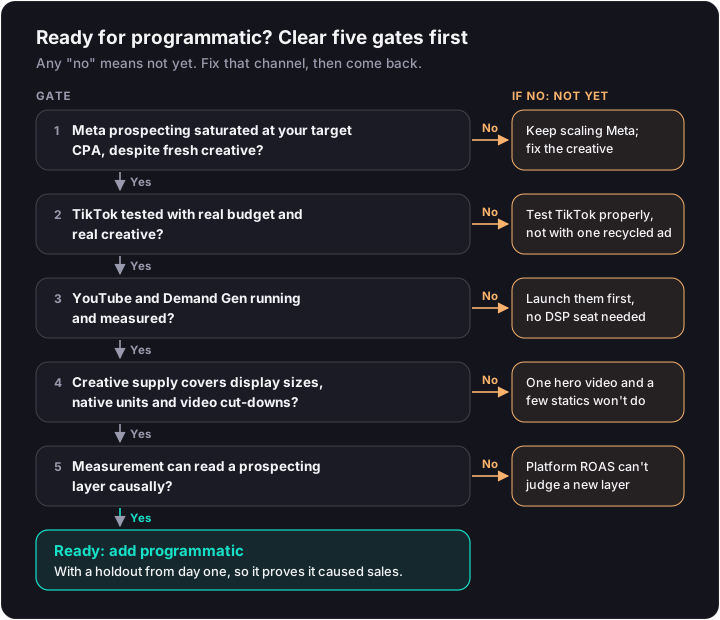
Mostly "not yet"? Wait. Fix the earlier channels, then come back. If you're close, plan a holdout from day one with incrementality testing so the new layer proves it caused sales.
Creative Still Decides What Programmatic Returns
Nielsen's analysis credited creative with 47% of sales contribution, against 9% for targeting. It's a relative finding across advertising, and programmatic doesn't escape it.
A DSP can find the right household. It can't make your ad worth watching.
Programmatic also demands more formats than social does:
- Display in multiple standard sizes
- Native units that read like the surrounding content
- Video cut-downs for in-stream and out-stream placements
- CTV-ready assets built for a lean-back screen with sound on
A DSP seat running one recycled Meta video wastes the reach you paid for. The same logic is why creative as targeting holds across every paid channel.
What Chance Ecom Does
Chance Ecom is a creative-led paid media team. Our Paid Media includes programmatic DSP buying alongside the creative, so the people making the ads and the people placing them work from the same brief.
What we handle:
- Creative for programmatic: display, native, video cut-downs and CTV-ready assets
- The programmatic buy itself, with fees itemized and seat ownership agreed upfront
- Meta, TikTok and Google buying, so programmatic is judged against the channels it has to beat
It fits two kinds of DTC brands. Brands deciding whether to add programmatic at all. And brands already running it with thin creative and a fee stack nobody has explained. See the full scope of our performance marketing services.
Get the Readiness Call Before You Sign
Send us your current Meta, TikTok and Google setup. We'll review the creative and spend, tell you plainly whether programmatic belongs in your plan yet, and build the creative to run either way.
If the answer is "not yet", you'll know which channel to fix first. If it's "yes", you'll know what to demand from whoever holds the seat. Start with our paid media team, or request a free creative teardown.
You
Can you look at our ads?
Want this read on your own ads?
We pull your live ads from the Meta Ad Library, set them next to the longest-running ads in your category, and send back what we'd change and test next. The teardown is free.
Get my free creative teardownWe usually reply within one business day.