YouTube Ads for DTC: Where Shorts Beats Meta on CPM
Most DTC brands run YouTube ads the same way they run Meta, which is exactly why their dashboards say YouTube does not work. It is a different psychological contract, a different attribution model, and a different cost curve. The rest is the format-fit decisions that change everything, the five seconds before the skip button, the Shorts CPM gap versus Meta, and how a social video gets recut to earn the view instead of paying for one.
YouTube Ads for DTC, in One Answer
The DTC mistake on YouTube is treating it like Meta. It is a sound-on, intent-driven, view-through channel where Shorts CPMs sit at $2 to $8 versus a Meta median of about $15 in Triple Whale's ecommerce panel, the first 5 seconds before the skip is the entire ad, and the in-platform dashboard underreports YouTube's incremental sales by roughly 3.4x, according to Haus's analysis of 190 incrementality tests across 74 brands.
Four pillars decide whether YouTube pays out for a DTC brand: platform fit, format fit, the Shorts arbitrage, and view-based measurement. Get those right and YouTube is the cheapest net-new-customer engine on the board. Get them wrong and you will kill profitable campaigns on day three. Treat it as a creative lever judged on blended truth, not the platform's own dashboard.
Why the Meta Mindset Breaks on YouTube
Meta is a feed. Users scroll passively, half-attending, sound off, ready to be interrupted by a thumb-stopper. YouTube is the world's second-largest search engine, and viewers arrive with intent. They came to learn a skill, research a product, or sit through long-form entertainment in a lean-back state.
OMG Commerce's Brett Curry documents the exact failure point. A major DTC brand took a 12-second silent-scroll winner from Meta and pasted it straight into a YouTube skippable in-stream placement. Result: zero view-throughs, no conversions, and the algorithm halted delivery, because YouTube is a sound-on environment that demands immediate voiceover engagement before the skip button activates.
This is not a creative tweak. It is a structural mismatch between feed mechanics and intent mechanics.
What "Meta mindset" looks like in practice
Four tells, each one breaking a different part of YouTube's economics:
- Silent-scroll creative pasted into a sound-on environment. The hook dies in the first second.
- 15-second cuts dropped into in-stream, where the algorithm struggles to scale assets that short for conversion and viewers expect more substance.
- 3-day kill switch applied to a channel whose incremental return measurably lifts in the weeks after exposure.
- Last-click attribution crediting Search or Direct for a sale a YouTube view-through actually drove.
Each one looks like prudent media buying. Each one is throwing away the channel.
The Four YouTube Ad Formats and What Each Is For
YouTube's four primary ad formats map to distinct funnel jobs. Pick the wrong format for the objective and the bidding model itself fights you.
| Format | Duration | Bid Model | User State | DTC Use Case |
|---|---|---|---|---|
| Skippable In-Stream | 45 to 90s sweet spot | CPV / tCPA | Captive for 5s | Mid-funnel education, higher-AOV products |
| In-Feed (Discovery) | Long-form, opt-in | CPC / CPV | Active opt-in | $150 to $1,000 high-ticket, tutorial intent |
| YouTube Shorts | 15 to 60s | tCPA / tROAS / CPM | Active swipe | Net-new acquisition, impulse, format arbitrage |
| Bumpers | 6s non-skippable | tCPM | Forced view | Retargeting frequency, retail-launch reach |
Skippable In-Stream (the consideration workhorse)
The 5-second skip gate is the entire game. Advertisers pay on CPV, charged only when the user watches 30 seconds or interacts. That makes in-stream a self-qualifying filter: the audience that stays past second six has effectively raised its hand.
The sweet spot is 45 to 90 seconds, sometimes pushed to three minutes for a deep founder story or product science explanation. Unlike Meta, where 15-second cuts dominate, YouTube's algorithm struggles to scale very short assets in conversion-focused in-stream. The anti-use case is the low-margin impulse buy under $20 that cannot justify the CPV or sustain a 45-second narrative.
In-Feed / Discovery (the opt-in high-ticket play)
In-Feed (formerly TrueView Discovery) shows up as a thumbnail and headline in YouTube search results, the watch-next column, and the mobile homepage. The user actively clicks. That changes the entire psychology.
This is the format for high-ticket products, the $150 to $1,000 price band where consumers want to be educated before they buy. A clicked In-Feed ad behaves more like organic content marketing than a commercial: long-form tutorials, "how it works" deep dives, comparison videos, founder documentaries. The lever is not the in-video hook. It is the thumbnail and the headline, the same way a YouTuber's CTR is decided before the video ever plays.
YouTube Shorts (the arbitrage engine)
YouTube says Shorts now averages over 200 billion daily views (Neal Mohan at Cannes Lions 2025), on top of the 2 billion logged-in monthly users Alphabet reported in 2023, and the ad inventory is still undermonetized relative to demand. That is the entire arbitrage. The format is strictly 9:16 vertical, the sweet spot is 15 to 60 seconds, and YouTube Shopping integrated directly into the video drives conversion rates up to 2.3x higher than standard in-stream because the checkout never leaves the viewing session.
This is the format with the biggest cost gap to Meta, and the place most DTC brands should be testing first.
Bumpers (the retargeting frequency layer)
Six seconds, non-skippable, bid on CPM. You are buying guaranteed eyeballs, not a click. Bumpers are not a standalone direct-response vehicle, because six seconds cannot carry a problem, solution, proof point, and CTA for a cold audience.
Where they earn their keep is as the second layer: a viewer watches a 90-second in-stream explaining a skincare routine, then a week later gets hit with a 6-second Bumper showing the product and a discount code. The Bumper closes the loop the in-stream opened.
The 5-Second Hook: What Has to Happen Before the Skip
The skippable ad architecture is brutal in its simplicity. At second five, the Skip button activates. Every viewer who would have skipped, skips. The first five seconds are not the opening of the ad. They are the entire ad, because viewers who do skip at second six should still walk away knowing what the product was. Treat the first five seconds the way you would treat the hero section of a landing page.
The three jobs of the hook
The opening sequence does three things in order, and it does them all inside five seconds:
- Visual and auditory disruption. Striking opening frame, vibrant color, sudden motion, immediate voiceover. Creative strategist Mirella Crespi notes that 95% of Shorts viewers keep sound on, which makes auditory hooks (a surprising noise, a direct claim, a trending sound) non-negotiable.
- Immediate qualification. A provocative question or bold claim that names the viewer's pain in the first beat. "Struggling to grow your business?" is qualifying. A slow cinematic fade is not.
- Brand or product reveal. If the viewer skips at second six, they should still recall what was advertised. The hook doubles as a brand impression for everyone who does not stay.
What kills the hook: slow cinematic fade-ins, generic corporate logo stings, the "setup before the payoff" structure that works in a film trailer. The payoff has to land before the skip becomes available.
Diagnosing a broken hook with thumbstop math
Barry Hott's diagnostic stack gives you the math to separate a broken hook from a broken middle:
- Thumbstop Rate = 3-second video plays divided by impressions. Below 20% the ad is failing to compete in the feed. 35%+ is passing for e-commerce product demos.
- Hold Rate = 15-second plays divided by 3-second plays. 40 to 50% is standard for e-commerce. A high Thumbstop with a low Hold diagnoses a structural failure in the middle of the video, not the opening.
- Shorts kill signal (Liam Dinneen): a Short dropping below 6% view rate or 1% CTR is signaling a dead hook. Refresh or retire.
These ratios sit upstream of your test design: you do not need a winning ROAS to know an ad is broken, you need a 12% Thumbstop Rate.
Family-of-hooks testing
The only honest way to isolate hook performance on YouTube is to keep the body identical and swap the first 3 to 5 seconds across variants. Build at minimum three:
- Variant A: the pattern break. Sudden motion or visual incongruence.
- Variant B: the pain call-out. Direct verbal naming of the customer frustration.
- Variant C: the specific promise. A hyper-specific numerical or outcome claim.
Track which version yields the highest view-through rate for In-Stream or the lowest swipe-through for Shorts. The body holds the conversion logic constant, so the delta is the hook. This is how the test actually attributes a result to a creative decision instead of to noise.
The Shorts CPM Arbitrage (and Where It Closes)
Shorts inventory is still cheap relative to attention. The cost gap to Meta is the single largest live arbitrage in DTC paid social right now.
| Surface | Average DTC CPM | User Intent |
|---|---|---|
| Meta (Facebook / Instagram) | $15.06 median ($11.50 to $21.80 by industry) | Passive scroll |
| TikTok | $3.00 to $10.00 | Dopamine swipe |
| YouTube Shorts | $2.00 to $8.00 | Swipe / intent hybrid |
| YouTube In-Stream | $3.53 to $10.00 (CTV $10 to $25) | Lean-back captive |
The Meta row is Triple Whale's ecommerce panel, August 2025 to July 2026. The gap exists because Shorts went from launch to 200 billion daily views faster than the auction could repopulate with sophisticated advertisers, and because Demand Gen and Performance Max have only recently started forcing brand budgets into Shorts placements automatically. Both compressors are running, so the window will close. This is one of the cleanest current asymmetries in the channel mix, and it is treated as such in the benchmark tables.
Why this isn't free money
The arbitrage is on CPM. CTR on Shorts is often under 1%. That means the cost-per-click math only works when the creative is format-native: vertical 9:16, UGC-styled, sound-on, jump-cut every 2 to 3 seconds, with hard-coded captions and a native look that blends with the organic feed. Pillar-boxed horizontal video dropped into a Shorts slot underperforms format-native creative by 30 to 50%, and audience retention can collapse from four minutes down to two.
Cheap CPMs on the wrong creative is the same wasted spend as expensive CPMs on the right creative. The format-fit decision is what unlocks the arbitrage.
Recutting Social Video for YouTube (Strategy, Not Editing)
The question at this level is which assets to recut, which to reshoot, and which two structural moves to make in the edit. The pipeline-level UGC craft, brief writing, and creator sourcing live with creative direction and influencer sourcing.
What transfers cleanly
Three UGC archetypes survive the platform shift because they carry substance, not pacing:
- Problem-solution. The highest-converting UGC format universally. Practitioner data puts the problem-solution conversion rate around 4.2% versus a 2.1% paid-social average, with CPAs near $42 versus $68 on Instagram for the same product set.
- Founder-led, direct to camera. Founder ads stabilize fast in the learning phase because they lean on direct human trust. Reported lift: 2.7x higher CTR, 18 to 31% lower CPA versus standard UGC, 2.3x higher ROAS.
- Educational / tutorial. "How to" content is what YouTube users actively seek out. Repurposed tutorials routinely hold 60% to 120%-indexed retention in Shorts.
What has to be reshot
The savings on recutting these are illusory:
- Trend-reliant or purely aesthetic content. Without substance, completion rates collapse to as low as 3% on YouTube. The trend that carried it on TikTok does not exist here.
- Horizontal pillar-boxed assets. Black bars in a 9:16 slot read as a non-native ad and underperform by 30 to 50%.
- Over-compressed social rips. YouTube recommends uploading 1080p at 8 Mbps (12 Mbps at 48 to 60 fps) at the native frame rate. A re-encoded TikTok rip usually sits well below that and looks broken on a living room screen.
If the asset falls in one of these buckets, do not recut. Brief a fresh shoot.
The two structural recuts
For the assets that do transfer, two moves change at the strategy layer:
- Compress the hook for Shorts. The swipe-or-stay decision lands around the 3.1-second mark. The hook has to resolve in 1 to 2 seconds. Pattern interrupts every 2 to 3 seconds maintain visual momentum.
- Expand the middle for In-Stream. Do not cut a 15-second TikTok down. Splice in raw B-roll, deeper founder explanation, and a real product demonstration to push the runtime to 45 to 90 seconds. YouTube viewers reward depth.
Same source footage, two different builds, two different rhythms.
The 900x1400 safe zone
Every short-form platform encroaches on the vertical frame with UI. The universal safe zone across TikTok, Reels, and Shorts is a 900x1400 pixel central rectangle inside the 1080x1920 master. Lock all text, faces, product imagery, and CTAs inside it. The CTA itself sits at least 350 pixels above the bottom edge.
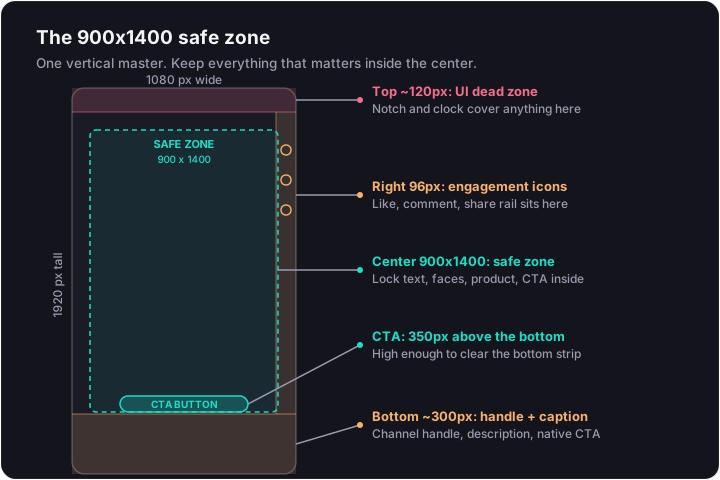
The reason to standardize on 900x1400 is operational. You stop rendering platform-specific crops for every destination. One master, one safe zone, the same file ships everywhere it needs to.
Why YouTube's Dashboard Lies to You
Incrementality decides whether YouTube survives a CFO review. Haus analyzed 190 geo-based incrementality tests that 74 brands ran on YouTube over 16 months. The findings reshaped the conversation:
- YouTube drove 3.4x more incremental DTC sales than Google Ads reported. A dashboard reporting 1.0x ROAS was, on the actual business, closer to 3.4x.
- 76% of YouTube's DTC sales impact came from new customers. It is a discovery channel, not a remarketing channel.
The mechanism is view-through, not click-through. A viewer watches a 90-second ad for a wellness supplement on Connected TV. They cannot click the TV. Three days later they open a laptop, Google the brand, and buy through a Search ad. Last-click hands 100% of the credit to Search. YouTube looks like wasted spend. It was the cause of the sale. This is the case for routing the attribution stack off the platform dashboards and onto blended truth.
The post-treatment window
In the same Haus data, YouTube's incremental ROAS improved by an average of 79% during the post-treatment window, the roughly two weeks of measurement after the ads stopped. A Meta-style 3-day kill switch on a YouTube campaign actively erases conversions that land weeks later. The required testing posture is structurally different:
- 90-day learning cycles, not 7-day.
- View-based measurement, not click-based.
- Blended ROAS or true incrementality, not the in-platform dashboard.
If you kill a YouTube ad at day three because its in-platform ROAS is 0.8x, you are killing a 2.7x business outcome.
The halo: branded search and retail
YouTube's revenue does not only show up on Shopify. Arctic coolers saw a 230% lift in mobile branded search volume in geographies where YouTube ran versus matched control regions. Another DTC brand documented by OMG Commerce used Shorts purely to seed product awareness while Amazon and retail partners acted as the cash register.
This is what "YouTube is a discovery engine" actually means in dollars. It loads demand into your other channels.
Realistic Cost and Performance Benchmarks
A single reference for 2026 DTC YouTube costs, aggregated from media-buying agencies and platform-level data (what these rates mean for a test budget is worked through in how much YouTube ads cost):
| Metric | Range | Notes |
|---|---|---|
| In-Stream CPM | $3.53 to $10.00 | Premium CTV pushes $10 to $25 |
| Shorts CPM | $2.00 to $8.00 | Active arbitrage versus Meta |
| Skippable CPV | $0.05 to $0.30 | Charged at 30s view or interaction |
| In-Stream CTR | 0.5% to 1.5% | Lower than Search, naturally |
| Shorts CTR | Under 1% | Scale offsets the rate |
| View Rate (Skippable) | 15% to 25% | 30%+ is exceptional |
| Blended ROAS (well-run) | 3.4x to 4.5x | Properly measured, not dashboard |
A few diagnostic floors worth memorizing. A Shorts ad below 6% view rate or 1% CTR has a creative problem, not a targeting problem. An e-commerce Thumbstop below 20% is failing to compete. And the absolute LTV:CAC floor across the channel mix stays at 3:1, below which the unit economics destabilize regardless of how good the YouTube reporting looks.
Where YouTube Fits in the Media Mix
A mature DTC media plan in 2026 does not pick between Meta, TikTok, and YouTube. It uses each one for the job it is actually best at. A working allocation frame:
| Layer | Budget Share | Channels | Job |
|---|---|---|---|
| Core | 50 to 60% | Meta Advantage+, Google Search / Shopping | Capture existing high-intent demand |
| Growth / Testing | 20 to 25% | YouTube (Demand Gen, In-Stream, Shorts), TikTok | Break audience saturation, seed new demand |
| Retention | 15 to 20% | Email, SMS, dynamic retargeting | Maximize LTV of acquired customers |
Inside the testing layer, TikTok and YouTube play different roles. TikTok is the rapid-iteration ground for trend-driven UGC, with the lowest CPMs but the coldest traffic. YouTube uses Google's search-intent data to find higher-intent viewers, drives higher AOV through long-form persuasion in In-Stream, and stabilizes brand awareness in a way TikTok does not.
The aggregate effect is measurable. Brands diversifying spend into Google's visual surfaces alongside paid social report Cost Per Purchase 11.3% lower than paid-social-only competitors. The channel-mix decision and the brand-versus-performance split are where this gets enforced; the search-versus-social split decides what sits inside the core.
Operationalizing the Pipeline (and Where It Routes Out)
At this page's level, the operational question is volume, format-fit, and testing cadence. Dara Denney's TRACE framework consolidates budget into a small set of distinct big concepts and only iterates on micro-elements once a concept proves it can sustain profitable scale. The volume benchmark to beat: brands testing 47 ads per month versus an industry standard of 11 are reporting 14% YoY paid CAC reductions, and that volume is what the AI-assisted production stack now makes possible.
The named tools that show up across YouTube post-production pipelines:
- Premiere Pro Auto Reframe and CapCut Pro for the actual edit, safe-zone-compliant captions, and pattern-interrupt pacing.
- Topaz Video AI or Photoshop Generative Fill for upscaling horizontal source into a usable vertical background.
- VEED for auto-trimming dead air and bulk subtitling.
- Adobe Firefly for licensed b-roll generation with commercial indemnification.
The actual UGC creator pipeline, brief craft, and shoot direction is its own discipline and lives with creative direction. The statistical test cadence sits there too. Handing the scripts, the recuts and the buying to one team is what a YouTube ads agency does.
Diagnose Your YouTube Channel Before You Scale Spend
If you are spending on YouTube right now, three questions decide whether the next dollar of budget pays back:
- Are you running format-fit creative, or pasted Meta files? If the Shorts queue contains pillar-boxed 16:9 or silent-scroll Meta exports, the format itself is forfeiting 30 to 50% of the channel's performance before the hook even fires.
- Are you measuring view-through, or last-click? If Search and Direct are eating credit for sales YouTube actually seeded, your dashboard is telling you to cut a profitable channel.
- Are you on a 90-day decision window, or a 3-day one? A Meta kill cadence applied here erases the 79% post-treatment lift before it lands.
If any of those answers is wrong, the spend underneath them is being judged against the wrong reality. A paid media audit is built to surface exactly which of the three is breaking, and our creative team inherits the rebuild from there, with the buying run by our paid media service. For the broader diagnosis of why a DTC account stopped scaling across channels, start there instead.
You
Can you look at our ads?
Want this read on your own ads?
We pull your live ads from the Meta Ad Library, set them next to the longest-running ads in your category, and send back what we'd change and test next. The teardown is free.
Get my free creative teardownWe usually reply within one business day.