
If you ship the same file to both platforms in 2026, you are leaving roughly a third to a half of the performance on the table. UGC for TikTok ads and UGC for Meta ads are no longer the same job, and treating them as one is the most common budget leak we see on intake.
Same UGC Ad, Two Platforms: Why One Cut Is Not Enough
Running one UGC file unchanged across TikTok and Meta is the single most expensive paid-social mistake of 2026. Aggregated 2026 teardowns put the performance loss at 30% to 50% when a winning creative is cross-posted without a dedicated re-cut. The platforms are not interchangeable surfaces. Build one concept, then cut it twice.
The four elements that almost always have to change between the two:
- Sound. TikTok is watched with audio on (roughly 88% or more of views). Meta is watched on mute (roughly 72% of views), so captions and visual autonomy are mandatory there.
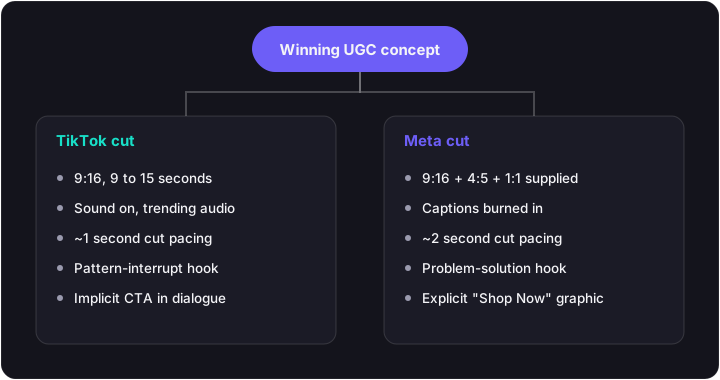
- Length and pacing. TikTok rewards 9 to 15 seconds with fast 0.8 to 1.5 second cuts. Meta tolerates 15 to 60 seconds with slower 1.5 to 2.5 second cuts.
- The hook. TikTok wants an organic pattern interrupt. Meta wants a structured problem-solution open.
- The amplification format. Spark Ads on TikTok, Partnership Ads on Meta. The raw brand upload is effectively dead on both.
This page is the side-by-side and the re-cut list, not a single-platform setup guide. If you only need one platform end-to-end, read the TikTok-only walkthrough or the Meta-only walkthrough. If the craft inside the ad is what is failing, the issue is usually the hook, not the platform.
The Fast Comparison: TikTok vs Meta at a Glance
Read the table, then read why. Every cell below is a relative 2026 finding from current teardowns and platform documentation, not a guarantee.
| Dimension | TikTok | Meta |
|---|---|---|
| Primary delivery algorithm | Smart+ automation | Project Andromeda / Advantage+ (ASC) |
| Typical CPM range | ~$3 to $10 (cheaper reach, discovery) | ~$7 to $15 (higher cost, higher intent) |
| Typical median ROAS | ~1.4x (top-of-funnel) | ~2.2x (mid-to-bottom funnel) |
| Ideal length | 9 to 15 seconds | 15 to 30s awareness, 30 to 60s consideration |
| Aspect ratio | Strict 9:16; other ratios letterboxed and penalized | 9:16 priority, plus 4:5 and 1:1 for fluid placement |
| Cut pacing | 0.8 to 1.5 seconds per cut | 1.5 to 2.5 seconds per cut |
| Audio environment | ~88%+ sound-on, native and trending audio | ~72% sound-off, captions and visual autonomy |
| Visual aesthetic | Raw, lo-fi, phone-shot, creator-first | Hybrid: polished UGC, studio, static all tolerated |
| Creator amplification | Spark Ads (creator handle, preserves social proof) | Partnership Ads (co-branded, full-funnel) |
| Creative fatigue rate | 3 to 7 day lifespan, high velocity | 7 to 14 day lifespan |
| Diversity requirement | Weekly hook swaps to beat fatigue | 15 to 20 distinct concepts per ASC |
Treat the numbers as aggregate findings, not promises. They will move with your AOV, vertical, and offer. The shape of the contrast is the durable part. For why UGC carries paid social in the first place, see the strategic case.
Sound Is the Biggest Split: Audio-On vs Audio-Off
Audio is the single largest divergence between the two platforms. Everything else flows from this.
TikTok is fundamentally an audio-first app. Roughly 88% to 95% of views happen with sound on, and the algorithm explicitly rewards trending sounds, creator voiceovers, and sound-effect punctuation. Teardowns put sound-on conversion at around 28% higher than sound-off variants on the platform. Strip the audio and you strip the narrative.
Meta is the opposite environment. About 72% of video views happen with audio off, because Meta is consumed in waiting rooms, on commutes, and at desks. The story has to survive in silence: bold on-screen text, prominent subtitles, and clear visual demonstration. A TikTok ad that relies on a spoken hook to make sense will quietly die on Meta until you burn in captions and let the visuals carry the meaning.
Caption Placement and Safe Zones
Captions are mandatory on both, but for different reasons. On Meta they are required for basic comprehension. On TikTok they reduce cognitive load and lift watch time by 12% to 40% in recent measurement.
Respect platform UI. TikTok crowds the screen at the top (username) and the bottom-right (engagement rail, audio track, description). Park captions in the center to upper-middle of the frame so the UI does not chew through them.
Length, Ratio, and Pacing: The Technical Reframe
The verdict is short: TikTok punishes anything slow or long. Meta rewards a little more room and a little more polish.
- Length. TikTok engagement peaks at 9 to 15 seconds. Meta runs 15 to 30 seconds for awareness and 30 to 60 seconds for consideration where product education actually pays off.
- Aspect ratio. TikTok is strict 9:16 at 1080 x 1920. Other ratios are displayed with black letterboxing and engagement collapses. Meta wants 9:16 as the priority but should also receive 4:5 and 1:1 files, because Advantage+ will otherwise auto-crop a single asset in ways that gut the composition.
- Cut pacing. TikTok viewers reward 0.8 to 1.5 second cuts. Meta viewers reward 1.5 to 2.5 second cuts.
The cross-platform failure mode in one line: a hyper-fast TikTok edit reads as visual chaos on Meta, and a slow, deliberate Meta edit triggers an instant scroll-away on TikTok. Same footage, two different rhythms.
One concept, two cuts:
Native Feel Means Different Things on Each Platform
"Authentic" is not one aesthetic. TikTok actively skips anything that looks like an ad, which is why the platform demands lo-fi, selfie-style, raw, organic-feeling content with chaotic energy. Polished studio work gets scrolled.
Meta is a hybrid. UGC-style ads work hard there too, especially as cheap testing fuel and for scaling CPA down, but the platform still tolerates and sometimes rewards polished UGC, studio hybrid, and even static images. For premium goods above roughly $150 AOV and for broad awareness, polish is not punished.
The diagnosis: matching the wrong register to the platform is a quiet budget leak. Lo-fi on Meta can work; studio polish on TikTok almost never does. For the deeper craft question of what actually makes the hook land, see hook and retention mechanics.
How Each Algorithm Reads Your Creative
Both platforms now treat the creative itself as the targeting parameter. Manual audience selection is largely dead. But they reward different things.
Meta's Project Andromeda is a single transformer model that parses your transcript, on-screen text, frames, and audio to decide who sees the ad. Inside Advantage+ Shopping Campaigns, it rewards diversity. Ten near-identical variations get grouped under one "Entity ID" and cannibalize each other. A healthy ASC needs 15 to 20 genuinely different concepts running concurrently, across hooks, angles, formats, UGC, static, and demo.
TikTok's Smart+ rewards velocity. Smart+ campaigns routinely outperform manual setups by 35% to 52% in ROAS in current measurement, but the price of admission is freshness. Creative fatigue on TikTok sets in inside 3 to 7 days, versus 7 to 14 days on Meta, so the platform needs constant new hook injections to stay live.
The principle in one line: Meta is a diversity problem, TikTok is a velocity problem. The fix on TikTok is usually modular editing, where you isolate the 3-second hook from a universal product body and batch-shoot five distinct hooks instead of five full videos. That is a pipeline mechanic, and it lives at the creative pipeline in full.
Running It From the Creator's Handle: Spark Ads vs Partnership Ads
The raw brand upload is effectively obsolete on both platforms. Uploading a creator's file from your brand ad account strips the social proof: zero likes, zero comments, zero context. Users read that as a commercial message instantly and scroll.
TikTok's answer is Spark Ads. The creator authorizes the brand to boost their existing organic post; the ad runs from the creator's handle and keeps all original likes, comments, and shares. Findings put Spark Ads at roughly 134% higher completion rate, 25% higher CTR, and up to 69% higher conversion versus standard in-feed uploads.
Meta's answer is Partnership Ads. The creator tags the brand, the brand approves, and the ad runs co-branded with a "Paid Partnership" label. Critically, Partnership Ads plug into Meta's bottom-funnel retargeting infrastructure with "signal stacking" across both audiences. Current measurement reports up to 53% higher CTR, 19% to 50% lower CPA, 15% higher ROAS, and up to 40% cheaper CPMs versus brand-only equivalents.
The format-level contrast: Spark Ads carry organic proof into discovery, Partnership Ads marry creator trust to Meta's closing mechanics. The full step-by-step on authorization codes, durations, and account-versus-code access lives at Spark Ads and Partnership Ads setup.
Disclosure and Music: The Rules Differ Too
The compliance mechanics differ across platforms, and the most expensive trap is the one this whole page is built around.
Each platform has its own disclosure mechanic. TikTok requires the in-app "Disclose commercial content" toggle, with a 24-hour grace window before the algorithm starts suppressing reach. Meta requires the Branded Content tag that generates the "Paid Partnership" label, and bypassing it is now classified as a deceptive practice that can earn ad rejection and account-quality downgrades.
Music is the bigger trap. TikTok's Commercial Music Library and Meta's Sound Collection are walled gardens. A track cleared for use in a TikTok ad is not licensed once the same file is reposted as a Meta Reel. That is exactly the "one file, both platforms" move this page warns against, except with statutory damages of up to $150,000 per infringed track on the back end. Treat it as one more reason to re-cut. The full legal layer lives at music and likeness legal traps, and pre-paid rights work belongs in usage rights.
The Re-Cut Checklist: Porting a Winner Between Platforms
The rule, before the checklist: never download a winning TikTok ad and upload the identical file to Meta, or vice versa. The mathematics of pacing, audio, and ratio guarantee a quiet 30% to 50% loss.
| Element | TikTok to Meta | Meta to TikTok |
|---|---|---|
| Audio + subtitles | Strip the trending audio; enlarge and extend bold captions for silent viewing | Inject trending sound and an energetic voiceover; remove clinical brand text overlays |
| Cut pacing | Combine erratic 0.8s clips into ~2 second scenes | Tighten aggressively; force a visual disruption every 1 to 1.5 seconds |
| Hook | Switch to a structured problem-solution open with a clear value prop | Replace with an organic pattern interrupt: unexpected angle, bizarre reaction, relatable break |
| CTA | Explicit "Shop Now" plus brand UI graphics are tolerated and helpful | Remove aggressive CTA graphics; make the CTA implicit in natural creator dialogue |
| Aspect ratio | Re-export to 4:5 (and supply 1:1) so Advantage+ does not auto-crop awkwardly | Lock to strict 9:16 at 1080 x 1920 |
This is the "Approach C" twin-cut workflow current production teams use to stop fighting either algorithm. Same concept. Two builds. Two files exported from the edit, not one.
When to Lead With Which Platform
The honest diagnosis, doctor not waiter: most scaling DTC brands need both, but the platform you LEAD with depends on what is broken right now.
Lead with TikTok if you need cheap reach and discovery and you can feed a 3 to 7 day fatigue clock with fresh hooks. The CPM is roughly half of Meta's, but the median ROAS is lower at around 1.4x because the platform is doing top-of-funnel work, not closing.
Lead with Meta if you have a working offer and need efficient conversion. Median ROAS sits closer to 2.2x, the bottom-funnel retargeting is meaningfully better, and the platform forgives a slower production cadence with its 7 to 14 day fatigue rate, provided you can field 15 to 20 distinct concepts inside the ASC.
The trap on both sides is brands that pick TikTok for the cheap CPM, fail to produce at velocity, then blame the platform. If the broader "is paid UGC worth it for our brand at all" question is still open, see the qualifying read.
Getting Both Cuts Produced
Knowing the specs is the easy part. The actual bottleneck is producing two genuinely platform-native cuts of every winner, on each platform's fatigue clock, without the production cost spiraling past the savings.
That is the work we do: one concept brief, two platform cuts per winner, modular hooks to reset TikTok fatigue, diverse concept families to feed Meta's diversity requirement, and the rights and music cleared per platform so nothing gets muted at the worst possible moment. If that is the gap, here is how we produce platform-native UGC ads at volume.