
Most brand-handle TikTok ads die for the same reason: the file was built for a different platform and uploaded with a sterile brand profile picture sitting on top of it. A TikTok-native UGC ad is a specific physical object, run through a specific mechanic, under a specific set of disclosures.
What a UGC ad on TikTok actually needs to look like
A TikTok UGC ad is a 9 to 15 second vertical video that reads like a peer post: sound-on, phone-shot, hook in the first two seconds, and run as a Spark Ad through the creator's handle instead of uploaded from your brand account.
Anything that looks like a TV commercial gets skipped, and anything that looks native earns cheaper CPMs, higher completion rates, and a 24-hour grace window before TikTok's compliance bots come for it.
The rest of this page covers the specs, the native-feel rules, the Spark mechanic, the compliance toggles, and the production cadence the platform demands. If you came looking for how the same concept re-cuts for Facebook and Instagram, that lives on the TikTok vs Meta page. The strategic case for UGC as direct response sits one level up.
The specs that keep your ad native
TikTok rewards one specific physical format and penalizes everything else with letterboxing, weaker delivery, or instant scroll-away. Reading these specs as suggestions is how brands burn money on assets the auction quietly refuses to scale.
| Lever | What TikTok rewards | What it punishes | Why |
|---|---|---|---|
| Aspect ratio | 9:16 strict, 1080 x 1920 | 1:1 and 16:9 (letterboxed) | Black bars eat the screen and signal "ported from elsewhere" |
| Length | 9 to 15 seconds, hook in 2 to 3 | Files that ramp slowly | Users decide in roughly 1.7 seconds; under 30% hook rate, delivery stalls |
| Cut pacing | 0.8 to 1.5 seconds per cut | Long "breathing room" shots | Slow pacing reads as a commercial; fast cuts mirror the For You rhythm |
| Audio | Sound-on, trending sound or energetic voiceover | Silent files or clean music beds | Roughly 88 to 95% of TikTok views happen with sound on; mute kills narrative cohesion |
| Captions | Mandatory, upper-middle safe zone | Bottom-right placement | UI buttons cover the bottom-right; captions there get buried |
| Resolution | Phone-native 1080 x 1920 vertical | Studio-camera framing | Polished framing breaks the lo-fi expectation TikTok users scroll for |
Aggregated findings from 2025-2026 platform reports. Specific deltas vary by vertical and creative.
The first 2 to 3 seconds carry the whole ad
TikTok users decide whether to keep watching inside roughly 1.7 seconds, and creative analytics tools peg the floor at a 30% hook rate (3-second views over impressions) before the algorithm stops feeding it. The practical brief implication: lead with the visual or text that creates the pattern interrupt, never an intro card, never the logo, never a slow-build establishing shot. Which hook archetypes actually create that interrupt is its own deep topic; see hook archetypes for the playbook.
Native feel: what TikTok actually rewards
The blunt diagnosis: TikTok's algorithm and audience both reject content that looks like an advertisement. Polished, studio-lit, tripod-locked, brand-voiced video gets skipped on signal alone, regardless of how good the script is. The platform rewards selfie-mode framing, phone audio, lo-fi lighting, real environments, and pattern interrupts that look like a friend filming something they actually care about.
What "native" means when you write the brief:
- Selfie-mode (front camera, creator addressing the lens) over locked-off tripod.
- Real rooms over white seamless or studio backdrops.
- Trending sound or energetic voiceover over a clean music bed.
- Spoken captions and on-screen text in the platform's typeface defaults.
- A visible pattern interrupt in the first beat (gesture, drop, reaction shot).
- Imperfections kept in (typos in captions, casual phrasing, room noise).
That last bullet is the one most brand teams want to override and shouldn't. The constraint is the feature: Spark Ads literally cannot be edited after authorization, which forces the imperfection to stay, which is what reads as genuine to the user.
The Spark Ads format: run UGC from the creator's handle, not yours
Uploading raw UGC from a brand account leaves performance on the floor in 2026. A Spark Ad runs the same video file from the creator's handle, preserving the original likes, comments, and profile link, and the deltas against a sterile brand-handle upload are not small.
The trade you accept up front: once the post is authorized, you cannot edit the caption, the video, or the audio. That constraint is what keeps the ad native.
| Metric | Spark Ad direction vs raw upload | What it means |
|---|---|---|
| Video completion rate | Around 134% higher | The ad keeps people watching long enough to absorb the offer |
| Engagement rate | Around 142% higher | Comments and likes compound on the original post |
| Conversion rate | Around 43 to 69% higher | The trust transfer survives the click |
| CPM | Up to 66% lower | The algorithm treats native-feeling files like organic content |
| CPC | Up to 67% lower | Same mechanic, click side |
| CPA | Around 30 to 37% lower | Lower acquisition cost net of the higher engagement |
Relative findings from aggregated 2025-2026 industry reports. Specific deltas vary by vertical, creative, and audience.
How the authorization actually works (the short version)
The creator opens the specific video they want to authorize, toggles "Ad authorization" inside the post's Ad settings, picks a duration of 7, 30, 60, 90, or 365 days, and sends you the generated alphanumeric code. You paste it into TikTok Ads Manager under "Apply for Authorization," link the post, and select it at the ad level under "Use other authorized account or post."
The one operational risk to track: when the authorization window expires mid-flight, delivery stops cold and you cannot extend it from your side. The creator has to generate a new code. TikTok One reduces the friction with in-app requests and batch syncing across multiple videos at once, which matters once you are running more than a handful of concepts.
The full step-by-step, including how Spark stacks up against Meta's Partnership Ads, lives on Spark vs Partnership. The contract language you want in place before you ask a creator for a code lives on usage rights.
What "buying Spark rights" should cost you
Creators typically charge a 20 to 50% premium over their base UGC rate for granting Spark code rights, because the asset stays on their handle and accrues engagement under their name. Build that into the brief and the rate, not the invoice surprise. The fuller UGC pricing breakdown covers base rates plus usage tiers.
Compliance: the toggles that decide whether your ad even gets seen
TikTok's automated enforcement is now fast enough that a missed toggle kills organic and paid reach inside a day. Three things every TikTok UGC ad must clear before it goes live: the commercial content toggle, the FTC disclosure (separate from the toggle), and the music source.
The "Disclose commercial content" toggle
The creator activates this before posting and picks "Branded content," which generates the "Paid partnership" label under their handle. TikTok's AI scans for brand logos, calls to action, and affiliate links; if it spots them with the toggle off, the creator gets an in-app notice within 2 to 3 hours and a 24-hour grace window to fix it.
Miss the 24-hour window and the video is pulled from the For You feed entirely. Whatever paid spend is sitting behind it stops earning the organic compounding that justified the Spark format in the first place.
The #ad caption is still required
The in-app toggle does not satisfy the FTC by itself. The caption needs an unambiguous "#ad," "Sponsored," or "Paid partner" in the first two lines, plus a verbal or on-screen disclosure inside the video. "#collab," "#partner," and "sp" are legally insufficient under the modernized Endorsement Guides.
If AI tools generated or substantially modified the script or visuals, add a second "AI-generated" or "Created with AI assistance" disclosure in close proximity. Joint liability means the brand carries the same exposure as the creator, with civil penalties inflation-adjusted to $53,088 per non-compliant post.
Music has to come from the Commercial Music Library
Any video the brand boosts as a Spark Ad has to use audio cleared from TikTok's Commercial Music Library. Copyrighted trending pop attached to an organic post will be muted, geoblocked, or rejected the moment that post becomes a paid ad, and the platform's audio-fingerprinting catches it automatically.
The cross-platform trap: CML tracks are cleared for TikTok only. A TikTok-cleared ad is not an Instagram-cleared ad. Strip and replace the audio per platform, or buy a third-party multi-platform license from a provider like Epidemic Sound or Artlist. The music and likeness pitfalls page covers the full liability map, including the Bang Energy and DSW lawsuits that turned this from theoretical to existential.
AI-generated content needs the toggle too
TikTok's detection runs on synthetic faces at roughly 94.7% accuracy, and undisclosed synthetic media triggers CPM inflation up to 300%, shadowbanning, or full account suspension. If the UGC was generated or partially generated by an AI avatar tool, flip the AI disclosure on the post. Where AI UGC actually performs on TikTok versus where it backfires is covered on AI UGC for ecommerce.
Why one good TikTok ad is not enough (and the lazy way to ship more)
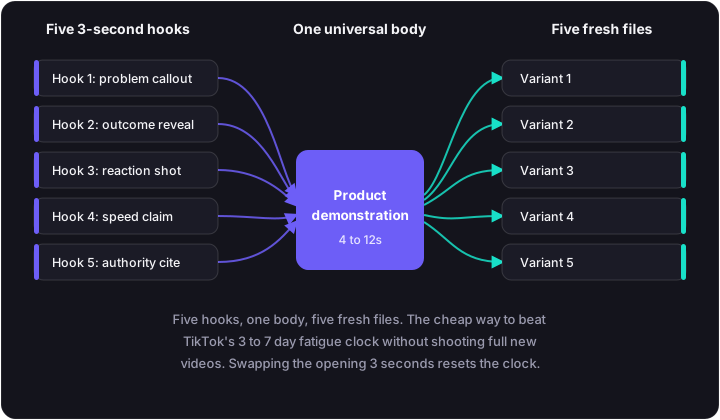
Here is the uncomfortable line: a winning TikTok UGC ad has a 3 to 7 day lifespan before fatigue sets in and the algorithm suppresses near-duplicates. Brands that scale on the platform inject fresh hooks weekly, not monthly.
The cheap way to do it is modular editing. Shoot five distinct 3-second hooks against one universal product-demo body, export each combination as a separate file, and rotate. Because the first 3 seconds dictate the entire algorithmic delivery, swapping that opening alone reads as a fresh creative to Smart+ and resets the fatigue clock without the cost of shooting a full new video.
The full operating system around this (batch sizes, file naming, kill and scale thresholds, how to brief a creator for modular shoots) lives on the creative pipeline page. Which hook archetypes are worth modularizing is covered on what makes a good UGC ad.
When TikTok UGC is the right channel (and when it is not)
TikTok dominates top-of-funnel discovery for visually-driven, lower-AOV, impulse-friendly categories. Skincare, beauty, supplements, food and beverage, accessories, novelty: this is where the platform's discovery engine pays out.
It under-delivers for high-AOV, complex, or B2B products where bottom-funnel signal stacking and longer-form storytelling close better. Median ROAS sits lower than Meta on average (closer to 1.4x vs 2.2x in early 2026 benchmarks) because TikTok is a discovery engine, not a closer.
Budget it as the awareness lane in a paid mix, not the only lane. The other half of the mix is covered on UGC for Meta ads, and the full self-qualify decision (when UGC pays off and when it burns cash) sits on is UGC worth it.
Getting it produced
Most brands fail at TikTok UGC not on the strategy but on the volume. Producing enough genuinely native, performance-built hooks weekly to keep the Spark codes flowing and the modular hooks fresh is the actual bottleneck, and it is where the operational coordination between creators, compliance, and media buyers tends to break.
That coordination is what we do. If you want a partner that briefs creators for modular shoots, runs the Spark authorization workflow without dropped codes, and ships TikTok-native UGC at the cadence the platform demands, see how the UGC agency engagement is structured.