Types of UGC for Brands, With DTC Examples for Each
"Types of UGC" is really two questions stacked: who made it, and what shape it takes. Get those mixed up and you end up running a paid actor's ad in the slot a real customer review was supposed to fill, then wondering why the page does not convert.
The six types, in one breath
Source splits four ways: real customers, influencers posting to their own audience, hired creators shooting native-looking video for the brand to run, and the brand's own studio. Format splits into the six things buyers actually see:
- Reviews and ratings: text and stars on a product page, the last check before checkout.
- Customer photos: buyer-shot images in real light, closing the tactile gap.
- Organic social posts: unprompted brand tags on TikTok, Instagram, Reddit, X.
- Unboxings: the literal "what arrives when I pay" video.
- Video testimonials: a person to camera naming the problem and the fix.
- Commissioned creator video: paid, UGC-looking vertical video the brand runs as its own ad.
A genuine customer review and a paid creator ad both get called "UGC" in a slide deck, but they are not interchangeable. Putting the wrong one in the wrong slot is the most common mistake we see. For the plain-English definition and the line between earned and paid, start there; for how this fits a wider plan, see UGC in DTC.
Two ways to slice UGC: by who made it, and by what it is
The word stretched between 2020 and 2022 to cover any front-camera, lo-fi clip. By 2026 the regulators and the audience pulled it back: native-looking is an aesthetic, not a source. The clean way to keep the taxonomy honest is to slice on two axes. SOURCE sets cost, rights, and trust. FORMAT sets where it works in the funnel. Both axes follow.
UGC by source: the four kinds, and what each one buys you
The four sources are not a ranking. They buy different things, and trust runs inverse to control: the more the brand shapes the content, the less it persuades.
| Source | Who makes it | Who owns it | Trust level | Best job |
|---|---|---|---|---|
| Brand-produced (studio, in-house) | Brand team or agency | 100% brand | Lowest, bias is recognized | Identity, hero shot above the fold |
| Influencer content (IGC) | Creator with their own audience | Creator, unless rights or whitelisting are bought | High inside that creator's community | Awareness, reaching net-new audiences |
| Commissioned creator ("UGC-style") | Hired freelance creator, not a customer | Brand, via work-for-hire | Moderate, native look without the pure-truth premium | Paid-social ad fuel, A/B testing hooks |
| True UGC | Actual customers, unpaid or lightly incentivized post-purchase | Customer, license secured via DM or T&C opt-in | Highest, no incentive to misrepresent | Social proof, on-page validation |
Industry surveys keep landing on the same direction: roughly 92% of consumers say they trust everyday-person recommendations over brand ads, and only around 13% of shoppers say brand-produced content meaningfully impacts a purchase decision. Cost and rights vary widely across these four, but those mechanics belong on the creator-vs-influencer breakdown and the cost page.
"Looks like UGC" is not the same as "is UGC"
The lo-fi, selfie-style aesthetic is available to any of the four sources. A paid creator shooting native-looking video is making an ad that resembles user content, not user content itself. That matters legally, because FTC disclosure rules apply, and it matters for trust, because the persuasion premium of true UGC comes from the creator having no incentive to misrepresent.
UGC by format: the six types buyers actually see
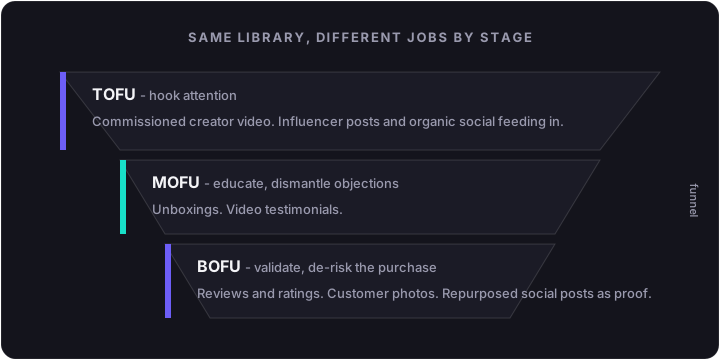
Source is the back-end question. Format is what the shopper actually encounters. The six formats below are ordered by where they first earn their keep, top of funnel down.
Reviews and ratings (the BOFU bedrock)
The foundational, text-first format and the thing a shopper checks last before paying. Its job is consensus and risk removal at the product page: aggregated stars, written feedback, an AI-curated summary sitting under the price. A counterintuitive detail worth keeping in mind: Northwestern's Spiegel research found purchase likelihood peaks when average ratings sit in the 4.0 to 4.7 range, and a flawless 5.0 actually suppresses conversion because shoppers read it as manipulated. PowerReviews' platform data also indicates reviews with customer photos convert meaningfully better than text-only reviews on the same SKU. For how to lay this out on the page, see product-page placement.
Customer photos (visual proof, real bodies, real rooms)
Buyer-shot imagery of the product in unoptimized light, doing exactly what studio photography cannot: showing how a garment drapes on a non-model body, the true pigment of a shade on different skin tones, the furniture in a normal-sized living room. The job is closing the tactile gap mid-decision, usually placed in a "real results" or "wear it your way" gallery below the buy box. Bazaarvoice and Idukki's network data both point in the same direction: pages carrying genuine customer photos see materially higher conversion and lower returns because expectations are set accurately. The acquisition side of this is its own playbook; see customer UGC.
Organic social posts (earned brand mentions)
Public, unprompted brand affinity: an Instagram Story tag, a TikTok, a Reddit thread, an X post. Two jobs at once, word-of-mouth reach inside the user's own network, and, once rights are secured via DM or T&C opt-in, a low-cost asset to repurpose into ads and email flows. Industry benchmarks put repurposed organic-post engagement well above brand-produced equivalents. The licensing mechanics live on usage rights.
Unboxings (the MOFU "what will I actually get")
A clip of receiving, opening, and first use, answering the most literal question in ecommerce. Can be true UGC, an actual buyer filming a delivery, or commissioned, a creator hired to do the same. It earns its keep in mid-funnel retargeting and post-signup email: a subscription brand auto-sending an unboxing the moment someone joins the list, for example. The SaaS or digital equivalent is the screen-record UX walk-through.
Video testimonials (the emotional nudge)
A person to camera naming the problem, what the product did about it, and the outcome. Job: dismantle a specific objection, price, safety, "will this work for someone like me," right before the decision. Sourced from real customers or scripted via a creator; either way the credibility detail is that slightly rough beats slick, because imperfect audio and uneven lighting read as real. Edelman survey data has repeatedly placed peer video among the most-trusted formats consumers cite.
Commissioned creator video (paid "UGC-style" ads)
This is the format that confuses everyone, so be precise: it is not true UGC. It borrows UGC's visual language and is the engine of modern paid social. A hired creator, follower count irrelevant, delivers 15-to-30-second vertical video that the brand runs as its own ad on TikTok, Reels, and Shorts. The brand controls the script, tests hooks ("if you struggle with X, stop scrolling"), and handles objections at scale; per-asset rates typically sit in the low hundreds rather than influencer premiums. It must be disclosed as advertising. For the craft of what makes one actually work, go to good UGC ads; for the broader performance case, UGC ads.
Which type to use where (the funnel map, in one view)
You do not pick a "best" type. You match the type to the buyer's state. The Idukki PDP benchmarks reinforce a hybrid pattern that most strong DTC pages already use: brand-produced hero above the fold to set a clean baseline, then UGC below it to confirm.
| Type | Source | Funnel stage | The job |
|---|---|---|---|
| Commissioned creator video | Commissioned | TOFU | Interrupt the scroll, test hooks, handle objections in 15 seconds |
| Influencer content | Influencer | TOFU | Borrow audience reach and parasocial trust |
| Organic social posts | True UGC, or repurposed | TOFU into BOFU | Earned awareness; cheap proof asset once licensed |
| Unboxings | Either | MOFU | Kill uncertainty about what actually arrives |
| Video testimonials | Either | MOFU into BOFU | Dismantle a specific objection right before decision |
| Customer photos | True UGC | BOFU | Visual proof in real light, real bodies, real rooms |
| Reviews and ratings | True UGC | BOFU | Consensus and risk removal at the product page |
| Post-purchase ask | Brand-triggered, customer-produced | Loop | Refills tomorrow's reviews and photos |
For where this sits in the bigger plan, link up to the DTC overview.
The post-purchase loop (where the next cohort's UGC comes from)
The funnel does not end at checkout. A post-purchase SMS or email asking recent buyers for a review or photo is what keeps BOFU proof fresh, and tagging customers in your own feed converts one-time buyers into repeat generators. True UGC is a renewable supply, not a one-time buy. For the actual mechanics of running the ask, see asking customers.
Getting the right mix produced
The win is never "do UGC." It is running the right TYPE in the right slot: earned proof on the page, commissioned creative in the ad, social posts licensed properly, all of it produced on a cadence the funnel can actually consume. Coordinating that across a real DTC calendar is where most brands get stuck, and where we come in. If you want a UGC agency to assemble the mix end-to-end, that is what we do.
You
Can you look at our ads?
Want this read on your own ads?
We pull your live ads from the Meta Ad Library, set them next to the longest-running ads in your category, and send back what we'd change and test next. The teardown is free.
Get my free creative teardownWe usually reply within one business day.