Growth Marketing Agency for DTC: Ad to Second Order
A growth marketing agency earns its fee by fixing the handoffs between stages. Most stalled DTC brands don't have a broken channel. They have an ad angle that dies on the product page, or a first order that never turns into a second.
Four vendors, four wins. If your media buyer, CRO shop, email agency and creative studio each report a good month while revenue sits flat, the leak is in the gaps between them.
What a Growth Marketing Agency Does for a DTC Brand
A growth marketing agency for DTC runs one experiment loop from the first ad to the second order, judged on contribution margin and repeat rate, not clicks. Creative sits at the center, because creative drives the largest share of ad-driven sales in Nielsen's analysis.
NoGood defines a growth agency as one accountable to business outcomes (CAC, LTV, revenue) across the full funnel, acquisition through referral, instead of running isolated campaigns. That definition holds. The funnel it applies to is what changes.
- For a tech company, growth means SEO, paid search, LinkedIn, CRO and revenue ops. Growth Marketing Pro and Growth Division both sell that model to startups and SaaS.
- For a Shopify brand, growth means ad, landing page, checkout, first order, flows and second order. No LinkedIn. No RevOps.
The loop is the unit of work. A test that wins in the ad should change the page and the flow too, or the win stays trapped in one dashboard.
Performance marketing is the paid-media slice of that loop, judged mostly on what the ad account returns. If you want the full contrast, start with what performance marketing measures and where it stops.
The DTC Growth Loop: Six Stages, Six Metrics
A read from one stage should set the next stage's test. Each stage has one lever you pull and one metric that judges it.
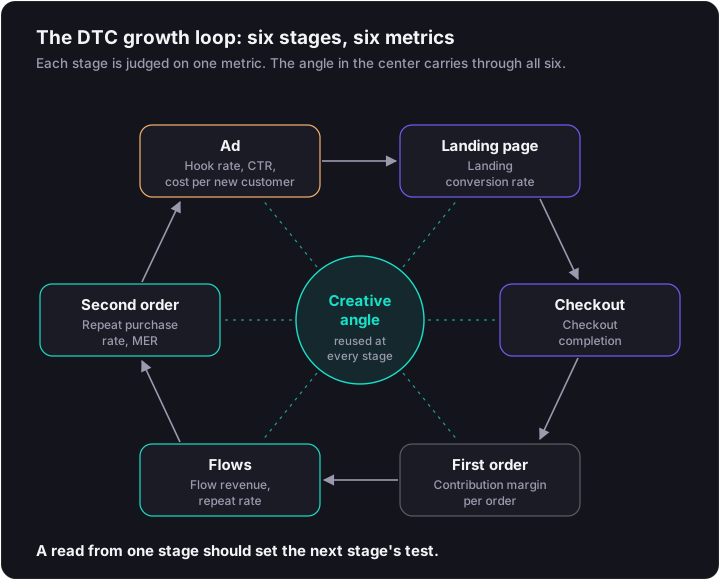
| Stage | Lever | Metric that judges it | Where we go deeper |
|---|---|---|---|
| Ad | Hook, angle, format | Hook rate, CTR, cost per new customer | Paid media |
| Landing page | Message match, offer, proof | Landing conversion rate | CRO |
| Checkout | Friction, payment options, trust | Checkout completion | Checkout |
| First order | AOV, bundle, offer | Contribution margin per order | Margin |
| Flows | Welcome, post-purchase, win-back | Flow revenue, repeat rate | Retention |
| Second order | Timing, replenishment, cross-sell | Repeat purchase rate, MER | Retention |
Ad: Where the Angle Gets Tested
Angles and hooks get tested on Meta, TikTok and Google, and budget follows the angles that win. Every test needs a clear read before money moves. The scope of our paid media work and the testing framework behind it carry the detail.
Landing Page and Checkout: Where the Click Pays or Leaks
The winning ad angle has to show up as the page headline, or the click lands somewhere that feels like a different brand. Proof goes where the doubt appears. Read landing conversion rate first, then checkout completion, and send the friction fixes to CRO and the checkout leaks that cost the most.
First Order: Margin Before Volume
AOV and offer structure decide whether the first order funds the next ad. A cheap order that loses money after shipping and discounts isn't growth. Judge it on contribution margin, and read the account through MER vs ROAS instead of trusting platform ROAS.
Flows and the Second Order: Where Growth Compounds
Klaviyo's 2026 benchmarks show flows generating nearly 41% of email revenue from 5.3% of sends, with flow revenue per recipient nearly 18x campaigns. Nearly 48% of flow-driven email revenue comes from new buyers, so the post-purchase stretch is part of acquisition math.
Retention pays back hard. Fred Reichheld's 2001 Bain finding put a 5% retention lift at more than a 25% profit increase, though that was in financial services, not ecommerce. The direction carries over; the exact number doesn't. Build the retention stage and the Klaviyo flows behind it with the same angle the ad proved.
Creative Sits at the Center of the Loop
Creative is the lever every stage reuses, and it outweighs targeting. Nielsen analysis reported in 2021 put creative at 47% of ad-driven sales contribution against 9% for targeting. Marketers and agencies, surveyed by Advertiser Perceptions, guessed 17% for creative.
| Factor | Share of sales contribution (Nielsen) | Marketer and agency estimate |
|---|---|---|
| Creative | 47% | 17% |
| Reach | 22% | Not reported |
| Brand | 15% | Not reported |
| Targeting | 9% | 22% |
| Context and recency | 7% | Not reported |
Nielsen's 2017 review of nearly 500 campaigns pointed the same way, naming creative the most important element. That study covered FMCG brands across TV, digital, mobile, magazines and radio, so treat it as a relative finding, not a DTC benchmark.
A growth partner without in-house creative is buying its biggest lever from someone else.
One winning angle should become three assets:
- The ad hook
- The product page headline
- The post-purchase email subject line
That's why creative strategy and UGC production sit inside the loop, not beside it.
A Worked Loop, With Hypothetical Numbers
Every figure in this example is hypothetical. It shows how one read travels across three stages; it isn't a client result.
Say a skincare brand tests a "replaces three products" angle against two others. It wins the ad test. The product page headline gets rewritten to match, and the post-purchase flow leads with the same claim.
| Stage | Test | Hypothetical read | What changes next |
|---|---|---|---|
| Ad | Three angles, same format and budget | "Replaces three products" beats the others on cost per new customer | Angle moves to the page; ad tests shift to new hooks on that angle |
| Landing page | Old headline vs angle-matched headline | Matched headline lifts landing conversion rate | Proof block tested next: before-and-after vs routine comparison |
| Post-purchase flow | Generic thank-you vs "here's how to drop the other two" | Angle-led email lifts repeat rate in the cohort | Replenishment timing becomes the next flow test |
Each read sets the next test. When three vendors run those three stages, that chain usually breaks at the first handoff.
Who a Growth Agency Like This Is Not For
This loop fits DTC brands selling on their own store. It doesn't fit:
- B2B SaaS. Pipeline attribution, sales enablement, LinkedIn, ABM and long buying cycles. Omniscient Digital notes B2B SaaS companies outsource roughly 28% of digital marketing, and that's a different job.
- App-install growth. MMPs, app store optimization and install-to-subscription funnels.
- Marketplace-only sellers. No owned checkout and no email list means there's no loop to run.
The tech and startup version of growth (channel discovery, RevOps, SEO content engines, "growth hacking and sales enablement") is real work. It isn't this work. If that's your need, an ecommerce partner will waste your first quarter.
Growth Agency vs Performance Agency vs Specialist
One underperforming channel calls for a specialist. Several uncoordinated channels call for a full-funnel partner. That rule of thumb from Omniscient Digital's selection guidance holds up for DTC.
| Type | Scope | Judged on | Who owns creative | Who owns page and retention | Typical failure mode |
|---|---|---|---|---|---|
| Growth agency | Ad to second order | Contribution margin, repeat rate | In-house, or it should be | Yes | Breadth without depth |
| Performance agency | Paid media | ROAS, CPA | Often outsourced | No | Ad wins that die on the page |
| Specialist (CRO, email, creative) | One stage | That stage's metric | Varies | One stage only | Handoff gaps between vendors |
If your page, checkout and flows already convert and only spend is stuck, a performance agency may be the cheaper fix.
What Growth Marketing Agencies Charge
Published growth agency rates are rare. The ones that exist are market context, not our pricing.
| Source | Published range | Model | Note |
|---|---|---|---|
| Growth Division (UK) | £5,000-£10,000 a month plus VAT | Strategist plus channel experts | Strategist £2,000-£3,000 a month, channel experts from about £1,000 each, no lock-in |
| Omniscient Digital roundup | $5,000-$30,000 a month | Mixed retainers | Most mid-market engagements $10,000-$20,000; the roundup lists NoGood averaging above $20,000 and Stellar at about $30,000 fixed |
| Percentage-of-spend convention | Roughly 10-20% of managed ad spend | % of spend | Tiers down as spend grows, usually with a monthly floor |
| Chance Ecom | Scoped per engagement | Scoped to the stages in play | Set after a teardown of your loop |
Retainers, percentage of spend, rev-share and hybrids each push an agency's incentives a different way. The trade-offs, plus what in-house costs, sit in our breakdown of agency vs in-house.
Questions to Ask Before You Hire a Growth Marketing Agency
Ask how they report, who makes the creative, and when they kill a test. The answers sort a real partner from a channel vendor in one call.
| Question | Good answer | Red-flag answer |
|---|---|---|
| What metric do you report weekly? | Contribution margin, new-customer cost, repeat rate | Traffic, impressions, platform ROAS only |
| Who makes the creative? | An in-house team tied to test results | "We brief your designer," or no creative capacity |
| How do you define growth for my store? | Names the stages and the weakest one | "Full-funnel" with no specifics |
| What are your kill criteria for a test? | A stated spend or time threshold and a clear read | Tests run until they "find their feet" |
| Who owns the ad account and data? | You do | The agency's account |
| How is the fee set? | Flat or floor-plus logic tied to scope | % of revenue with no floor logic |
| How many channels at once? | The few your margin can fund, run deeply | Every channel, shallow execution |
| How fast will organic or SEO pay? | Realistic months, framed as long-term | Fast organic promises |
Omniscient puts realistic organic payback at 9 to 12 months. Anyone promising faster is selling the pitch, not the plan.
How We Run the Loop
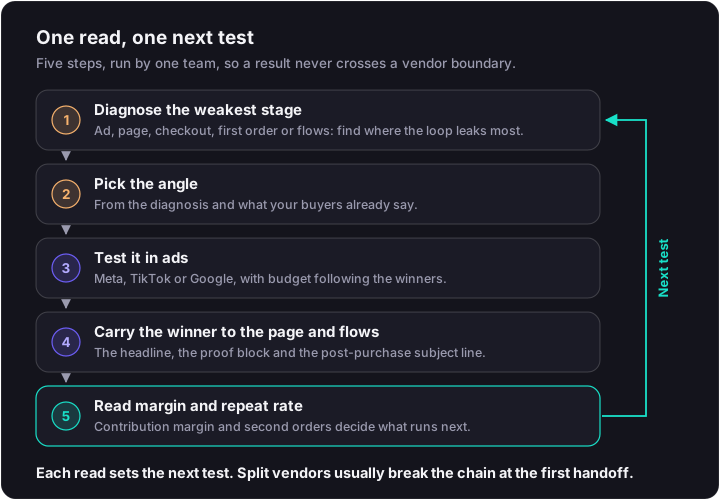
One team handles creative, paid media, pages and retention, so a read never crosses a vendor boundary.
- Diagnose the weakest stage. Ad, page, checkout, first order or flows: find where the loop leaks most.
- Pick the angle. Choose the angles worth testing based on the diagnosis and what your buyers already say.
- Test it in ads. Run the angles on Meta, TikTok or Google with budget following the winners and a clear read on each test.
- Carry the winner to the page and flows. The winning angle becomes the headline, the proof block and the post-purchase subject line.
- Read margin and repeat rate, then set the next test. Contribution margin and second orders decide what runs next.
More on the people doing that work is on our team page.
Who It's For
- DTC brands selling on their own store, Shopify or WooCommerce
- Spending on paid social already, with creative that needs to keep up
- Flows live, or ready to build
- Stuck between stages, not short of traffic
Get a Teardown of Your Loop
Send us your store and ad account for a free creative teardown. You'll get the weakest stage between your ad and your second order, named plainly, and the first test we'd run to fix it.
You
Can you look at our ads?
Want this read on your own ads?
We pull your live ads from the Meta Ad Library, set them next to the longest-running ads in your category, and send back what we'd change and test next. The teardown is free.
Get my free creative teardownWe usually reply within one business day.