Instagram Ads Agency for DTC: Creative and Media, One Team
An Instagram ads agency is a Meta ads agency. Every Instagram ad is bought in Meta Ads Manager, in the same tool and auction as Facebook. Every agency on your shortlist logs into that tool.
That leaves two real questions. Who makes the Instagram-native creative, and who owns the ad account? Chance Ecom answers both with one team. We make the Reels, Stories and partnership ads, and we run the account that tests them. The account stays in your name.
What an Instagram Ads Agency Does for a DTC Brand
Instagram ads are Meta ads, bought in Ads Manager alongside Facebook. The agency worth hiring makes Reels, Stories and partnership ads to Meta's own specs and runs the account that tests them. Chance does both with the same team.
According to Meta's Business Help Center, Instagram ads can run in six placements:
- Feed, the main scroll
- Stories, full-screen and vertical between friends' stories
- Reels, full-screen vertical video
- Explore, the discovery grid
- Profile feed, shown while someone scrolls another account's posts
- Search results, shown inside Instagram search
Media buying is the shared part of the job. Agencies use the same Ads Manager, the same audiences and the same bidding options as everyone else in paid social. The creative is what separates them. So does the speed of the loop between the test results and the next ad.
If you run Google, YouTube or native alongside Meta, the full multi-channel scope is in our Paid Media offer.
The Problem: One Resized Asset Running in Every Placement
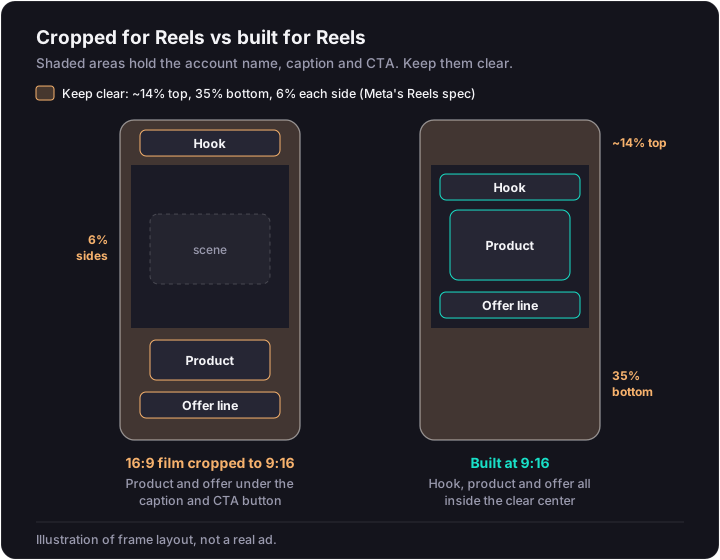
The most common Instagram account problem is a single asset stretched across every placement. A 16:9 brand film gets cropped to 9:16 and pushed into Reels. Then the product sits under the caption.
Meta's Reels spec asks you to keep roughly 35% of the frame clear at the bottom, plus about 14% at the top and 6% on each side. Those areas hold the caption, the account name and the CTA button. A cropped landscape video usually puts its hook, its product shot or its offer line in that dead zone.
Format alone moves the numbers. Meta's own 2023 data on Reels ad sets that used vertical, sound-on video showed:
- 4.8% lower cost per action than other video types
- 5.1% higher CTR
- 2.9% higher conversion rate
Meta reported these figures about its own product, so read them as a direction, not a guarantee. The direction matches what you'd expect. On Meta, the ad does much of the targeting work. That's why creative as targeting starts with the file being right for the slot.
What We Make and Run on Instagram
Each file is built for its placement. We don't make one asset and crop it.
- Reels video ads, scripted and edited at 9:16 inside the safe zones
- Stories video ads, captioned and built for sound-on and sound-off viewing
- Feed image ads at 4:5
- Carousel ads of 2 to 10 cards, for range, steps or before-and-after
- Collection ads, built on your product catalog with an Instant Experience
- Partnership ads, run from a creator's handle with their permission
- Account management: structure, budgets, testing and reporting in your Meta ad account
Meta's Ads Guide sets the specs every file has to meet:
| Placement | Aspect ratio | Resolution | Length / cards | Safe zone or requirement |
|---|---|---|---|---|
| Reels video | 9:16 | 1440 x 2560 px | Up to 15 minutes | Keep ~14% top, 35% bottom, 6% sides clear; no licensed music, GIFs or product tags |
| Stories video | 9:16 | 1440 x 2560 px | 1 second to 60 minutes | Same safe zone; captions and sound recommended |
| Feed image | 4:5 (recommended) | 1440 x 1800 px | Single image | Fills more of the mobile screen than square |
| Carousel | Per card | Per card spec | 2 to 10 cards | Each card needs its own reason to swipe |
| Collection | Cover plus products | Per asset spec | Catalog-driven | Requires a product catalog and an Instant Experience |
You can see these formats running for real brands in our sample Instagram ads roundup. Script structure for the video side is covered in UGC video ads.
Partnership Ads and Creator Permissions
Meta's Newsroom calls partnership ads "the most performant and transparent way for advertisers and creators to run ads together." The ad runs from the creator's handle, with your brand attached, so it looks like a creator post because it is one.
Buyers respond to that framing. A Meta-commissioned survey found 53% of people are more likely to buy an item a creator promotes on Reels. That's Meta's own research, but it explains why creator-led Reels carry so much of a DTC Instagram budget.
The catch is permission. You need the creator's approval to run ads from their handle, and the creator can revoke it. We set those permissions at account level in Partnership Ads Hub, inside your own Meta business settings. They aren't tied to ours. If we part ways, the creator relationships stay with you.
The mechanics of partnership ads, whitelisting and sourcing creators for UGC for Meta each have their own breakdown.
How an Engagement Runs
There are seven stages, and the last one feeds back into the third.
- Teardown. We audit your current Instagram and Facebook ads: which concepts carry spend, which placements leak, and where the hook gets lost.
- Account and pixel access. You keep ownership. We work through partner access to your business portfolio, ad account and pixel.
- Concept sprint. Angles, hooks and offers, each written as a testable idea.
- Native production. Separate 9:16 and 4:5 builds, scripted and edited inside Meta's safe zones.
- Launch into a structured test. New concepts go into a clean account structure, so results compare like with like.
- Weekly read. We cut the losers, flag the winners and name the next iteration.
- Refresh before fatigue. Winning concepts get new hooks and cuts before frequency climbs and CPA follows.
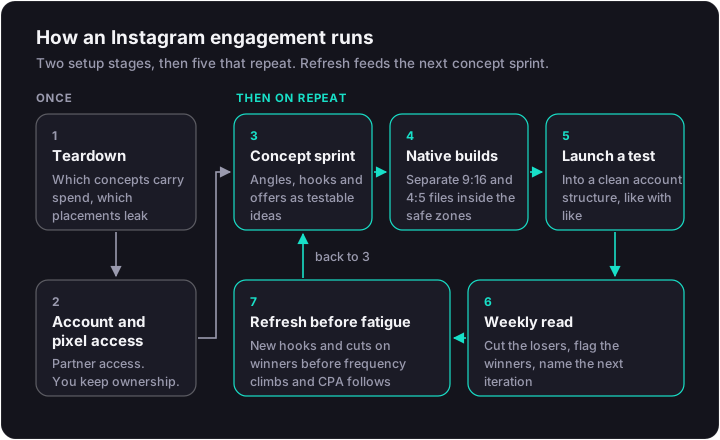
The testing logic follows our testing framework. The refresh timing follows the signals in creative fatigue.
The Number We Report
We report against margin and blended results, not impressions, reach or clicks.
Merchant advice in a Shopify Community thread on hiring an ad agency converged on the same point: judge the agency on ROI. A cheap click that doesn't convert costs you money. That's why platform ROAS is read against MER, since Meta's attribution claims credit that your bank account may not confirm. MER vs ROAS explains the gap. Your floor comes from break-even ROAS, the number every test has to clear.
Who This Is For, and Who It Isn't
A good fit:
- DTC brands with existing sales and real margin to test against
- Brands that need a steady supply of new Instagram-native creative, not a one-off shoot
- Teams whose ads used to work and have stalled (run the stopped scaling diagnostic first)
- Brands that want creative and media judged by one team on one number
Not a fit:
- Pre-revenue launches in crowded categories. One agency in the Shopify Community thread admitted its own approach doesn't work in competitive markets without existing sales. Paid testing needs conversion data to learn from.
- Brands that want organic posting and community management only. Start with an Instagram strategy instead.
Red Flags to Raise on the Sales Call
Seven questions separate a performance partner from a posting service, and they apply to every agency you talk to, including us. The last row comes from inBeat, which flags agencies that can't explain their campaign build, favor pretty ads over outcomes, or have no case studies with transparent metrics.
| Question to ask | Good answer | Red flag |
|---|---|---|
| Who owns the ad account and pixel? | You do; the agency gets partner access | The agency's own account, or "we'll set one up for you" |
| Who makes the Reels? | A named in-house team | Outsourced with no detail, or "you supply the creative" |
| How many new concepts per month? | A stated number tied to your spend | A vague "as needed" |
| What number gets reported? | Contribution margin, MER, CPA | Impressions, reach, clicks |
| What happens to creator permissions at the end? | They sit in your account and stay with you | They're tied to the agency's setup |
| Placement-native files or one resized asset? | Separate 9:16 and 4:5 builds inside the safe zones | One asset cropped everywhere |
| How do you build a campaign? | Explained step by step | Can't articulate it |
Agency vs Freelancer vs In-House
The right option depends on spend and on who'll make the creative. Every cost figure below is third-party market data, not Chance pricing.
| Option | Typical cost (market data) | Who makes the creative | Who owns the account | Best fit |
|---|---|---|---|---|
| Agency, media only | $2,500 to $6,000/month flat, or 10% to 20% of spend (The Remarkable Agency estimate); SMB packages from $500/month plus a $300 setup fee (LYFE Marketing published prices) | You | Varies; ask | Brands with a creative team already |
| Agency, media + creative | $6,000 to $12,000/month flat (The Remarkable Agency estimate) | The agency | Varies; ask | Brands without in-house production |
| Freelancer | Varies widely by skill and scope | Usually one skill: buying or editing, rarely both | Usually you | Small, simple accounts |
| In-house buyer | $76,328/year average salary for a US paid social buyer, salary only (Glassdoor) | A separate hire or vendor | You | Large, steady spend with a creative team |
| Chance Ecom | Scoped per engagement | Our team, alongside the media | You | DTC brands that want creative and media judged on one number |
Percentage-of-spend fees often step down as budgets grow. The Remarkable Agency cites WebFX at 15% of spend at smaller budgets and 12% above $30,000 a month. The full fee breakdown sits in agency vs in-house and agency pricing.
Why One Team for Creative and Media
Split vendors slow the loop. The media buyer sees a Reel losing, writes a note, and the creative shop gets to it next sprint. Meanwhile the budget keeps funding the loser.
With one team, the people reading the test also brief the next ad. Losing concepts get cut. Winning hooks get new cuts in days, not after a handoff between two inboxes. The test result and the creative decision happen in the same meeting.
That's the model behind our creative strategy work and our UGC production. More on our team and how it's built.
Get a Free Teardown of Your Instagram Ads
Send us your account and we'll tear down your current Instagram ads. You'll see which concepts are carrying spend, which placements are leaking, and which files are being cropped into the safe zone. Request your free teardown.
To get the whole paid program checked, tracking included, start with a paid media audit. If you run Google, YouTube or native alongside Meta, the full scope is on our Paid Media service page.
You
Can you look at our ads?
Want this read on your own ads?
We pull your live ads from the Meta Ad Library, set them next to the longest-running ads in your category, and send back what we'd change and test next. The teardown is free.
Get my free creative teardownWe usually reply within one business day.