Influencer Marketing for DTC: A Performance Channel
Influencer marketing for DTC stops being PR the moment you separate two goods you used to pay for as one. The creator's audience is what you rent for trust. The creator's asset is what you license, then run as paid media you control.
Influencer Marketing for DTC, Run as a Performance Channel
Allowlist the winners through Meta Partnership Ads and TikTok Spark Ads, pay creators on CPA where you can, and use UGC, not influencers, for high-volume creative testing. Influencer dollars buy borrowed trust and a starting asset; paid social scales the winning asset; UGC iterates the hook at a tenth of the cost.
The operating system for that handoff covers the metrics it has to carry, the licensing mechanics, the contract clauses that stop lawsuits, and a decision matrix that tells you when to use influencer, UGC, or both.
The Mandate Shift: From EMV to CPA, ROAS, and LTV
Earned Media Value is dead inside performance teams. It was a theoretical estimate of "what equivalent ad impressions would have cost," it never reconciled to revenue, and finance stopped accepting it. The channel is now judged on the same scorecard as the rest of your paid media metrics: Cost Per Acquisition, ROAS, and Customer Lifetime Value.
That shift is not a side experiment. The global influencer category is projected to clear $32B, 87.49% of brands plan to raise creator budgets in 2026, and 72.2% of marketers expect increases of 50% or more. Money at that scale only moves when finance gets reconciled numbers.
The replacement scorecard is short:
- CPA, measured the way you measure any paid-social ad set.
- ROAS, blended against the same window you use for everything else; the headline numbers are noisy, so MER vs ROAS becomes the truth check.
- LTV, because creator content tends to deliver buyers who repeat, and a first-order CPA in isolation will undersell the channel. The LTV math is what makes the math work.
If the program cannot carry that scorecard, it is not a performance channel. It is a publicity line item with a creator's face on it.
Influencer vs UGC vs Both: Drawing the Line Before You Spend
The most expensive mistake in this category is treating "an influencer post" and "a UGC ad" as the same line item. They are different goods at different prices doing different jobs.
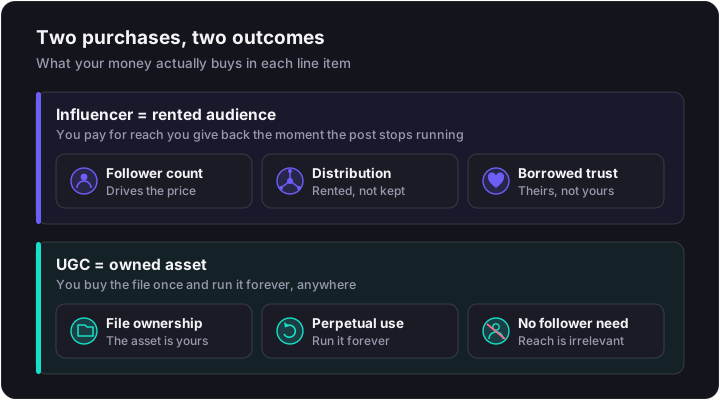
- Influencer marketing is renting an audience. You are paying for distribution and borrowed trust. A $2,500 micro-influencer post is overwhelmingly funding the audience, not the labor of filming.
- UGC is buying an asset. The creator's follower count is irrelevant; you own the file and run it perpetually across Meta, TikTok, email, and PDPs.
Thirty hooks from UGC creators land near $6,000 in total. Thirty hooks sourced through influencers, with usage rights stacked on top, can run past $60,000. Same number of files. Order of magnitude difference in cost, because one purchase includes an audience and the other does not.
The full asset-level breakdown of which one wins per dollar, per format, lives on UGC vs influencer. The mechanism that makes owned creative volume the real lever is performance creative.
Allowlisting, Partnership Ads, Spark Ads: How the Handoff Actually Works
Allowlisting is what turns an organic creator post into a media buy you control. The term used to be "whitelisting"; the platforms standardized on allowlisting or permission-based advertising, and the mechanics matured along with the language.
What you get when a creator allowlists you: the right to run paid ads from the creator's handle, while your media team controls targeting, frequency capping, budget, and optimization. The audience sees a recognizable face; the ad account does the buying.
What it costs: roughly a 30% premium on the creator's base post rate, or a flat monthly licensing fee of $100 to $1,500 depending on tier. The creator is taking reputational risk by letting ads run under their name, so it is never free.
Why it beats studio "business-as-usual" creative on cold traffic: consumers have trained themselves to skim past brand-directed polish. A face and a handle they recognize bypasses that filter. The economics separate the cost of content from the cost of distribution, which is what allows the winning concept to scale infinitely without paying the creator again per impression.
Where these ads sit inside your account: typically inside a prospecting or Advantage+ campaign in your account structure. What you do after a Partnership Ad wins: ramp it through scaling paid social.
Meta Partnership Ads
Meta formalized allowlisting through the Partnership Ads Hub, supported by a late-2025 API update that finally killed the password-sharing era. Creators connect at the account level through Creator Marketplace; brands reference the post inside Ads Manager and run it against their own pixel.
The mechanism that drives the lift is signal stacking: the creator's identity and engagement signals feed delivery alongside your brand's conversion pixel data. Two distinct streams of high-value data into the same auction. The delivery system has more to work with and wastes fewer impressions on unqualified users. The reported result against traditional studio BAU ads is roughly 53% higher CTR and 19% lower CPA, with Meta describing a 99% probability that Partnership Ads outperform business-as-usual creative.
The four-step media-buyer workflow:
- Creator connects. The creator joins Meta Creator Marketplace and grants account-level permission to the brand via Facebook or Instagram, so no post-by-post approval is needed.
- Locate the asset. The media buyer pulls the existing post by Post ID inside Ads Manager, preserving accumulated likes, comments, and shares as social proof.
- Configure ad identity. Both the brand handle and the creator handle are displayed so the "Paid Partnership" label fires correctly.
- Finalize targeting and launch. Standard objective and ad-set configuration (Conversions, optimization goal, exclusions).
Signal stacking only works if your data layer is honest, which is why CAPI and server-side tracking matter on the brand side of the pipe. Garbage in on the pixel will throw away the half of the advantage you are paying a 30% premium for.
TikTok Spark Ads
TikTok handles the same problem differently. The creator generates a Spark Code for a specific organic post, with an explicit authorization window of 7, 30, 60, or 365 days, and hands it over. The brand pastes the code into TikTok Ads Manager and pushes paid budget at the original post.
The defining difference from Meta dark posts: every like, comment, and share earned by the boosted ad anchors to the original organic post. Paid spend actively grows the creator's social proof rather than living invisibly in the ad auction. The reported lift against standard paid TikTok placements is roughly 25% higher CTR and 24% higher CVR.
The five-step workflow:
- Creator generates the Spark Code. In Ad Settings on the organic post, "Generate Code" with the chosen window. Send the alphanumeric code to the brand.
- Paste under Assets > Creative > Spark ads posts inside TikTok Ads Manager and click "Apply for Authorization."
- Build the campaign with a standard objective (conversions, traffic).
- Toggle "Use TikTok account to deliver Spark Ads" at the Ad level.
- Select the authorized post, route the URL, submit.
One contract implication: once authorized, the caption is locked. You cannot edit it after the fact. Write your brief, and your contract, so the caption is right the first time.
This is the channel-level mechanic that connects paid social to creative strategy without duplicating the briefing work.
| Mechanic | Meta Partnership Ads | TikTok Spark Ads |
|---|---|---|
| Identity model | Account-level connection via Creator Marketplace | Per-post Spark Code |
| Where engagement lives | Combined with the brand pixel via signal stacking | Anchored to the original organic post |
| Default authorization window | Ongoing until revoked | 7, 30, 60, or 365 days (set by creator) |
| Reported lift vs baseline | ~53% higher CTR, ~19% lower CPA vs BAU | ~25% higher CTR, ~24% higher CVR vs standard paid |
| Caption editable post-auth | Yes (standard ad copy fields) | No, caption locks at authorization |
| Targeting controlled by | Brand media team | Brand media team |
Licensing, Music Rights, and the Contract Clauses That Stop Lawsuits
The detail most brands miss: Spark Ads and Partnership Ads grant placement permission, not commercial music license. The trending audio on an organic post becomes copyright exposure the second paid budget touches it.
Under 17 U.S.C. § 504, statutory damages run $750 to $30,000 per work, escalating to $150,000 per work for willful infringement, with no small-business discount. Recent industry suits are in the eight-figure range: Warner Music Group sought $24M from Crumbl Cookies over 159 tracks; Sony Music pursued $40M against USC over 170-plus recordings. The exposure is real and existential.
The clauses that have to be in every 2026 creator contract:
- Perpetual vs term license, in writing. Either you own the asset forever, or you own it for a defined window and every ad runs dark when the window closes.
- Spark Code and allowlisting duration mandates. The creator delivers a 365-day Spark Code, or maintains an active Meta connection, within 24 hours of the post going live.
- Explicit commercial audio clearance. Audio must come from Commercial Music Libraries or properly licensed royalty-free sources. Trending personal audio is forbidden for any post you may amplify.
- Indemnification. If the creator falsely claims rights to third-party imagery or audio they inserted, liability sits with them.
This is a checklist, not a legal opinion. Run it past counsel before the first deal.
Affiliate and CPA Deals: Closed-Loop Compensation
A creator program functions as performance only when compensation is closed-loop. The baseline stack:
- Unique coupon code per creator. Catches conversions that never click a link.
- UTM parameters on every link. Standard hygiene; the difference between a measurable channel and a guess.
- Affiliate/CPA layer. Creator earns a base fee plus a cut of attributed revenue, with revenue matching back through an integrated platform.
The side effect of CPA-anchored deals is that the creative gets better on its own. When the creator's payout is tied to attributed sales, you do not need to dictate demos, urgency, or CTAs in the brief. Their incentive does the editorial work for you.
The deeper read on attribution windows, multi-touch modeling, and what counts as a credible match lives in the attribution stack. The ceiling on what you can afford to pay out on a CPA deal is dictated by your contribution margin: if a creator earns 15% of revenue on a product with a 20% contribution margin, you are buying volume at a near-zero margin and need to know that before signing.
The Tiering Decision: Nano, Micro, Macro
There is one counter-intuitive but reliable rule: engagement rate falls as follower count rises. As an audience grows, its engagement efficiency degrades. That single relationship is the reason DTC budgets have shifted down-market.
The headline number: reallocating budget from macro to micro reportedly drives up to 38% lower CAC at equal spend. For the cost of one macro at $5,000, you can activate ten micros at $500 each and aggregate 5x to 8x more total engagement across niche communities.
| Tier | Follower count | Reported engagement rate | Reported CPE | Best job-to-be-done |
|---|---|---|---|---|
| Nano | 1,000 - 10,000 | 5.0% - 8.0% | $0.01 - $0.05 | Gifting at scale, hyper-niche penetration, first social proof |
| Micro | 10,000 - 100,000 | 2.0% - 4.0% | $0.05 - $0.15 | The allowlisting workhorse: organic post + Partnership/Spark amplification |
| Mid-Tier | 100,000 - 500,000 | 1.2% - 2.5% | $0.15 - $0.50 | Category education, semi-broad reach with usable engagement |
| Macro | 500,000 - 1,000,000 | 0.8% - 1.5% | $0.50 - $2.00 | Launches, halo effect, screenshot-able social proof |
| Mega/Celebrity | 1,000,000+ | 0.5% - 1.0% | $2.00 - $10.00+ | Brand-moment plays, not ongoing performance |
Tier choice is a budget-allocation decision tied to the job. The CAC consequence is read through CAC and the LTV:CAC ratio that says whether the tier can pay back at all.
When to Use Influencer vs UGC vs Both: A Decision Matrix
The industry settled on a Pyramid Model. Macros sit at the narrow top, used sparingly for awareness spikes. Micros fill the middle, allowlisted for paid scale. UGC creators form the base, generating high-volume hook iteration that runs as paid media you own.
| Business objective | Primary creator channel | Execution | Rationale |
|---|---|---|---|
| High-volume creative A/B testing | Paid UGC creators | Commission 20-30 videos to test hooks and copy formats | Low per-asset cost (~$150 avg) lets you test fast without paying for reach |
| New market or product launch | Macro-influencers (100k+) | 1-3 established voices for broad reach and halo | Buying mass distribution and category education in one spike |
| Scaling paid social efficiency | Micro-influencers (10k-100k) via allowlisting | Activate 10-20 micros, secure 30-day Partnership/Spark rights, amplify top organic posts | Merges 2-4% organic engagement with brand-controlled targeting; up to 38% lower CAC |
| Hyper-niche penetration | Nano-influencers (1k-10k) | Product seeding/gifting at scale, often for free product | 5-8% engagement reads as peer recommendation; ideal first social proof |
| Retention and LTV expansion | Existing customer / employee content | Deploy testimonials and BTS in post-purchase flows and retargeting | Demonstrates advanced use cases to existing buyers at near-zero cost |
The base of the pyramid is where performance creative lives, and the statistical question of "did this UGC variant actually beat the control" gets answered through a real testing framework rather than gut.
The Hybrid Playbook in Three Phases
The matrix becomes operational when you sequence it across months.
Month 1: Macro launch. One macro-influencer at the 500k+ level posts a dedicated review. The first-order math loses money. The second-order effect is a roughly 300% spike in branded search and a piece of social proof you screenshot and reuse for the next year.
Month 2: Micro allowlisting. Seed the product to 30-50 micro-influencers, contract base fees plus 30-day Spark Ad rights up front. Watch organic for 72 hours, isolate the 5 videos with the highest organic engagement, and push paid budget behind only those through Spark Ads and Partnership Ads. The reported CPA reduction at this step is in the 38% range.
Month 3: UGC iteration. When one specific phrase or visual hook from a micro post is clearly winning, commission 15-25 UGC creators at ~$150 per asset to recreate hook variations on that concept. You own these assets perpetually and run them on Meta indefinitely without re-paying premium creator rates.
The brief work for that third phase belongs to creative strategy. The spend ramp on the eventual winner belongs to scaling paid social.
Realistic Benchmarks and the Attribution Trap
The headline "$5.78 ROAS" stat circulating across influencer reports needs handling. It is an aggregate that blends well-tracked micro programs with poorly tracked macro buys. Treat it as a directional ceiling for what tight programs achieve, not a planning number.
The deeper problem: more than 73% of marketers report struggling to measure influencer ROI accurately, almost entirely because they are stuck on last-click and same-day promo redemption. Creator-driven demand does not work that way. A viewer watches a YouTube review, deliberates for two weeks, and converts via branded search. Last-click hands that conversion to Google.
The fix has three parts:
- 30-90 day multi-touch attribution windows instead of same-day last-click. The underlying logic and trade-offs sit in the attribution stack.
- Revenue matching via affiliate platform integrations to Shopify, so creator-to-sale becomes a real data join, not a vibes estimate.
- Incrementality, not just attribution. The cleanest read on whether the channel actually moved revenue comes from incrementality testing: geo splits, holdout audiences, on/off windows. Attribution tells you what got credited; incrementality tells you what was caused.
For the operating cadence, MER is the blended truth metric that absorbs the natural delay between creator exposure and purchase. It is the number to put in front of the CFO; platform ROAS is the number to put in front of the buyer.
Tooling: What CRM and Affiliate Stack You Actually Need
The software layer is what makes the program operable at more than ten creators. Map tool to program stage rather than buying the loudest brand.
| Platform | Best for | Pricing band | Install model |
|---|---|---|---|
| Mavely | Affiliate links and DM automation, self-serve | Free tier; Pro $15/mo; Growth $30/mo | Self-serve, available to creators and brands |
| AMT | AI-native automation across discovery, contracts, gifting, tracking | Free Shopify install; bundle/scaling fees on agency tiers | Shopify / WooCommerce app |
| Upfluence | Mid-market/enterprise CRM with Shopify sync and ROI dashboards | $478-$3,000+/mo bands; 12-month contract | Sales-quoted |
| GRIN | Established gold-standard for large ambassador programs | ~$27,150 avg annual contract value | Enterprise sales, with trial phases |
Pick the tool that matches the program stage. A 5-creator program does not need GRIN. A 200-creator ambassador program will outgrow Mavely inside a quarter.
How This Channel Plugs Into the Rest of Your Paid Stack
The integration story is the part most teams skip, and it is what separates a working program from a "we tried influencers" line item.
Allowlisted creator ads belong inside a prospecting or Advantage+ campaign in your ad account structure, broad targeting, with the creator identity doing the heavy lifting on the hook. A winning Partnership Ad becomes a scaling candidate the same way any winning ad does: spend ramps, audience overlap gets watched, budget shifts campaign-by-campaign as efficiency holds.
The data layer is what keeps the signal-stacking advantage real instead of theoretical. Without clean server-side tracking, the pixel side of the stack is noisy, the algorithm gets confused, and you pay a 30% allowlisting premium for half the benefit. The whole channel is downstream of the creative-is-the-new-targeting thesis: in a privacy-constrained world, the creative is the targeting, and creator allowlisting is a clean way to acquire creative the studio cannot produce.
Where Influencer Marketing Fits In Performance Marketing
Influencer marketing for DTC is one channel inside the broader performance marketing stack. Specifically, it is the channel where you rent trust, license the winning asset, and run it as paid social.
Hand This to a Team That Runs It Like Paid Media
If you are already buying influencer posts and treating them as PR, the gap is structural. Contracts without allowlisting clauses. No Spark Code provision. No CPA layer. No UGC iteration of the winning concept. Every dollar is doing one job when it could be doing three.
The fix is a diagnostic first, an operating model second. Start with a paid media audit to see what the current creator dollars are actually returning, then bring in a creative agency or a UGC agency to run the handoff between influencer asset and UGC iteration, or full performance marketing services to run the whole stack.
You
Can you look at our ads?
Want this read on your own ads?
We pull your live ads from the Meta Ad Library, set them next to the longest-running ads in your category, and send back what we'd change and test next. The teardown is free.
Get my free creative teardownWe usually reply within one business day.